The motorway
The motorway is the fastest road in the Belgian network, but also the most demanding: high speeds, dense traffic and little margin for error. Driving on it requires knowing precise rules, from joining via the acceleration lane to the strictly regulated use of the hard shoulder. Here is everything you need to master for the exam and to drive safely.
📑 In this lesson (8)
Who is allowed to drive on the motorway?
The motorway is reserved for motor vehicles capable, by design and with their load, of reaching at least 70 km/h on a level road. A vehicle that is too slow, too heavily loaded or technically unable to maintain that speed is not allowed on it, as it would become a dangerous obstacle for the rest of the traffic.
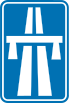
- Prohibited: pedestrians, cyclists, mopeds, animal-drawn vehicles, agricultural machinery and any vehicle unable to reach 70 km/h.
- Permitted: cars, motorcycles (of sufficient engine capacity), vans and lorries meeting the speed requirement.
- The entrance is identified by the motorway information sign (blue background); the end of the motorway is announced by the corresponding sign.
Joining via the acceleration lane
You enter the motorway via an acceleration lane: an entry lane designed for building up speed before joining the traffic. It is up to you, the one arriving, to adapt: vehicles already on the motorway have priority and are not required to make room for you.
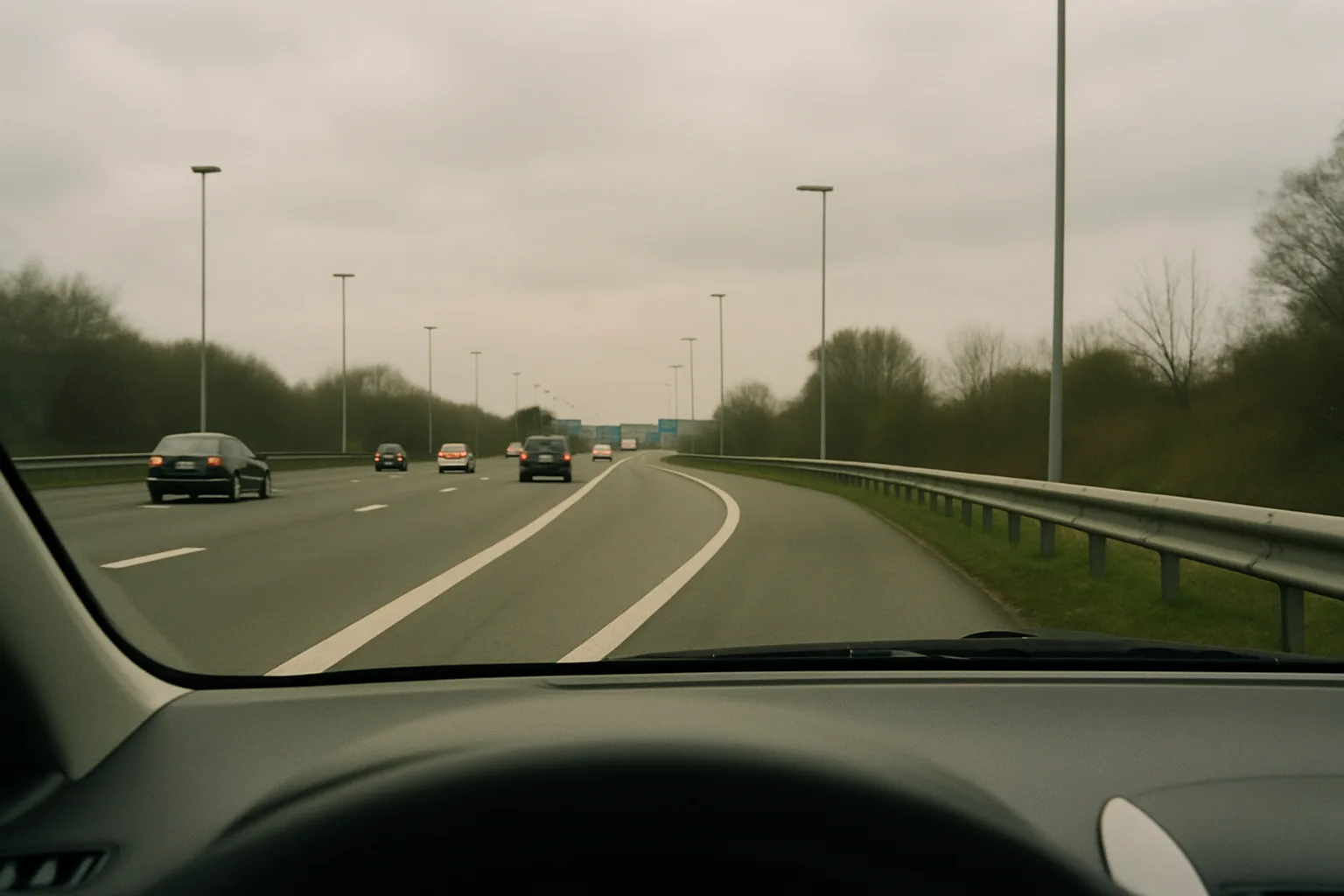
- Accelerate on the lane to reach a speed close to that of the traffic.
- Watch the traffic on your left (mirrors and blind spot).
- Identify a sufficient gap and merge in, giving way to the existing flow.
- Never force your way in and never stop on the acceleration lane, except in imminent danger.
Keep right, overtake on the left
On the motorway as elsewhere, the principle is to drive in the rightmost available lane. The left-hand lanes are only for overtaking. Once the overtaking manoeuvre is complete, you return to the right: "hogging the left lane" for no reason obstructs traffic and is an offence.
Speed: 120 km/h maximum, 70 km/h minimum
On the motorway, the maximum permitted speed is 120 km/h (unless a sign indicates a lower local limit). There is also a minimum speed: in the leftmost lane, you may not drive at less than 70 km/h in normal conditions. Too slow, you become a hazard; too fast, you lose control of your distances.
Keeping a safe following distance
At 120 km/h, you cover about 33 metres per second: sudden braking by the vehicle ahead leaves you very little time to react. Your following distance must therefore be enough to stop or slow down without a collision. A simple rule is to keep at least a two-second gap from the vehicle in front, and more in rain, fog or on a wet carriageway.
The hard shoulder
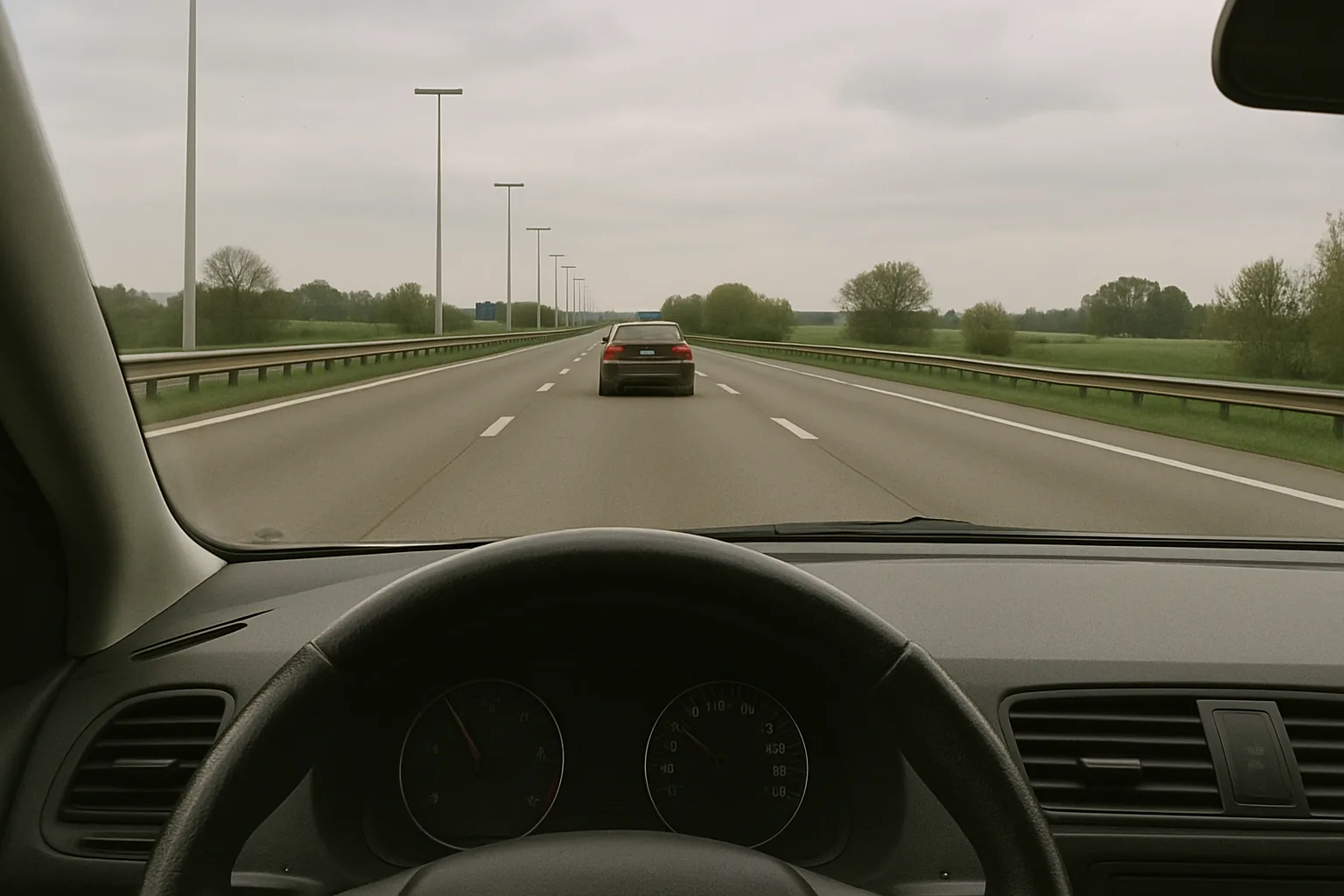
The lane on the far right, separated by a wide line, is the hard shoulder. It is not a traffic lane: it is forbidden to drive on it, to follow it to save time or to overtake on the right by using it. You may only stop on it in case of necessity: breakdown, sudden illness, immediate danger.
- If forced to stop, pull over as far to the right as possible and switch on your hazard warning lights.
- Place the warning triangle at a suitable distance behind the vehicle.
- Leave the vehicle on the side away from the traffic and get to safety behind the crash barrier, wearing a retro-reflective vest.
Strictly prohibited manoeuvres
Given the speeds involved, certain manoeuvres are completely prohibited on the motorway, both on the lanes and on the central reservation:
- Making a U-turn is prohibited, including by using a gap in the central reservation.
- Reversing is prohibited in all circumstances.
- Crossing the central reservation or driving on it is prohibited.
- Stopping or parking on the carriageway and on the hard shoulder is prohibited, except in cases of absolute necessity.
| Item | Rule |
|---|---|
| Maximum speed | 120 km/h (unless a sign says lower) |
| Minimum speed (left-hand lane) | 70 km/h |
| Joining | Via the acceleration lane, giving way |
| Traffic lane | Right by default, left for overtaking |
| Hard shoulder | Stopping in emergencies only |
| U-turn / reversing | Prohibited |
Excluded road users and end of motorway
Beyond the speed requirement, the Belgian highway code formally excludes a series of road users from the motorway, because they are too slow, too vulnerable or technically unsuited to high speeds. Their presence would create a major risk for themselves and for the rest of the traffic.
- Pedestrians and cyclists: no non-motorised road user has any place on the motorway.
- Mopeds (classes A and B): too slow for the 70 km/h requirement.
- Quadricycles without a passenger compartment and other light motorised devices unable to maintain the required speed.
- Slow vehicles (agricultural machinery, fairground vehicles, vehicles with limited electric propulsion) and any convoy unable to reach 70 km/h.
The end of the motorway is announced by an end-of-motorway sign: the same blue information sign, but crossed out with a diagonal red stripe. From that point onwards, the motorway and its special rules (speeds, prohibited manoeuvres, use of the hard shoulder) no longer apply, and you return to the ordinary rules of the road.
🧠 Check you've got it
Question 1 / 3
3 exam-style questions on this lesson — instant correction.
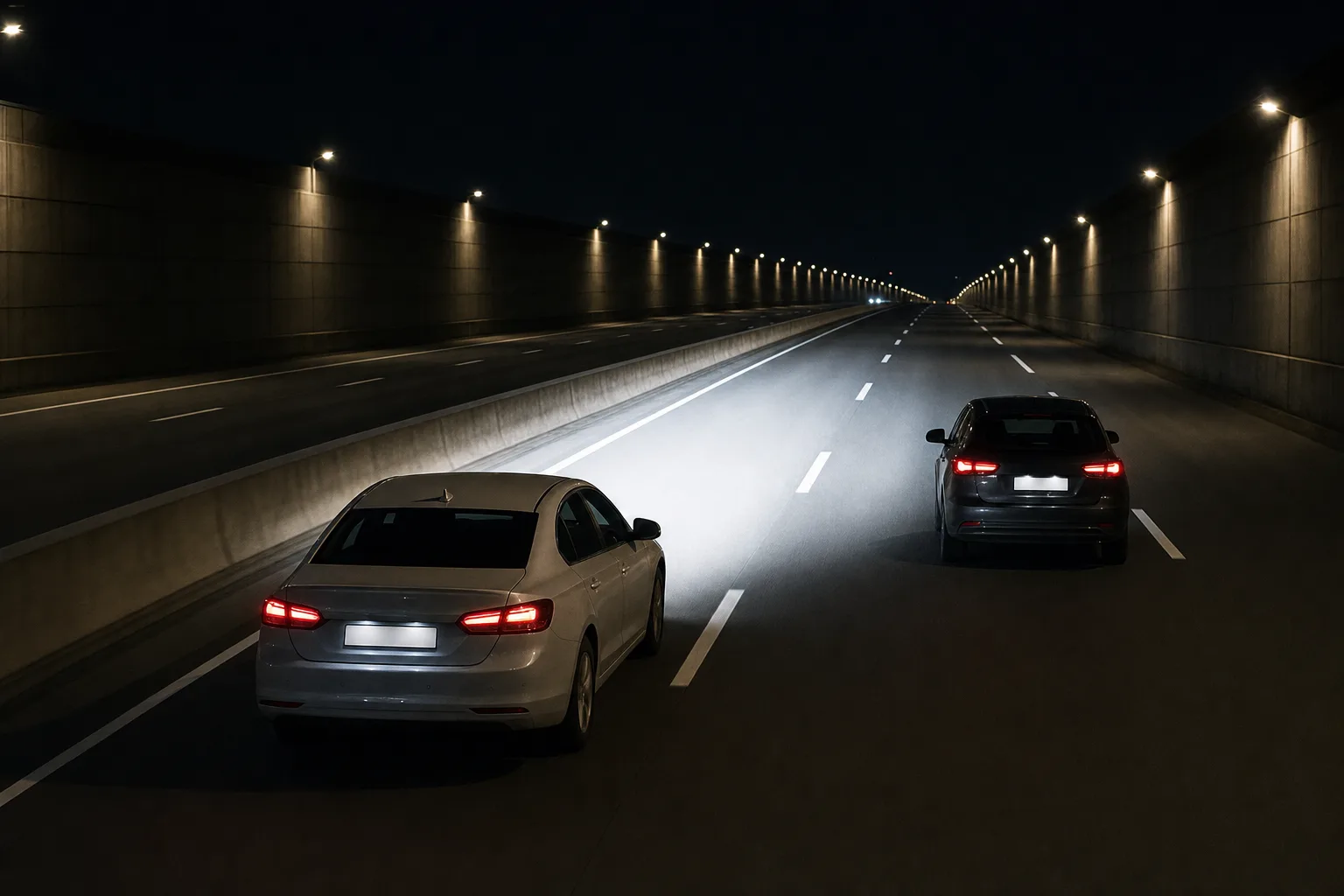
It is night-time. One driver is overtaking another. May the main-beam headlights stay on during the overtaking manoeuvre?
🛣️Practise Special situations (motorway, tunnels, difficult conditions, eco-driving)
Exam-style questions on this theme, with corrections and explanations — plus the full bank with access.
❓ Frequently asked questions
What is the minimum permitted speed on the motorway?
Every vehicle must be able to reach 70 km/h to enter it. In the left-hand lane, you may not drive at less than 70 km/h in normal conditions, so as not to obstruct faster traffic.
Who has priority when I join the motorway?
The vehicles already on the motorway. It is up to you, on the acceleration lane, to adapt your speed and give way so you can merge into a free gap, without forcing your way in.
Can I use the hard shoulder to avoid a traffic jam?
No. The hard shoulder is not a traffic lane. Driving on it or stopping on it without genuine necessity is prohibited and punishable: it must stay clear for breakdowns and the emergency services.
What should I do if I miss my motorway exit?
You never make a U-turn or reverse. Carry on to the next exit and resume your route from there: both of these manoeuvres are strictly prohibited on the motorway.