Express summary: the entire Belgian highway code at a glance
Here is the whole theory condensed on one page, for free. Be honest with yourself: you can't learn the highway code in 3 hours — allow around ten hours to understand everything. But this summary is the perfect tool for the day before and the morning of the exam: you re-scan the numbers, the priority rules and the trick signs at a glance. Every number in bold must be known by heart.
✨ Key takeaways
- Pass mark: 41/50, and 2 serious faults = instant fail.
- Outside built-up areas: 70 in Flanders, 90 in Wallonia — trap no. 1.
- Priority: official > lights > signs > priority from the right.
- Alcohol: 0.22 mg/l (0.09 for professionals).
- The metres: 5 m (crossings/junctions), 15 m (bus stop), 20 m (lights).
- This page takes 10 h to learn, 3 h to reread the day before the exam.
1. Speed limits by region (table no. 1)
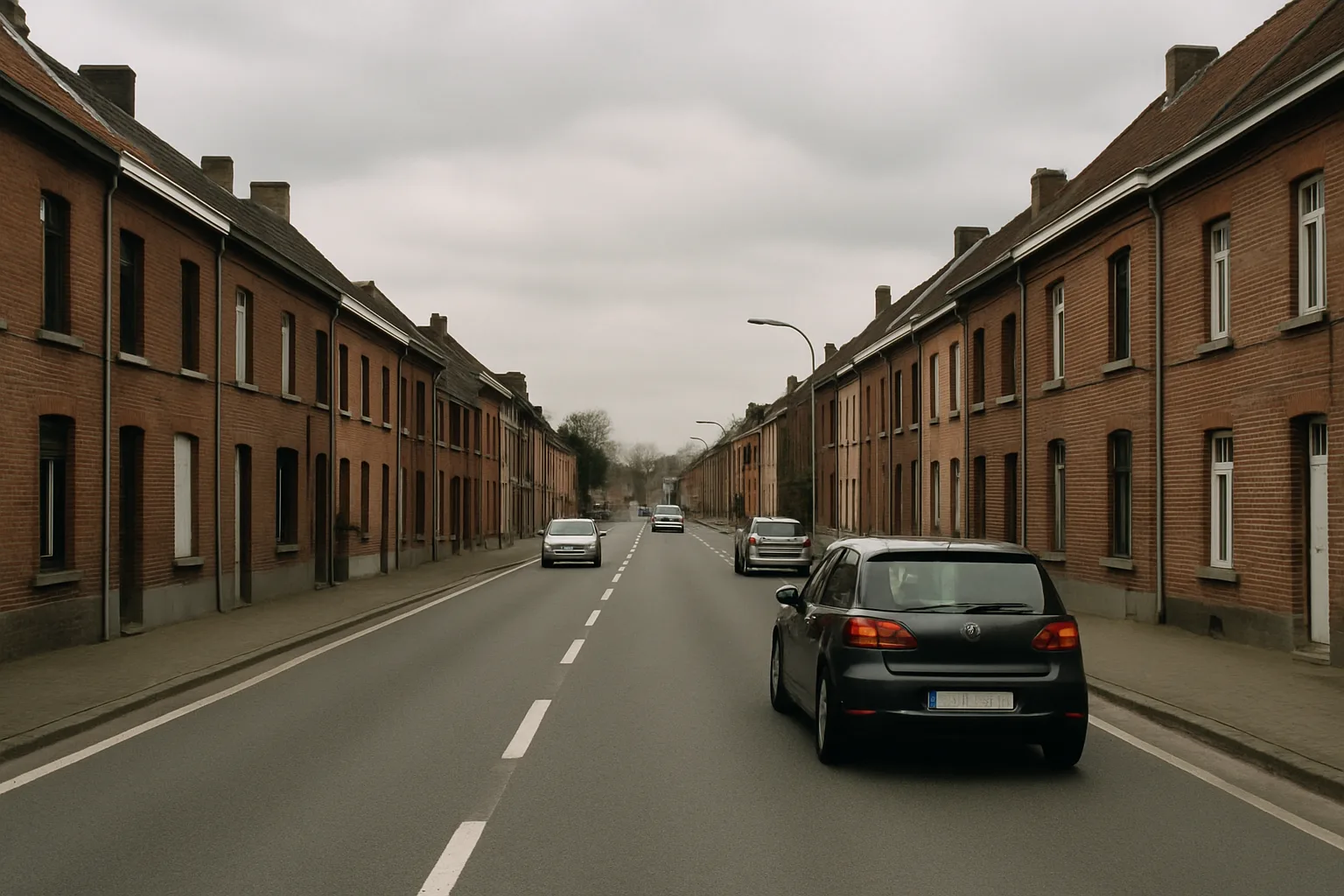
In Belgium, the speed limit depends on the region. It's the most common trap: outside built-up areas, Flanders and Wallonia don't have the same limit.
| Where | Flanders | Wallonia | Brussels-Capital |
|---|---|---|---|
| Built-up area | 50 | 50 | 30 (by default) |
| Outside built-up areas | 70 | 90 | 70 |
| Dual carriageway 2×2 lanes (central reservation) | 120 | 120 | 120 |
| Motorway | max 120 / min 70 | max 120 / min 70 | max 120 / min 70 |
| 30 zone / school surroundings | 30 | 30 | 30 |
| Residential / home zone | 20 | 20 | 20 |
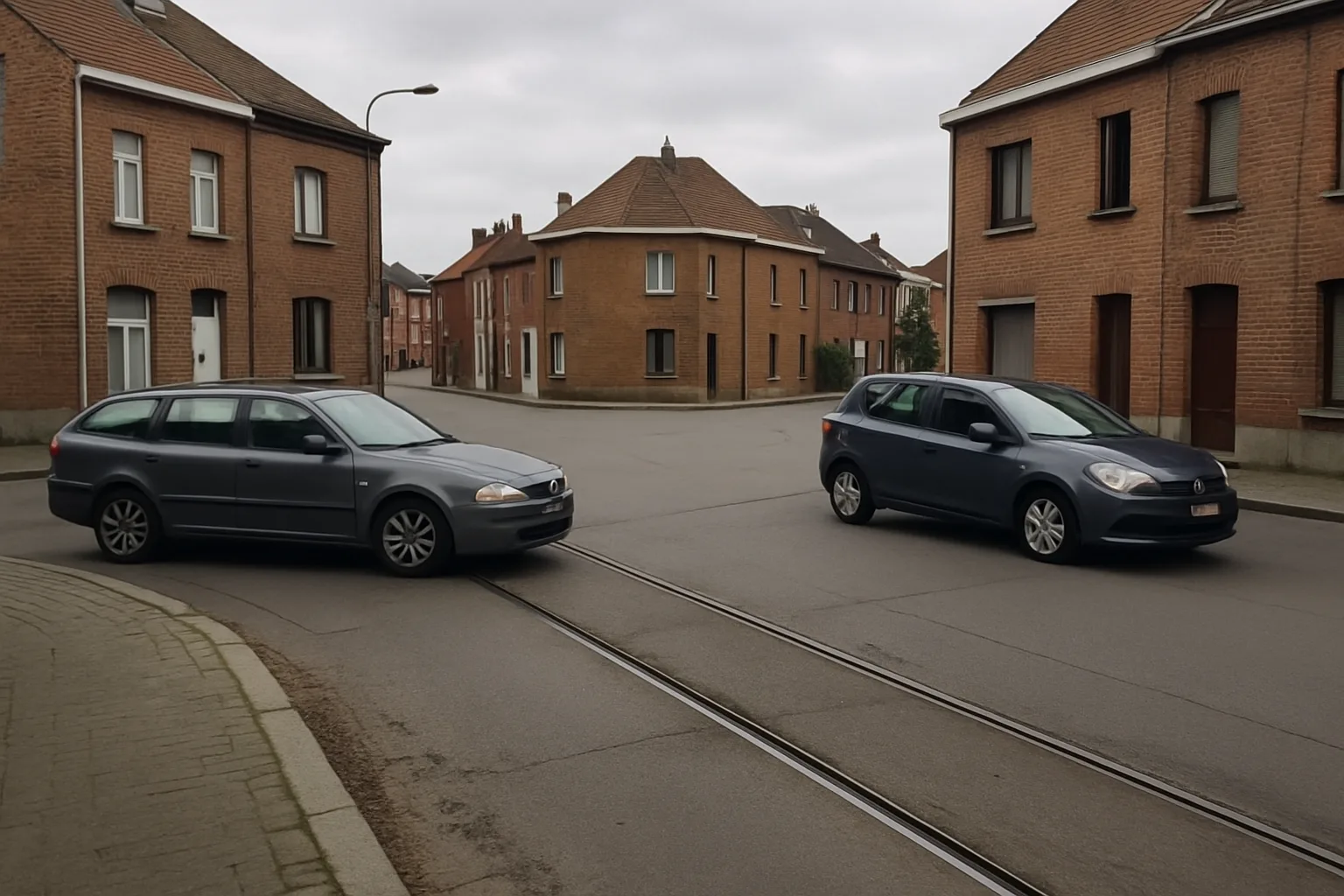
At a junction without signs or signals, a tram arrives on your left: who goes?
2. Priority: the order to remember
To know who goes, you always work down this order, from strongest to weakest:
- An authorised official (their signals override everything, even traffic lights).
- Traffic lights.
- Priority signs (B1, B5, B9, B15, B17) and road markings.
- Failing all of those: priority from the right.
 B1 — Give way
 B5 — Stop
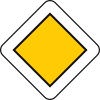 B9 — Priority road
💡 Triangle pointing down = you give way (B1). Red octagon = full stop compulsory (B5), even if the road is clear. Yellow diamond = you have priority (B9).
 B19 — You give way
 B21 — You go first
💡 Look at the red arrow: that's you. If the red arrow has to pull in (B19), you give way to oncoming traffic. If the red arrow has priority (B21), you go.
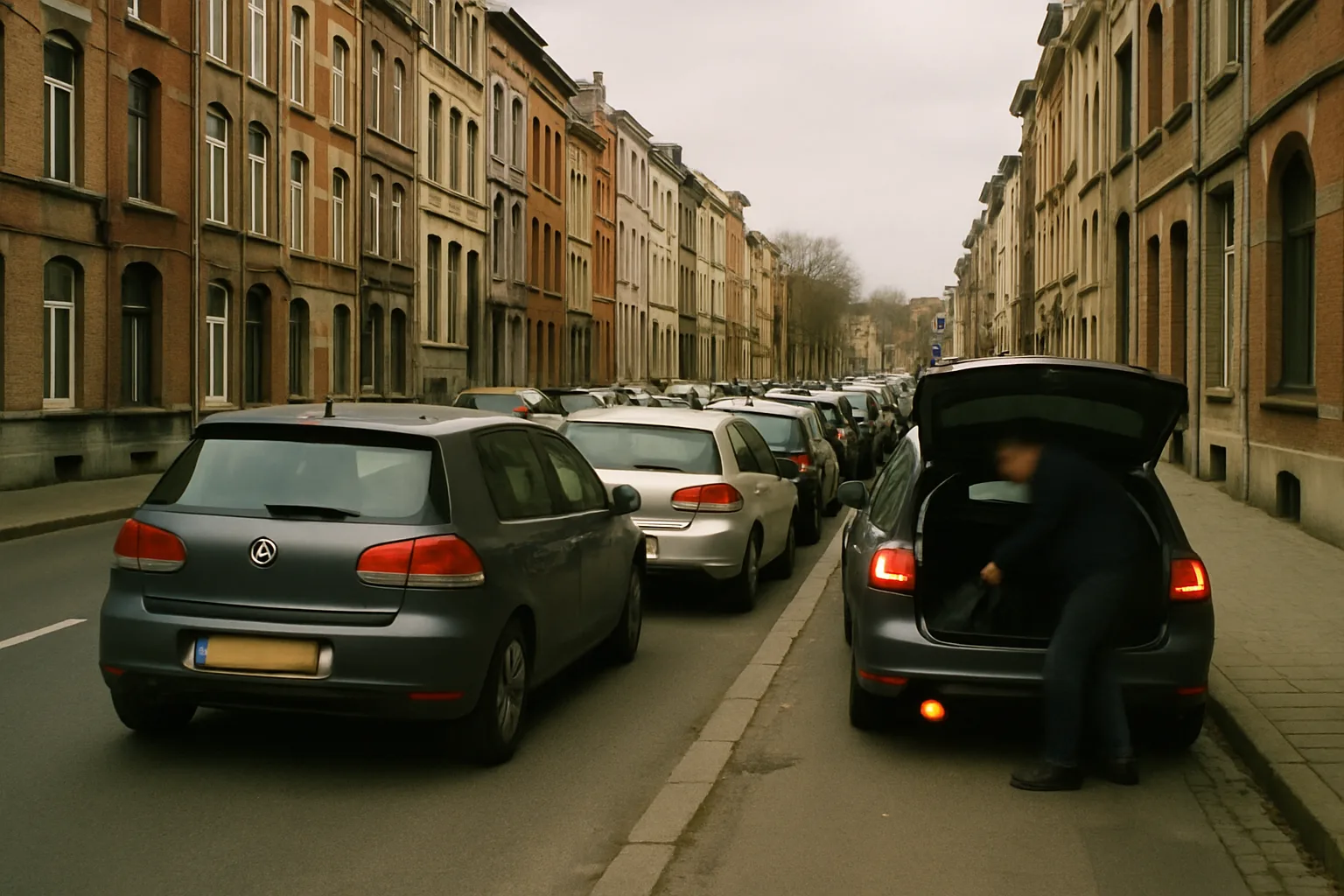
Within 5 m of a pedestrian crossing, you may…
3. Stopping or parking + the metres to remember
Stopping = you drop off/pick up people or things, for the time needed, without leaving the vehicle for long. Parking = everything else (you stay put longer). Some places prohibit only parking, others prohibit stopping too.
| Place | Distance | Prohibited |
|---|---|---|
| Before a pedestrian / cyclist crossing | 5 m before | Stopping and parking |
| From a junction (edge of the crossing road) | 5 m | Stopping and parking |
| From a bus / tram stop | 15 m | Parking |
| Before the lights at a junction | 20 m | Parking |
 E1 — No parking
 E3 — No stopping AND no parking
💡 One red stroke (E1) = you may stop briefly, but not park. A red cross (E3) = nothing at all, not even stopping.
At 90 km/h, your stopping distance on a dry surface ≈ ?
The parking signs that trip people up
 E5 — prohibited from the 1st to the 15th
 E7 — prohibited from the 16th to the end of the month
💡 E5 = prohibited from the 1st to the 15th · E7 = prohibited from the 16th to the end of the month. With alternate-side parking: from the 1st to the 15th you park on the odd-numbered side, from the 16th to the end on the even side — and you switch sides on the last day of the period, between 19:30 and 20:00.
- Blue zone: disc compulsory, arrow on the line following your arrival time, max 2 h (unless stated otherwise).
- Broken-down vehicle: max 24 h on the public highway. Advertising vehicle: max 3 h. Putting your vehicle up for sale on the public highway: prohibited.
4. Speed, following distance and stopping distance
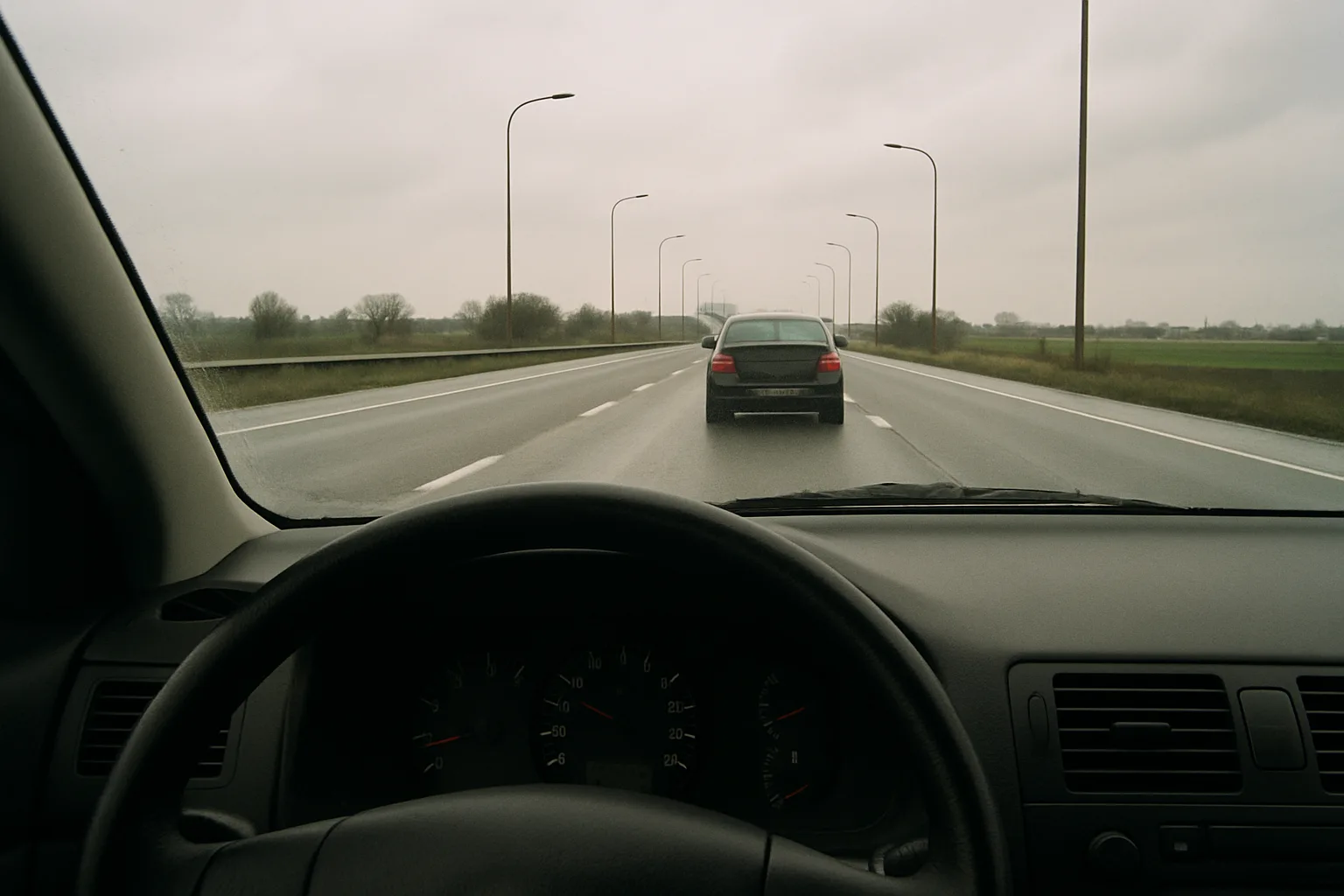
To turn a speed into metres per second, one single formula: km/h ÷ 3.6 = m/s. Example: 90 ÷ 3.6 = 25 m/s — at 90 km/h, you cover 25 metres every second.
| Speed | In 1 second | Safe distance (× 2) |
|---|---|---|
| 50 km/h | ≈ 14 m | ≈ 28 m |
| 90 km/h | ≈ 25 m | ≈ 50 m |
| 120 km/h | ≈ 33 m | ≈ 66 m |
The stopping distance = reaction distance (you're still moving while your brain reacts) + braking distance (once you're on the brakes).
| Speed | Reaction (× 3) | Braking (squared) | Stopping distance |
|---|---|---|---|
| 50 km/h | 5 × 3 = 15 m | 5 × 5 = 25 m | ≈ 40 m |
| 90 km/h | 9 × 3 = 27 m | 9 × 9 = 81 m | ≈ 108 m |
| 120 km/h | 12 × 3 = 36 m | 12 × 12 = 144 m | ≈ 180 m |
Overtaking a cyclist on the left requires a lateral gap of…
5. Overtaking: the prohibitions
You overtake on the left. Two exceptions where you overtake on the right: the tram, and a vehicle that has moved over to turn left. Overtaking is prohibited:
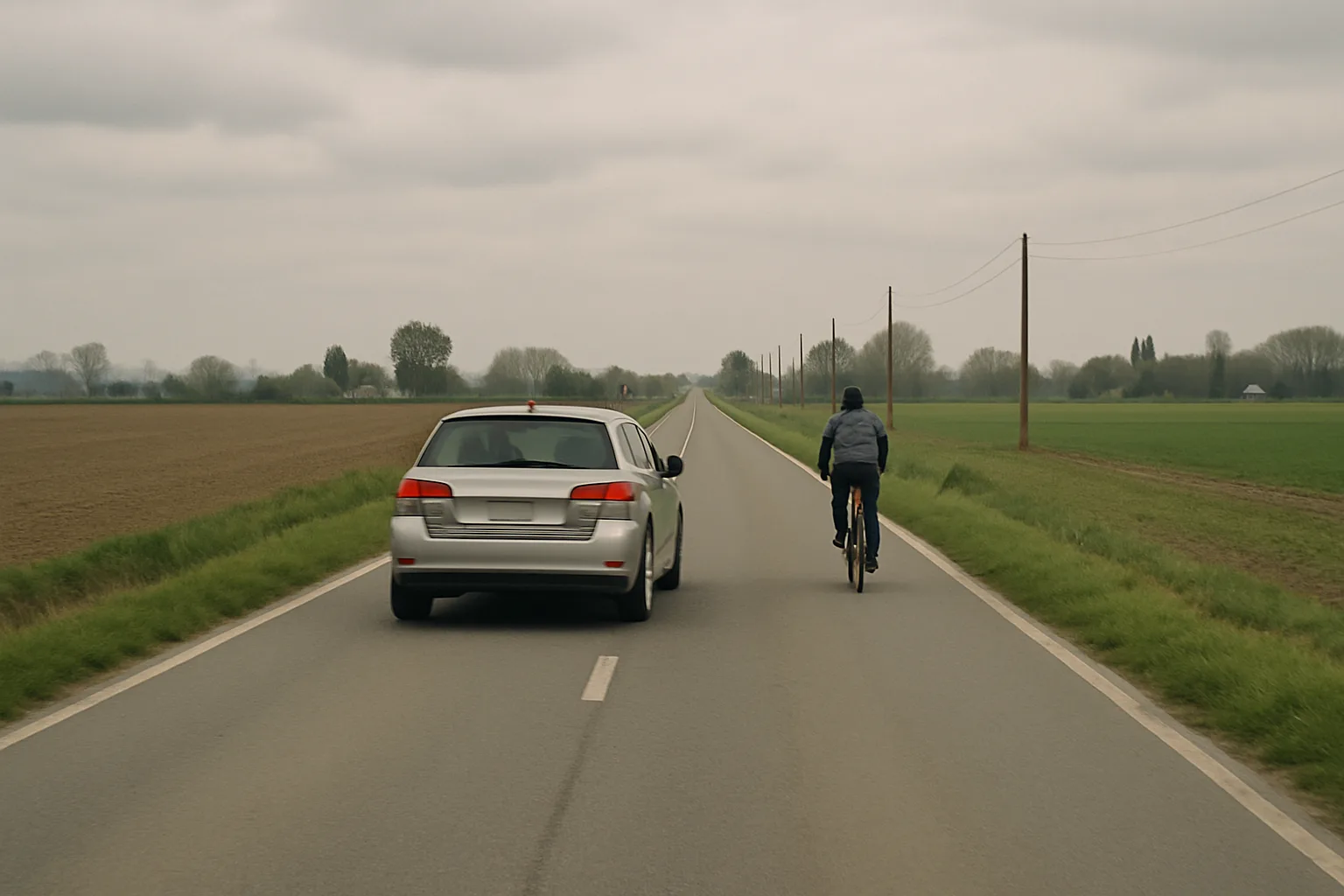
- On a pedestrian crossing and just before it.
- Approaching and on a level crossing without barriers.
- At the top of a hill and in a bend without visibility (outside built-up areas, solid line).
- When the vehicle in front is already overtaking (double overtaking).
At 0.25 mg/l of exhaled air (between 0.22 and 0.35), you must…
6. The driver: alcohol, drugs, fatigue
| Driver | In the blood | In exhaled air |
|---|---|---|
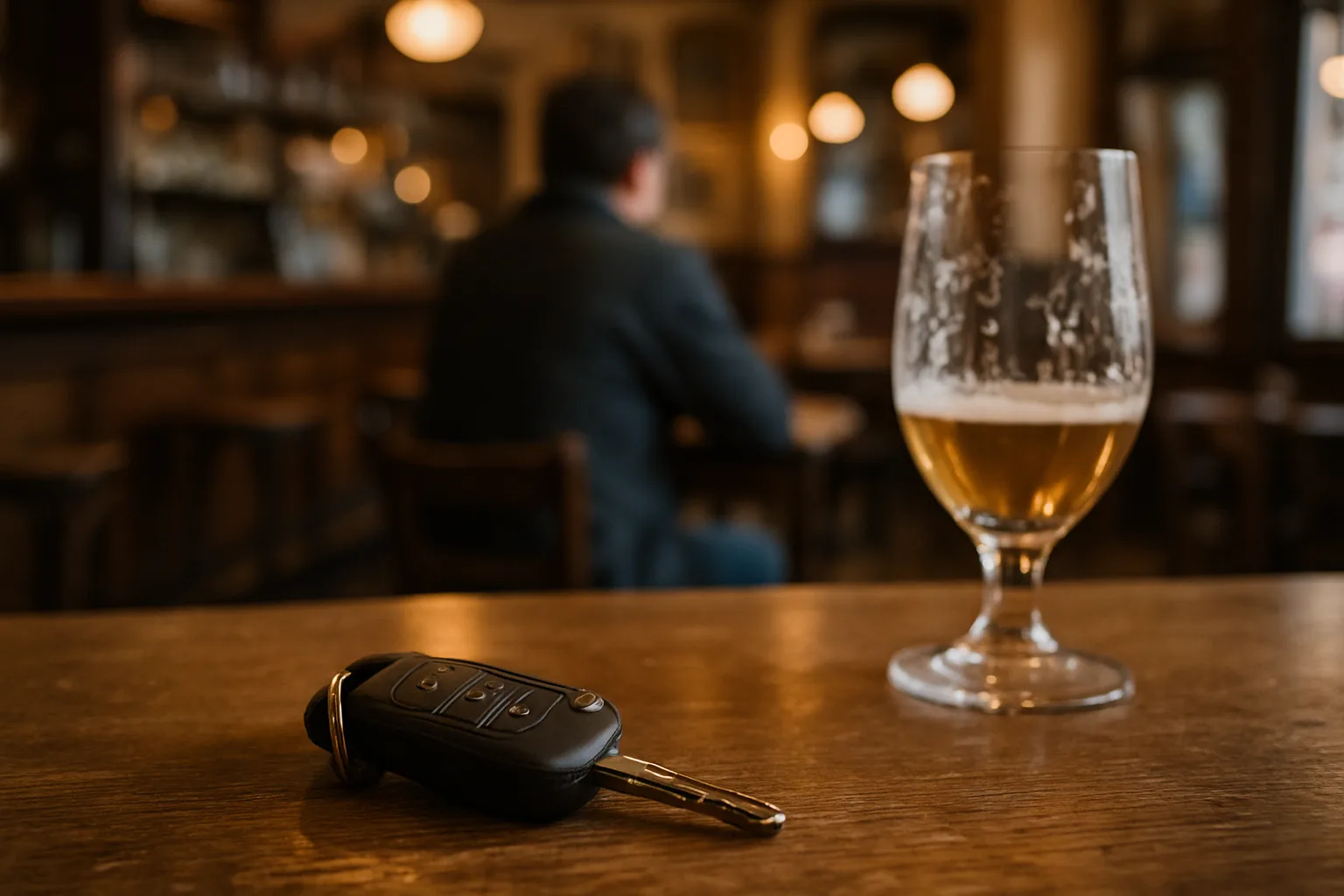
| Standard | 0.5 g/l | 0.22 mg/l |
| Professional (bus, lorry, taxi…) | 0.2 g/l | 0.09 mg/l |
Positive saliva drug test: you must wait…
7. The vehicle: children, breakdowns and accidents
The vehicle's lights
| Lights | When |
|---|---|
| Position (side lights) | when stopped/parked at night if visibility < 200 m |
| Dipped beam | from dusk to dawn + in daytime if visibility < 200 m (rain, snow, fog) |
| Main beam (full headlights) | at night — prohibited when passing oncoming traffic, when following within 50 m, or when street lighting lets you see 100 m ahead |
| Rear fog light | fog or snow (visibility < 100 m), or heavy rain — switch it off as soon as conditions improve |
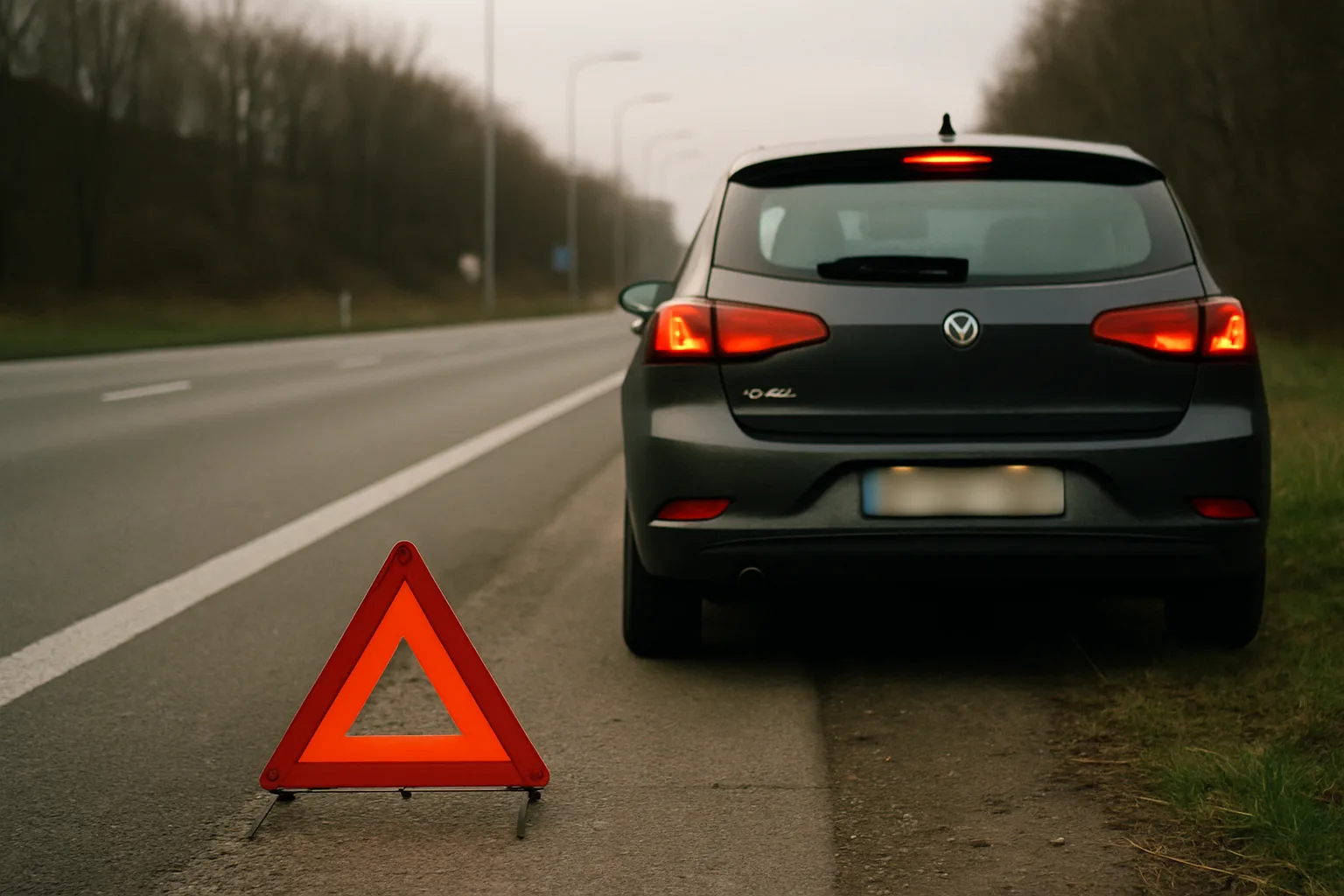
| Hazard lights (warnings) | breakdown, accident, or to warn of a traffic jam |
Documents, trailers and MAM
- On board, always: identity card, driving licence, registration certificate, insurance, certificate of conformity, roadworthiness test (if required) — 6 documents.
- Trailer: prohibited with a provisional driving licence; with a category B licence, max 750 kg MAM (beyond that: B+E or code B96).
- MAM = maximum authorised mass set by the manufacturer; the actual laden mass = the real loaded weight. Category B licence: vehicles up to 3.5 t MAM.
- Studded tyres: from 1 November to 31 March — max 90 km/h on motorways, 60 km/h elsewhere.
Your mirror is no longer enough: you check the blind spot…
8. The trick signs (learn to tell them apart)
A sign's family in 1 second — more than 10 questions in the bank simply ask for its category:
| Shape / colour | Family | Example |
|---|---|---|
| 🔺 Triangle, red border | A — Danger (≈150 m before) | bend, pedestrian crossing |
| 🔻 Inverted triangle / octagon | B — Priority | give way, STOP, priority road |
| ⭕ Circle, red border | C — Prohibition | no entry, maximum speed |
| 🔵 Solid blue circle | D — Obligation | compulsory direction, cycle track |
| 🟦 Square/rectangle E | E — Stopping & parking | E1, E3, E5/E7, E9 |
| ⬜ Blue rectangle | F — Information | motorway, built-up area, one-way street |
 C1 — No entry
 C3 — Access prohibited (both directions)
💡 Red circle with a white bar (C1) = no entry, traffic may come the other way towards you. Entirely red circle with a border (C3) = access prohibited to everyone, in both directions.
 A7a — on both sides
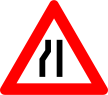 A7b — on the left
 A7c — on the right
💡 The drawing shows the side that narrows. A7b = narrowing on the left, A7c = on the right, A7a = on both sides.
 D1 — Compulsory direction
 C31 — No turning
 D5 — Compulsory roundabout
💡 Round blue sign = you MUST follow the arrow (obligation). White sign with a red border = you CANNOT (prohibition). The colour tells you everything before you even read the symbol.
Outside built-up areas in Wallonia, with no sign: maximum speed?
9. The 15 numbers to know by heart
| What they ask | The answer |
|---|---|
| Exam pass mark | 41 / 50 |
| Serious faults = fail | 2 |
| Built-up area | 50 km/h |
| Outside built-up areas — Flanders | 70 km/h |
| Outside built-up areas — Wallonia | 90 km/h |
| Motorway (max / min) | 120 / 70 km/h |
| Residential / home zone | 20 km/h |
| Safe following distance | 2 seconds |
| Alcohol (exhaled air) | 0.22 mg/l |
| Stopping+parking prohibited (crossings, junctions) | 5 m |
| Parking prohibited (bus stop) | 15 m |
| Parking prohibited (before the lights) | 20 m |
| Overtaking a cyclist (built-up / outside) | 1 m / 1.5 m |
| Child seat compulsory (if under 18) below | 1.35 m |
| Triangle (road / motorway) | 30 m / 100 m |
❓ Frequently asked questions
Can you really pass the theory exam in 3 hours?
No, and beware of anyone who promises it. It takes around ten hours to understand the theory. This summary is for revising the day before and on exam day, not for learning from scratch.
Is the limit outside built-up areas the same everywhere?
No: 70 km/h in Flanders, 90 km/h in Wallonia, 70 km/h in Brussels. It's one of the most common mistakes in the exam.
Is this summary up to date?
Yes, it includes the 2026 rules (including the new alcohol thresholds). A new public-highway code comes into force on 1 June 2027: the summary will be updated at that point.
📚 Want it all? The full course, theme by theme
View the whole course →Each theme has its detailed lesson and its practice questions:
- Signs, road markings and traffic lights117 questions
- Right of way and intersections143 questions
- Speed and safe following distances77 questions
- Overtaking and passing95 questions
- Stopping and parking130 questions
- Manoeuvres and position on the road42 questions
- Vulnerable road users and priority vehicles93 questions
- Driver fitness (alcohol, drugs, fatigue)100 questions
- Vehicle, documents and equipment116 questions
- Special situations (motorway, tunnels, difficult conditions, eco-driving)167 questions