The road reserved for motor vehicles
The road reserved for motor vehicles is often confused with the motorway: they share the same excluded users and a high speed limit. Yet one fundamental difference sets them apart: on a road reserved for motor vehicles, you may encounter junctions and traffic lights. Knowing how to tell the two apart is essential both for the theory exam and on the road.
📑 In this lesson (5)
What is a road reserved for motor vehicles?
The road reserved for motor vehicles is a road set aside for fast traffic, indicated by a specific sign. The F9 sign 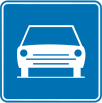 (a blue square sign bearing the symbol of a white car) marks its beginning: from that point on, the special rules for this category of road apply. The F11 sign
 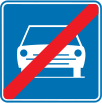 , identical but with a red diagonal bar across the car, marks its end.
Excluded users: the same as on the motorway
A road reserved for motor vehicles is closed to slow and vulnerable road users, exactly like a motorway. The following are not allowed:
- Pedestrians and horse riders;
- Cyclists and moped riders;
- Horse-drawn vehicles and drivers of animal-drawn vehicles;
- All slow vehicles which, by design, cannot reach a sufficient speed (agricultural machinery, slow quadricycles, etc.).
The key difference: junctions and traffic lights are possible
This is where it all comes down to. Unlike the motorway, which has entirely separated carriageways and no level crossings of traffic, a road reserved for motor vehicles may include junctions and be controlled by traffic lights. You must therefore stay alert to crossings and be able to stop, which never happens on a true motorway.
Speed on a road reserved for motor vehicles
For a car (category B), the maximum permitted speed on a road reserved for motor vehicles is 120 km/h, as on the motorway. This limit applies unless signs indicate otherwise: on the approach to a junction or traffic lights, a sign may impose a lower speed. Outside a built-up area but on an ordinary road, the limit would be 90 km/h; it is indeed the F9 sign that justifies the 120 km/h.
Motorway or road reserved for motor vehicles: the comparison
| Criterion | Motorway | Road reserved for motor vehicles |
|---|---|---|
| Level junctions | Never | Possible |
| Traffic lights | Never | Possible |
| Max speed (car) | 120 km/h | 120 km/h |
| Excluded users | Pedestrians, cyclists, mopeds, slow vehicles | Same as the motorway |
| Start / end sign | F5 / F7 | F9 / F11 |
🧠 Check you've got it
Question 1 / 3
3 exam-style questions on this lesson — instant correction.
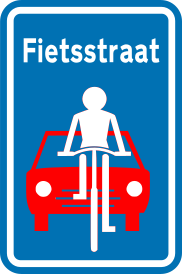
In the Brussels-Capital Region, what is the maximum speed at which you may drive in a cycle zone?
🛣️Practise Special situations (motorway, tunnels, difficult conditions, eco-driving)
Exam-style questions on this theme, with corrections and explanations — plus the full bank with access.
❓ Frequently asked questions
What is the difference between a motorway and a road reserved for motor vehicles?
Both exclude the same slow users and allow 120 km/h for a car. But the motorway never has junctions or traffic lights, whereas a road reserved for motor vehicles may include them. You must therefore stay ready to stop.
Can a moped use a road reserved for motor vehicles?
No. As on the motorway, mopeds, cyclists, pedestrians and slow vehicles are banned from a road reserved for motor vehicles. Only motor vehicles capable of reaching a sufficient speed are allowed.
How fast can I drive on a road reserved for motor vehicles?
With a car, the maximum speed is 120 km/h, unless a sign imposes a lower limit, for example on the approach to a junction or traffic lights. Always adapt your speed to the conditions and the signs.