⏱️ 4 min read
Stopping distance and safe following distance
Between the moment you spot an obstacle and the moment your car comes to a standstill, far more metres go by than you might imagine. This stopping distance depends on your speed, your attention and the state of the road. Understanding it means avoiding a pile-up and getting the "speed" questions right on the theory exam.
📑 In this lesson (6)
Stopping distance = reaction + braking
The stopping distance is the total distance covered from the instant you perceive a danger until the vehicle comes to a complete stop. It is made up of two parts that add together: the reaction distance and the braking distance.
- Reaction distance: the ground covered while you react (see, understand, move your foot to the pedal). On average this takes about 1 second, during which the car keeps going at full speed.
- Braking distance: the ground covered between the moment the brakes take effect and the complete stop. It depends on speed, tyres, brakes and the grip of the road.
Why speed changes everything
The reaction distance increases proportionally with speed: if you drive twice as fast, you cover twice as many metres during the second of reaction. But the braking distance increases with the square of the speed: doubling your speed does not double the braking distance, it multiplies it by about four.
Indicative distances by speed
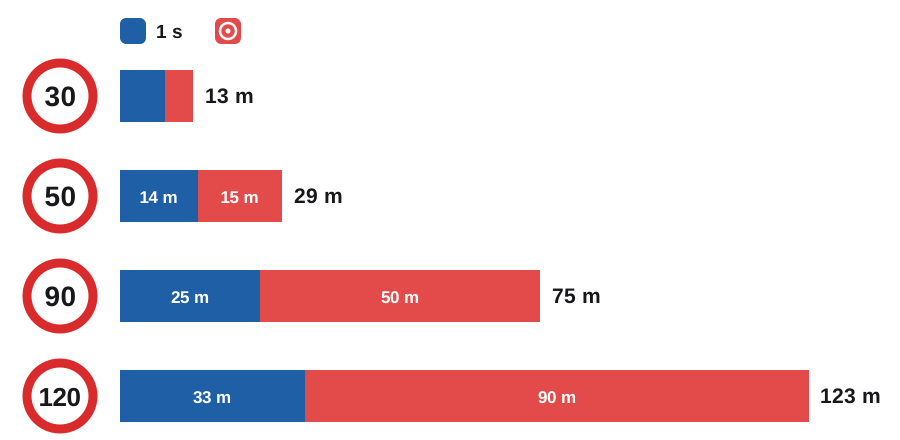
The table below gives orders of magnitude on a dry road, with a reaction time of about 1 second. These are indicative values: on a wet surface, allow considerably more.
| Speed | Reaction (~1 s) | Braking | Stopping distance |
|---|---|---|---|
| 30 km/h | ± 8 m | ± 5 m | ± 13 m |
| 50 km/h | ± 14 m | ± 15 m | ± 29 m |
| 90 km/h | ± 25 m | ± 50 m | ± 75 m |
| 120 km/h | ± 33 m | ± 90 m | ± 123 m |
The 2-second rule
To keep a sufficient following distance from the vehicle ahead of you, use the 2-second rule. Pick a fixed point at the side of the road (a sign, a tree, a road marking). When the rear of the vehicle in front passes it, count: "one thousand and one, one thousand and two". If you reach that point before you finish counting, you are too close.
This gap is a minimum in fine weather. As soon as conditions worsen, you must increase it significantly, as explained below.
What lengthens the stopping distance
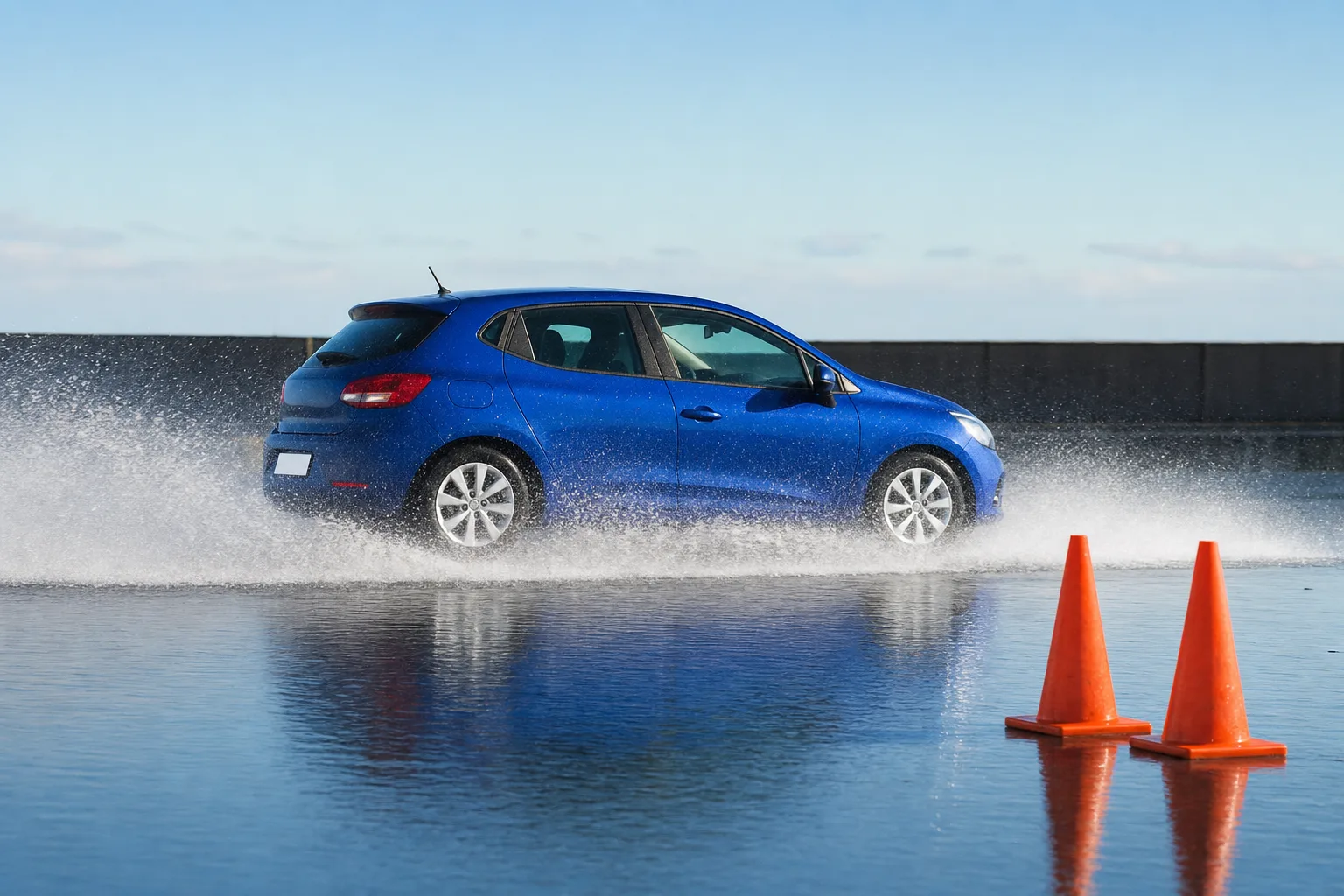
- Rain and a wet surface: grip drops, and the braking distance can double. On a wet road, switch to a 3 to 4 second rule. On snow or black ice, the distance grows even further.
- Fatigue and distraction (phone, sat nav, passengers): they lengthen your reaction time, and therefore the distance covered before you brake.
- Alcohol, drugs and certain medicines: they slow your reflexes and distort your judgement of distance. Reaction time can be very significantly increased.
- A loaded vehicle: the greater the mass (passengers, trailer, full boot), the longer the braking distance. Worn tyres or brakes in poor condition have the same effect.
Why keep your distance
- You have the time and space to brake if the vehicle in front of you stops suddenly.
- You see the road and the traffic further ahead more clearly, so you anticipate earlier.
- You avoid the main cause of rear-end collisions: following too closely.
🧠 Check you've got it
Question 1 / 3
3 exam-style questions on this lesson — instant correction.
You are towing another car with yours on the motorway...
🏎️Practise Speed and safe following distances
Exam-style questions on this theme, with corrections and explanations — plus the full bank with access.
❓ Frequently asked questions
What is the difference between reaction distance and braking distance?
The reaction distance is covered while you react (about 1 second), before you touch the brake. The braking distance is covered afterwards, between the brakes taking effect and the stop. Their sum is the stopping distance.
How do you apply the 2-second rule?
Choose a fixed point at the side of the road. When the rear of the vehicle in front passes it, count two seconds. If you reach the point before you finish counting, you are following too closely. Double the gap in the rain.
Why does the braking distance increase so much with speed?
Because it depends on the square of the speed. The energy that must be dissipated to stop grows with the square of the speed: driving twice as fast multiplies the braking distance by about four.
Should you keep more distance when it rains?
Yes. On a wet surface, grip decreases and the braking distance can double. Move from the 2-second rule to 3 or even 4 seconds, and reduce your speed.