⏱️ 6 min read
Position on the carriageway
Knowing where to position your vehicle on the road is as important as knowing how to drive. In Belgium, the basic rule is simple: you drive on the right. But between traffic lanes, driving in queues, bus lanes and selection lanes at junctions, several situations deserve to be properly understood. A bad position is not only a frequent fault in the exam, but also a regular cause of accidents.
📑 In this lesson (7)
The golden rule: drive on the right
Every driver must drive as close as possible to the right-hand edge of the carriageway. This rule applies on every road, whether or not there is a centre line. It has two purposes: to leave room for road users following or overtaking you, and to allow oncoming traffic to flow smoothly. You only move away from the right-hand edge for a specific reason: to overtake, to go around an obstacle, to prepare to turn left or to follow the instructions of road markings.
Traffic lanes
When the carriageway is divided into traffic lanes by white lines, each driver chooses a lane and stays in it. Outside built-up areas, you use the right-hand lane; the lanes to the left are only for overtaking. In built-up areas, on a carriageway with several lanes in the same direction, you may in principle choose your lane freely, but you must not obstruct other road users.
To change lanes, you must make sure you can do so without danger, check your mirrors and blind spot, then signal in good time with your indicator. Changing lanes is a manoeuvre: priority goes to the driver following their lane normally.
Driving in queues
When traffic is heavy and queues form on a carriageway with several lanes in the same direction, a special rule applies: the queues may move at different speeds, and a right-hand queue may then move faster than a left-hand queue. In this specific case, passing stationary or slower queues on the right is not considered forbidden overtaking: it is the normal consequence of driving in queues.
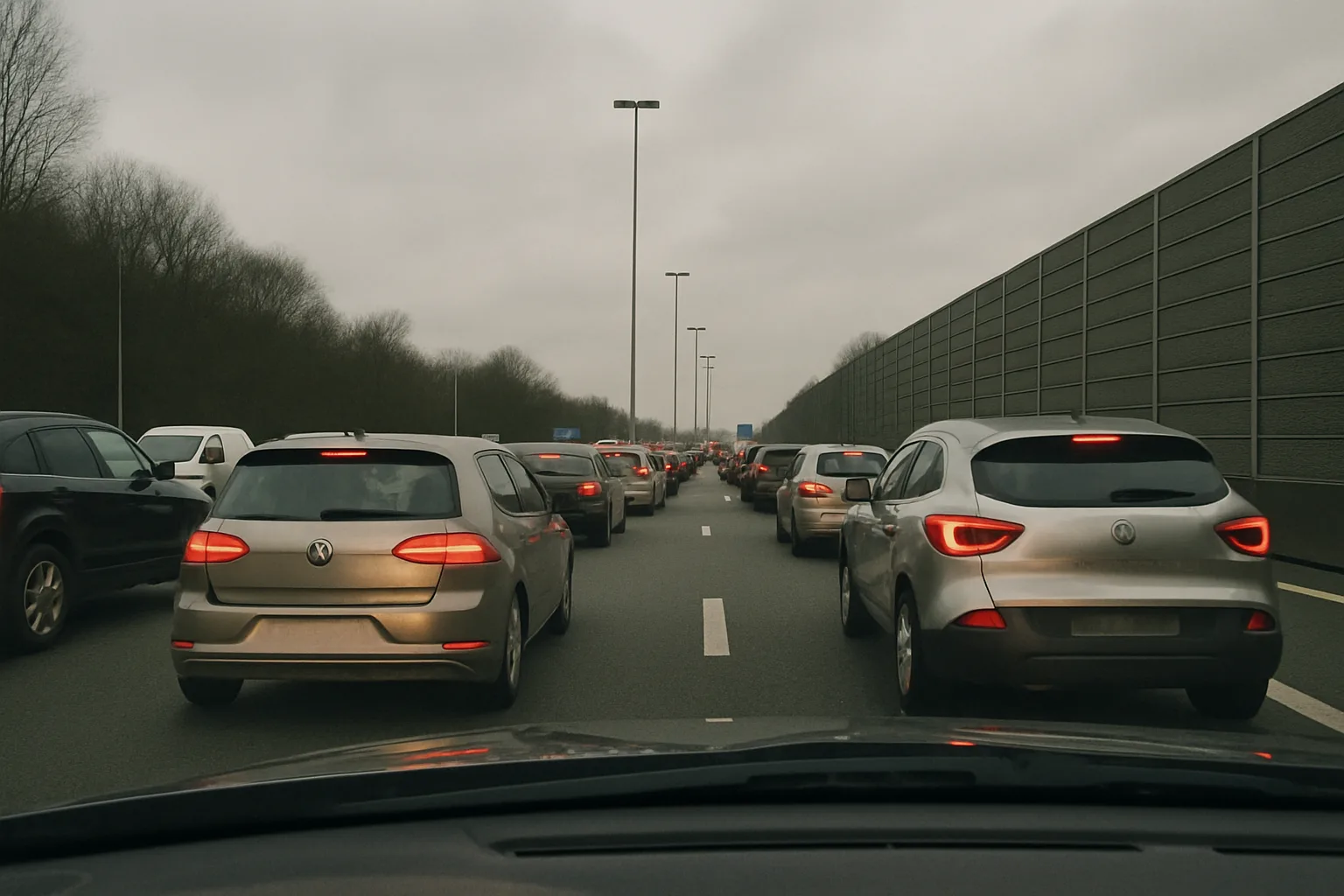
You must nevertheless stay in your queue and only change lanes with great caution, because other drivers do not always expect a vehicle to pull out. Stay alert to motorcyclists riding between the queues (filtering) and leave them the space they need.
Reserved lanes and tracks
Some lanes are reserved for specific categories of road users and are in principle forbidden to you. The best known is the crossable special lane or bus lane, indicated by the word "BUS" marked on the road and by a wide broken line. You may only use it in specific cases: to turn right shortly afterwards, to cross it, or if signs allow it (for example for taxis or cyclists).
- Bus lane: reserved for public transport vehicles; other drivers may use it only if authorised or for a brief manoeuvre.
- Cycle lanes and cycle tracks: reserved for cyclists; do not drive or stop on them.
- Tram tracks: do not drive onto them, unless markings and signs expressly allow it.
Selection lanes at junctions
On approaching a junction, the carriageway is often divided into selection lanes indicated by arrows on the road. Each arrow imposes a direction: the right-hand lane to turn right, the middle lane to go straight ahead, the left-hand lane to turn left. You must move in good time into the correct lane, depending on the direction you intend to take.
Once you are in a selection lane, you are in principle required to follow the direction indicated by the arrow. Changing lanes at the last moment or cutting across a queue to reach another direction is dangerous and a fault. Anticipate: choose your lane as soon as the arrows appear.
Distance from the edge and vulnerable road users
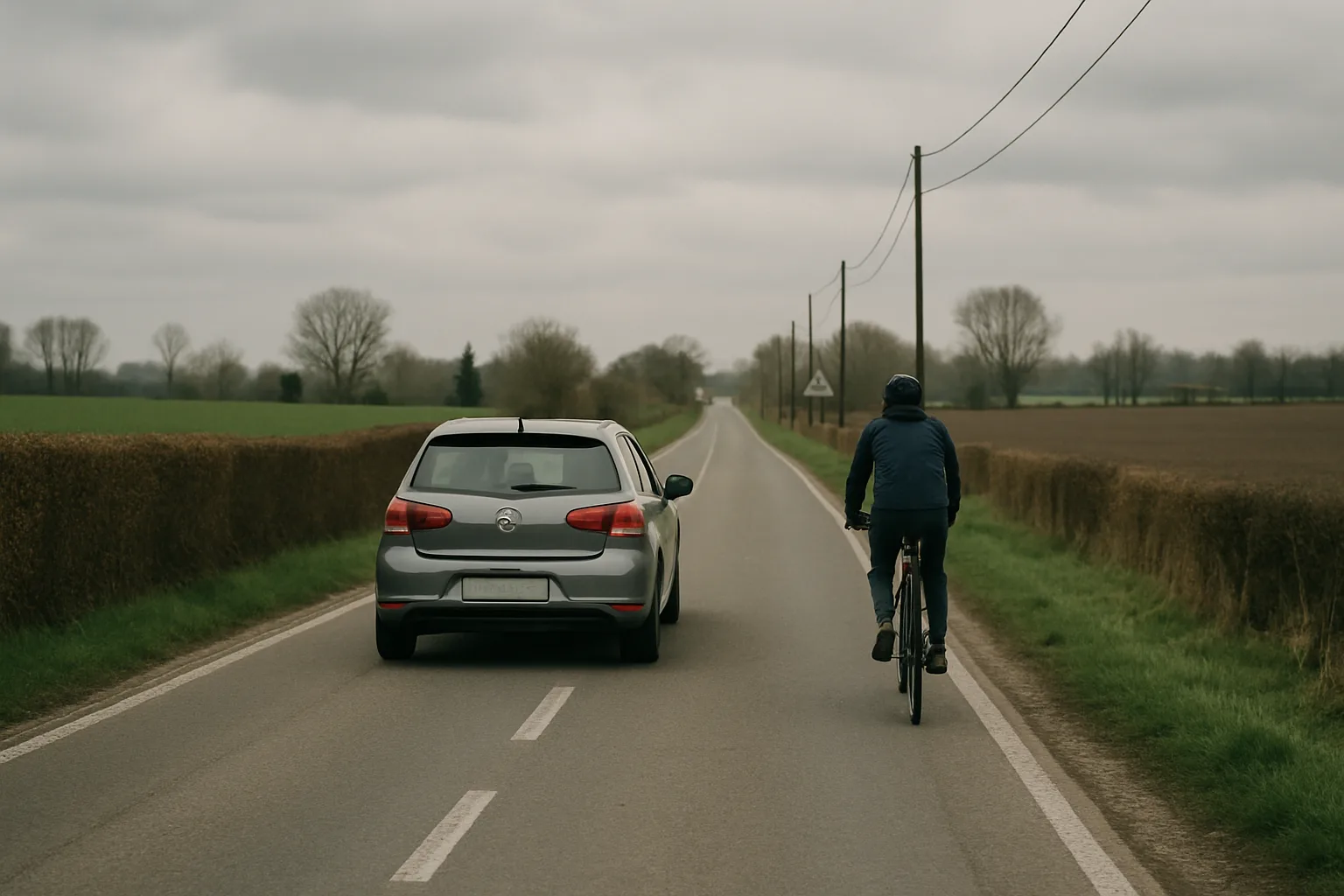
Driving on the right does not mean hugging the edge. You must keep a sufficient lateral distance from pedestrians, cyclists and other vulnerable road users. When passing or overtaking a cyclist outside built-up areas, you must leave a lateral gap of at least 1.5 metres; in built-up areas, this gap is at least 1 metre. Near pedestrians on the verge, also keep a comfortable margin and slow down if necessary.
| Situation | Correct position |
|---|---|
| Road without lanes | As close as possible to the right-hand edge |
| Several lanes outside built-up areas | Right-hand lane; left for overtaking |
| Driving in queues | Stay in your queue, change lanes with caution |
| Bus lane | Forbidden, except if authorised or for a brief manoeuvre |
| Approaching a junction with arrows | Selection lane for your direction |
| Passing / overtaking a cyclist | 1 m in built-up areas, 1.5 m outside |
Zip merging
When a traffic lane is about to end — because of a narrowing, roadworks or an obstacle — and traffic is heavily slowed or at a standstill, you must apply zip merging, also known as the zipper rule. The principle is simple: drivers in both queues merge in turn, alternately, just before the point where the lane ends. A vehicle in the continuing queue lets one vehicle from the merging queue in, then moves forward in its turn.
- Stay in your lane until the end, right up to the narrowing: do not merge too early.
- Merge alternately: one vehicle from each queue goes in turn, like the teeth of a zip.
- The driver who must give way lets in a single vehicle in front of them, without getting worked up.
🧠 Check you've got it
Question 1 / 3
3 exam-style questions on this lesson — instant correction.
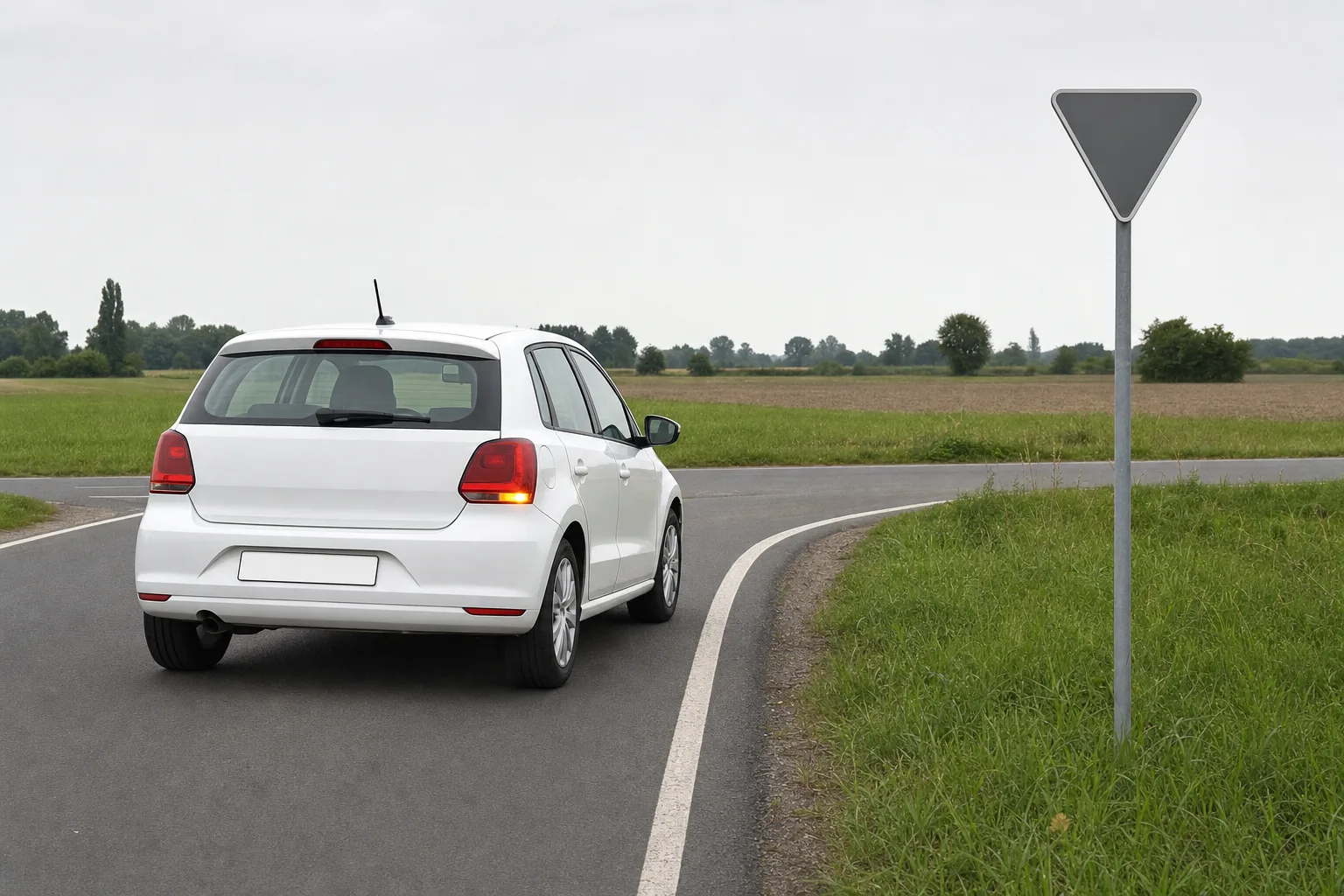
This driver wants to turn right at this junction. No other road users are visible. Must he still switch on the right indicator?
🔄Practise Manoeuvres and position on the road
Exam-style questions on this theme, with corrections and explanations — plus the full bank with access.
❓ Frequently asked questions
Can I stay in the middle lane of a motorway if I am driving fast?
No. Outside built-up areas and on the motorway, you drive in the right-hand lane and only use the lanes to the left for overtaking. Once your overtaking is complete, you move back to the right, whatever your speed.
Is passing a slower queue on the right allowed?
Yes, when traffic is moving in queues on lanes in the same direction. In that case, the queues may move at different speeds and moving faster on the right is not forbidden overtaking. Outside this situation, overtaking on the right remains forbidden.
Can I use a bus lane to turn right?
You may move onto it just before the junction to turn right, over the shortest possible distance and without obstructing public transport vehicles. Apart from this manoeuvre, the bus lane remains forbidden, unless signs say otherwise.
Do I really have to follow the arrow in the selection lane?
Yes. Once you are in a lane indicating a direction with an arrow on the road, you must follow that direction. That is why you must choose your lane in good time, as soon as the arrows appear.