⏱️ 5 min read
Overtaking
Overtaking means passing a road user travelling in the same direction as you. It is one of the riskiest manoeuvres: you leave your lane, you briefly drive against the flow of traffic and you have to move back in at the right moment. In Belgium, the basic rule is clear: you overtake on the left. Here are the conditions to meet and the exceptions to know for the exam.
📑 In this lesson (6)
The basic rule: overtake on the left
As a general rule, overtaking is done on the left. You pull out to the left, overtake the slower road user, then move back to the right as soon as you can do so without hindering the person you have just overtaken. Throughout the manoeuvre, you remain responsible for safety: only start an overtake if you are certain you can complete it.

The conditions for overtaking safely
Before pulling out, several conditions must be met at the same time. If even one is missing, you hold back:
- Sufficient visibility: you can see far enough ahead to complete the whole manoeuvre without surprises (no crest of a hill, no bend hiding the road, no fog).
- Clear space ahead: the left-hand lane is clear over a sufficient distance and no vehicle coming from the opposite direction will be hindered.
- Do not hinder others: no one behind you has already started overtaking you, and the road user in front of you has not themselves signalled that they are going to turn or overtake on the left.
- Signal the manoeuvre: you switch on your left indicator before pulling out, then the right indicator before moving back in.
- Check the blind spots: a glance in the mirrors AND over your shoulder, to the left, before pulling out.
- Suitable speed: you must be able to overtake clearly faster than the other vehicle, without exceeding the maximum speed allowed at that spot.
When may you overtake on the right?
Overtaking on the right is the exception. It is nevertheless allowed in several specific situations:
- When the driver you want to overtake has clearly signalled their intention to turn left and has moved into position to do so: you then pass them on the right.
- When traffic is moving in queues (for example at rush hour): a right-hand queue may then move faster than a left-hand queue without this counting as improper overtaking.
- On a carriageway with several lanes in the same direction (in a built-up area, or outside built-up areas under the conditions provided for): you may drive in the lane of your choice according to the rules, and therefore move ahead on the right.
Overtaking a cyclist, a pedestrian, a moped
Vulnerable road users require a bigger margin. When overtaking them, you must leave a sufficient lateral distance so as not to destabilise or frighten them:
- At least 1 metre of lateral clearance in built-up areas.
- At least 1.5 metres of lateral clearance outside built-up areas.
This distance is measured between the widest point of your vehicle and the road user. If the width of the road does not allow you to keep it, you wait for a better moment rather than brushing past the cyclist or pedestrian.
Summary
| Situation | Side / distance |
|---|---|
| Normal overtaking | On the left |
| The other driver is turning left and has moved into position | Overtaking on the right allowed |
| Traffic in queues / several lanes | Moving ahead on the right permitted |
| Overtaking a cyclist — built-up area | At least 1 m |
| Overtaking a cyclist — outside built-up areas | At least 1.5 m |
Overtaking is closely linked to other rules: the overtaking bans, passing oncoming traffic and the safe following distance. Master them all and you can approach the manoeuvre with confidence.
The overtaking manoeuvre in 3 phases
A successful overtake always follows the same order. Break the manoeuvre down into three steps and carry them out without rushing:
- Observe: first check your mirrors and the blind spot on your left, then switch on your left indicator to announce your intention to other road users.
- Pull out and overtake: move out to the left and pass while leaving a sufficient lateral clearance, particularly for two-wheelers (cyclists, motorcyclists), who are the most vulnerable.
- Move back in: only return to your lane when you can see the overtaken vehicle entirely in your interior mirror, switching on your right indicator, without hindering or cutting in on it.
🧠 Check you've got it
Question 1 / 3
3 exam-style questions on this lesson — instant correction.
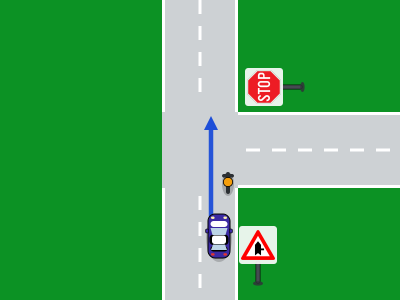
At this junction, may you overtake the motorcycle on the left?
🚙Practise Overtaking and passing
Exam-style questions on this theme, with corrections and explanations — plus the full bank with access.
❓ Frequently asked questions
May you overtake on the right on a road with a single lane in each direction?
No, unless the driver in front of you has signalled that they are turning left and has moved into position to do so. Apart from that case, overtaking is done on the left.
What distance must I leave when overtaking a cyclist?
At least 1 metre in built-up areas and at least 1.5 metres outside built-up areas. If the road is too narrow to keep this clearance, wait for a safer moment.
Must I use my indicator to overtake?
Yes. You switch on your left indicator before pulling out, then the right indicator before moving back in. It is compulsory and it warns other road users.
When is overtaking prohibited?
In particular when visibility is insufficient, when approaching the crest of a hill or a blind bend, or where signs prohibit it. The details are covered in the lesson on overtaking bans.