⏱️ 4 min read
Changing direction
Turning at a junction seems simple, but it is one of the manoeuvres where mistakes cost the most: forgetting the indicator, poor positioning, a cyclist caught in the blind spot. Changing direction is prepared in three steps: signal, position yourself, give way if necessary. Here is the exact method expected by the Belgian highway code.
📑 In this lesson (5)
First of all: announce your intention
Any change of direction must be signalled in good time using your indicators. You switch on the indicator early enough for other road users to understand your intention, and you switch it off as soon as the manoeuvre is complete. This obligation applies to turning at a junction, but also to moving out, pulling out, moving back in or leaving a lane.

Changing direction is a manoeuvre: you may only carry it out after making sure you can do so without danger to other road users, taking into account their position, speed and distance.
Turning right
To turn right, you must keep close to the right-hand edge of the carriageway well before the junction, without obstructing cyclists. In practice:
- Switch on your right indicator early enough.
- Move gradually towards the right of the carriageway.
- Slow down and check your right blind spot: a cyclist or moped rider may be coming up on your right.
- Watch out for pedestrians crossing the road you are turning into: they have priority.
Turning left
Turning left is trickier, because you cross the path of oncoming vehicles. The positioning rule differs depending on the direction of traffic on the road:
- Switch on your left indicator in good time.
- On a two-way road, move towards the centre line of the carriageway (the middle) without crossing it. On a one-way road, position yourself fully to the left.
- You must do this without obstructing oncoming drivers or those following you.
- Give way to oncoming road users continuing straight ahead or turning to their right.
When you make the turn, do not forget the road users you will cut across either: pedestrians crossing the road you are entering and cyclists travelling in both directions. Priority for oncoming vehicles never exempts you from watching out for these vulnerable road users.
Passing another car that is turning left
Two vehicles coming from opposite directions both want to turn left at the same junction? They pass behind each other (on the left), so as to go around one another, unless the layout of the junction or the signs require otherwise. This avoids getting stuck in the middle of the intersection.
The steps at a glance
| Step | To the right | To the left |
|---|---|---|
| Indicator | Right, in good time | Left, in good time |
| Positioning | Keep to the right | Towards the centre line (two-way) or to the left (one-way) |
| What to watch | Right blind spot, cyclists, pedestrians | Oncoming traffic, cyclists, pedestrians |
| Priority | To the pedestrians and cyclists you cut across | To oncoming traffic going straight ahead |
🧠 Check you've got it
Question 1 / 3
3 exam-style questions on this lesson — instant correction.
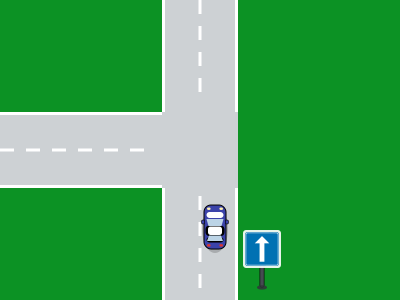
At this intersection, may the blue car turn left?
🔄Practise Manoeuvres and position on the road
Exam-style questions on this theme, with corrections and explanations — plus the full bank with access.
❓ Frequently asked questions
Is the indicator really compulsory even on a deserted street?
Yes. The highway code requires you to signal any change of direction using your indicators, regardless of traffic. In the exam as in real life, forgetting it is a fault.
Where should I position myself to turn left?
On a two-way carriageway, you move towards the centre line (the middle) without crossing it. On a one-way carriageway, you position yourself fully to the left. Always without obstructing other road users.
When turning left, do I have priority over oncoming cars?
No. You must give way to oncoming road users going straight ahead or turning to their right. You only begin your turn when the way is clear.
Why do you need to look over your shoulder when turning right?
Because a cyclist or moped rider may be in your right blind spot, invisible in the mirrors. If they continue straight ahead, they keep priority: a direct visual check prevents an accident.