⏱️ 5 min read
No entry and mandatory directions
Driving the wrong way down a street, ignoring a mandatory arrow or entering a prohibited access are common faults — and sometimes serious ones. The signs governing traffic directions and mandatory directions tell you exactly where you are allowed to drive and in which direction. Learn to tell apart one-way streets, no entry, cycle streets and mandatory directions so you never hesitate again.
📑 In this lesson (6)
The one-way street: a single direction of traffic
A one-way road can only be travelled in one direction. At the entrance, you see sign F19 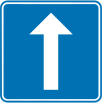 : a blue square sign with a white arrow pointing upwards. It authorises you to enter and indicates the permitted direction. You may use the full width of the carriageway, overtake more freely and there should, in principle, be no oncoming vehicles.
At the other end of that same street, a road user who tries to enter against the flow meets sign C1: no entry  . It is a red disc crossed by a wide horizontal white bar. It means "access prohibited in this direction": entering here would mean driving against the flow of the one-way street.

Access prohibited in both directions (C3  )
)
Not to be confused with no entry: sign C3 is a disc with a red border and an empty centre (white background). It means "access prohibited, in both directions, to all drivers". No vehicle may enter, in either direction. You come across it, for example, at the entrance to a pedestrian zone, a street closed to traffic or a reserved path.
An additional panel placed below the C3 may allow exceptions: "except local traffic", "except cyclists", "except residents". Without such a mention, the prohibition is total for the vehicles concerned.
The cycle street
The cycle street is announced by a specific sign showing a street with a car behind a cyclist. In this street, cyclists may use the full width of the traffic lane (the whole carriageway if it is one-way). Cars and other motor vehicles are allowed but must stay behind the cyclists: overtaking them is prohibited.
In addition, the speed there is limited to a maximum of 30 km/h. The cycle street ends at the end of cycle street sign. It is an increasingly common layout in towns: for the exam, remember above all the ban on overtaking cyclists and the 30 km/h limit.
Mandatory directions (D1)
D1 signs are blue discs with white arrow(s). They impose the direction you must follow: straight ahead, right, left, or a combination. Unlike a danger sign, which merely warns, a mandatory sign obliges you to take the direction shown — failing to follow it is an offence.
- Arrow pointing up: you must go straight ahead.
- Arrow pointing right or left: you must turn in that direction.
- Bent arrow: you must pass the obstacle on the side indicated.
- Two arrows (e.g. straight ahead or right): you must choose one of the directions shown, to the exclusion of all others.
Imposed lane choice and reserved lanes
Before a junction, your choice of lane may be imposed by selection arrows painted on the road surface or by signs suspended above the carriageway. An arrow on the ground pointing straight ahead means that lane continues straight on; an arrow turning left reserves the lane for those turning left. You must move in good time into the lane matching your direction and follow it.
Some lanes are reserved for specific road users. A bus lane (large "BUS" marking on the ground and a wide line) is prohibited to cars, unless an exception is signposted. A cycle path (marked by two broken white lines or sign D7  ) is reserved for cyclists: you may neither drive nor park a car on it. The special crossable site reserved for buses and trams may only be used in the cases provided for.
| Sign | Appearance | Meaning |
|---|---|---|
| F19 | Blue square, white arrow pointing up | Entrance to a one-way road |
| C1 | Red disc crossed by a white bar | No entry (prohibited in this direction) |
| C3 | Disc with a red border, white centre | Access prohibited in both directions |
| D1 | Blue disc, white arrow(s) | Mandatory direction to follow |
| Cycle street | "Car behind cyclist" sign | Overtaking prohibited, 30 km/h max |
Consequences and common traps
- Driving against the flow in a one-way street is a serious and very dangerous offence: you end up facing vehicles that are not expecting you.
- Failing to follow a mandatory direction (D1) or a selection arrow on the ground is a fineable offence, even if the road looks clear.
- A one-way street may be limited ("except cyclists"): a cyclist may then ride up it in the other direction, so stay alert when pulling out.
- Using a bus lane or a cycle path without authorisation is a fault, even briefly.
🧠 Check you've got it
Question 1 / 3
3 exam-style questions on this lesson — instant correction.
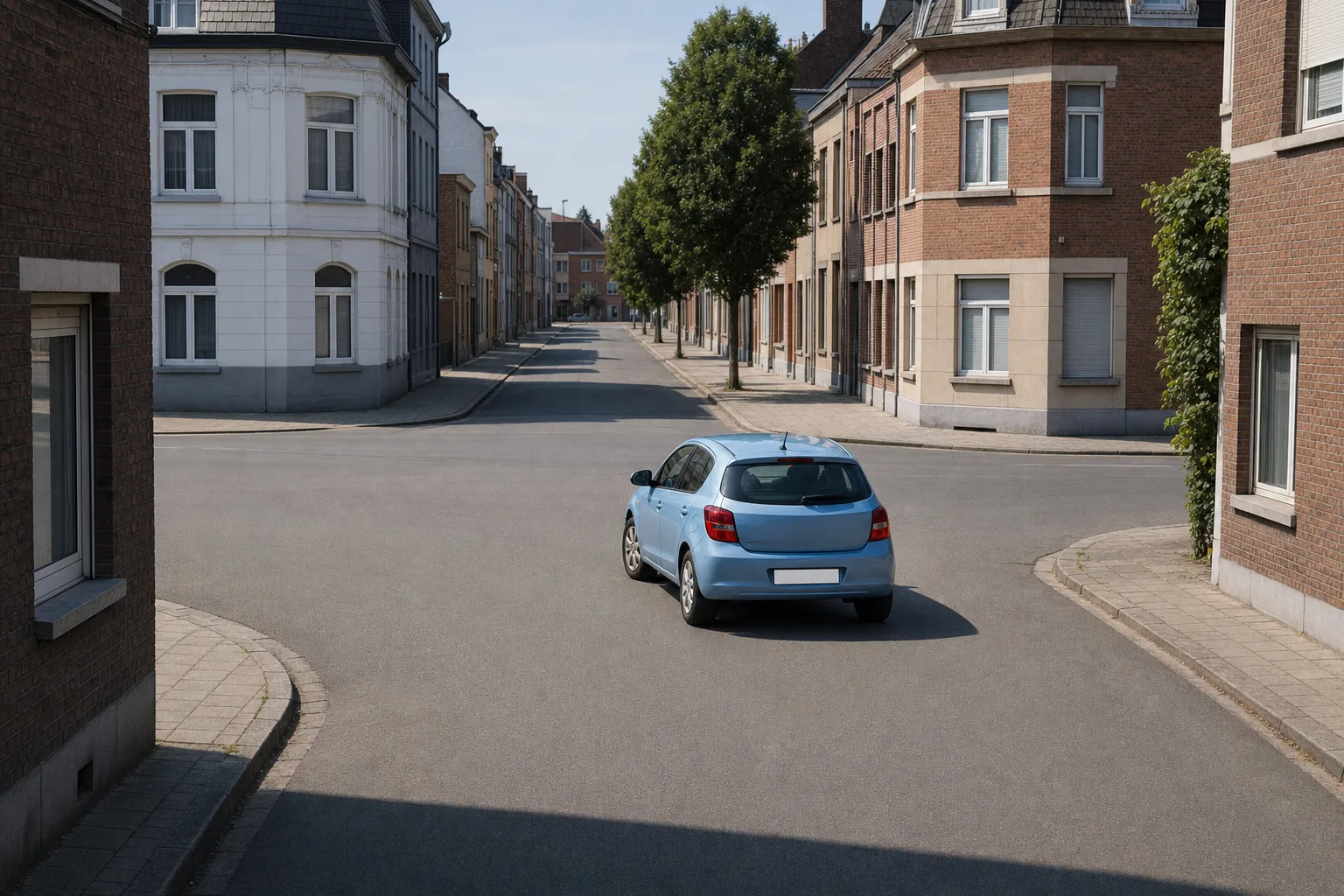
You are turning left at a junction. How do you take this turn?
🔄Practise Manoeuvres and position on the road
Exam-style questions on this theme, with corrections and explanations — plus the full bank with access.
❓ Frequently asked questions
What is the difference between sign C1 and sign C3 ?
C1 is a red disc crossed by a white bar: it prohibits access in this direction only (typically entering a one-way street against the flow). C3 is a disc with a red border and a white centre: it prohibits access in both directions to all drivers.
May I overtake a cyclist in a cycle street?
No. In a cycle street, motor vehicles must stay behind the cyclists and overtaking them is prohibited. The speed there is also limited to 30 km/h.
Am I obliged to follow an arrow painted on the carriageway?
Yes. Selection arrows on the ground impose the choice of lane before a junction. You must move in good time into the lane that matches your direction and follow the arrow, exactly like a mandatory sign.
Can a cyclist come towards me in a one-way street?
Yes, if an additional panel "except cyclists" is placed below the F19 and the C1 . The one-way rule still applies to cars, but cyclists may ride in both directions. So stay vigilant.