The level crossing
Where a road crosses a railway line at the same level, the slightest misstep can be fatal: a train cannot stop within a few metres and always has absolute priority. The level crossing is one of the most dangerous places on the road network. Knowing how to read its signs and adopt the right behaviour is essential for the theory exam and in real life.
📑 In this lesson (6)
What is a level crossing?
A level crossing is the place where a road and a railway line cross at the same height, with no bridge or tunnel to separate them. The danger comes from the train's mass and speed: it can neither brake suddenly nor swerve. It is therefore always up to the road user to give way.
The signs at a level crossing
Several elements announce and protect a level crossing. You must be able to recognise all of them:
- The St Andrew's cross: a white cross with red edges, placed just before the crossing. A single cross (X-shaped) indicates a single track; a double cross indicates several tracks.
- The triangular danger sign: a stylised barrier announces a level crossing with barriers; a locomotive announces a level crossing without barriers.
- The flashing red lights: one or two flashing red lights require an absolute stop. They are almost always accompanied by an audible signal (a bell).
- The barriers or half-barriers: they physically close off the road. Half-barriers block only the right-hand half of the carriageway, in the direction of travel.
- The marker posts (posts with red and white bars): placed before the crossing, they indicate the progressive approach to the crossing.
When must you stop?
You must stop and not cross the level crossing in each of these cases:
- The red lights are flashing.
- The audible signal is sounding.
- The barriers or half-barriers are closed or closing (in motion).
- A train is approaching, even if no signal is working.
Come to a stop before the lights, the barrier or the St Andrew's cross, without encroaching on the rails. Only move off again once the lights are off, the bell has stopped and the barriers are fully raised.
Never enter if you risk getting stuck
This is the golden rule, often tested in the exam: never enter a level crossing unless you are certain you can clear it completely. If traffic is heavy or slow on the other side, wait before the rails. Better to be patient than to end up stranded on the track.
What should you do if you are stuck on the tracks?
If, despite everything, your vehicle remains stranded on the level crossing (breakdown, traffic jam, stalling), react quickly and in this order:
- Leave the vehicle immediately and get all passengers out. Your life comes before the car.
- Take shelter, well away from the tracks, on the side the train would come from, so you are not hit by debris.
- Raise the alarm: call the emergency number shown near the level crossing (often displayed on an Infrabel sign) or 112. Give the number of the level crossing.
- If time and safety allow, try to move the vehicle clear (neutral gear and push) — but only if no train is approaching.
Overtaking is prohibited
It is prohibited to overtake a motor vehicle (other than a two-wheeler without a sidecar) on a level crossing and on its immediate approach. Visibility is reduced there and the slightest unexpected manoeuvre can trap a road user on the rails.
| Situation | What to do? |
|---|---|
| Flashing red lights / bell | Stop before the crossing, wait |
| Barriers closed or in motion | Never cross or go around them |
| Traffic blocked on the other side | Wait before the rails |
| Vehicle stranded on the tracks | Get out, take shelter, raise the alarm |
| On the approach and on the crossing | Overtaking prohibited |
🧠 Check you've got it
Question 1 / 3
3 exam-style questions on this lesson — instant correction.
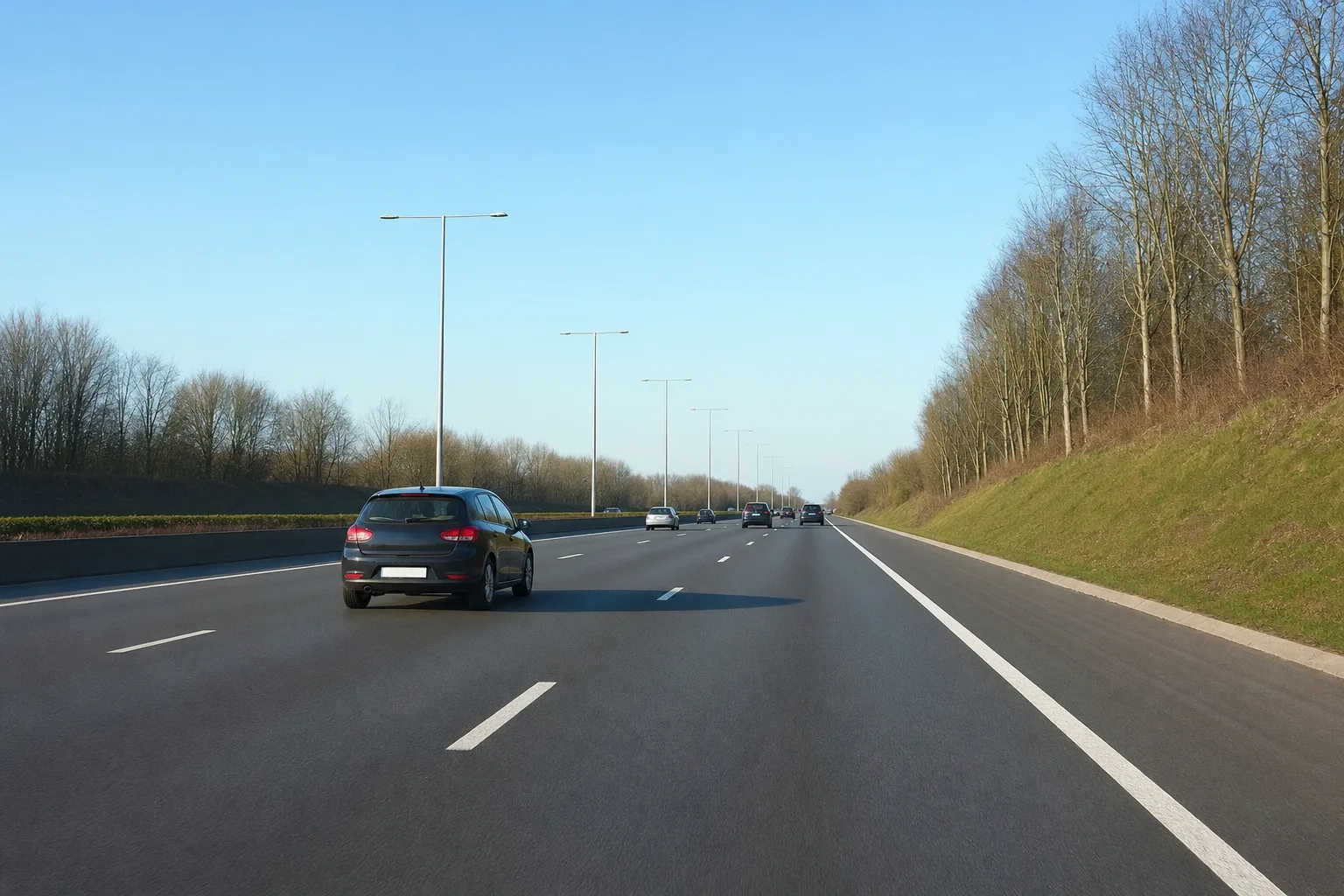
If the carriageway of a motorway has at least three traffic lanes, drivers are free to choose which lane they drive in.
🛣️Practise Special situations (motorway, tunnels, difficult conditions, eco-driving)
Exam-style questions on this theme, with corrections and explanations — plus the full bank with access.
❓ Frequently asked questions
What does the St Andrew's cross at a level crossing mean?
It is the sign that marks the exact location of the level crossing. The single cross (X-shaped) indicates a single track; the double cross indicates several tracks. It is in front of this sign that you must stop if necessary.
Can I cross if the lights are still flashing but no train is visible?
No. As long as the red lights are flashing or the bell is sounding, crossing is prohibited, even if you cannot see a train. A train can arrive very quickly or run in either direction. Wait until the signals have gone off completely.
My vehicle is stuck on the tracks: what should I do first?
Leave the vehicle immediately with all passengers and take shelter, well away from the rails. Then call the emergency number displayed near the level crossing or 112. Only try to move the car clear if there is no danger and no train approaching.
Is overtaking allowed on the approach to a level crossing?
No. Overtaking a motor vehicle on a level crossing and on its immediate approach is prohibited. Only two-wheelers without a sidecar may possibly be overtaken. Stay in line and keep your distance.