⏱️ 2 min read
Danger signs
A red-bordered triangle at the side of the road: that's a danger sign. It doesn't forbid anything and doesn't require any specific action, but it warns you of a risk ahead. Reading them at a glance and reacting correctly is one of the basics of the theory exam.



📑 In this lesson (5)
What are danger signs for?
Danger signs announce a place or situation that calls for extra vigilance. They don't require a specific manoeuvre, but they do oblige you to adapt your driving: ease off the accelerator, watch the sides, be ready to brake.
How do you recognise them?
A danger sign is instantly recognisable by its shape: an equilateral triangle pointing upwards, white background, red border, black symbol — like this one: .
Where are they placed?
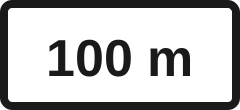
Outside built-up areas, the sign is generally placed about 150 metres before the danger. In built-up areas, it is placed closer. An additional panel may specify the exact distance (e.g. "100 m") or the extent of the risk zone.
The main danger signs
- Dangerous bend or series of bends.
- Dip or hump (speed bump).
- Slippery carriageway.
- Carriageway narrows.
- Dangerous descent.
- Pedestrian crossing.
- Place frequented by children (often near schools).
- Cyclists or animals crossing.
- Roadworks.
- Traffic lights ahead.
- Level crossing, with or without barriers.
- Other danger: a triangle with an exclamation mark, specified by an additional panel.
How should you react?
- Reduce your speed according to the danger announced.
- Sharpen your observation, especially to the sides.
- Increase your safety distance.
- Be ready to stop if necessary.
| Shape | Family | Role |
|---|---|---|
| Triangle, red border | Danger | Warn |
| Circle, red border | Prohibition | Prohibit |
| Circle, blue background | Obligation | Require |
| Blue square or rectangle | Indication | Inform |
🧠 Check you've got it
Question 1 / 3
3 exam-style questions on this lesson — instant correction.
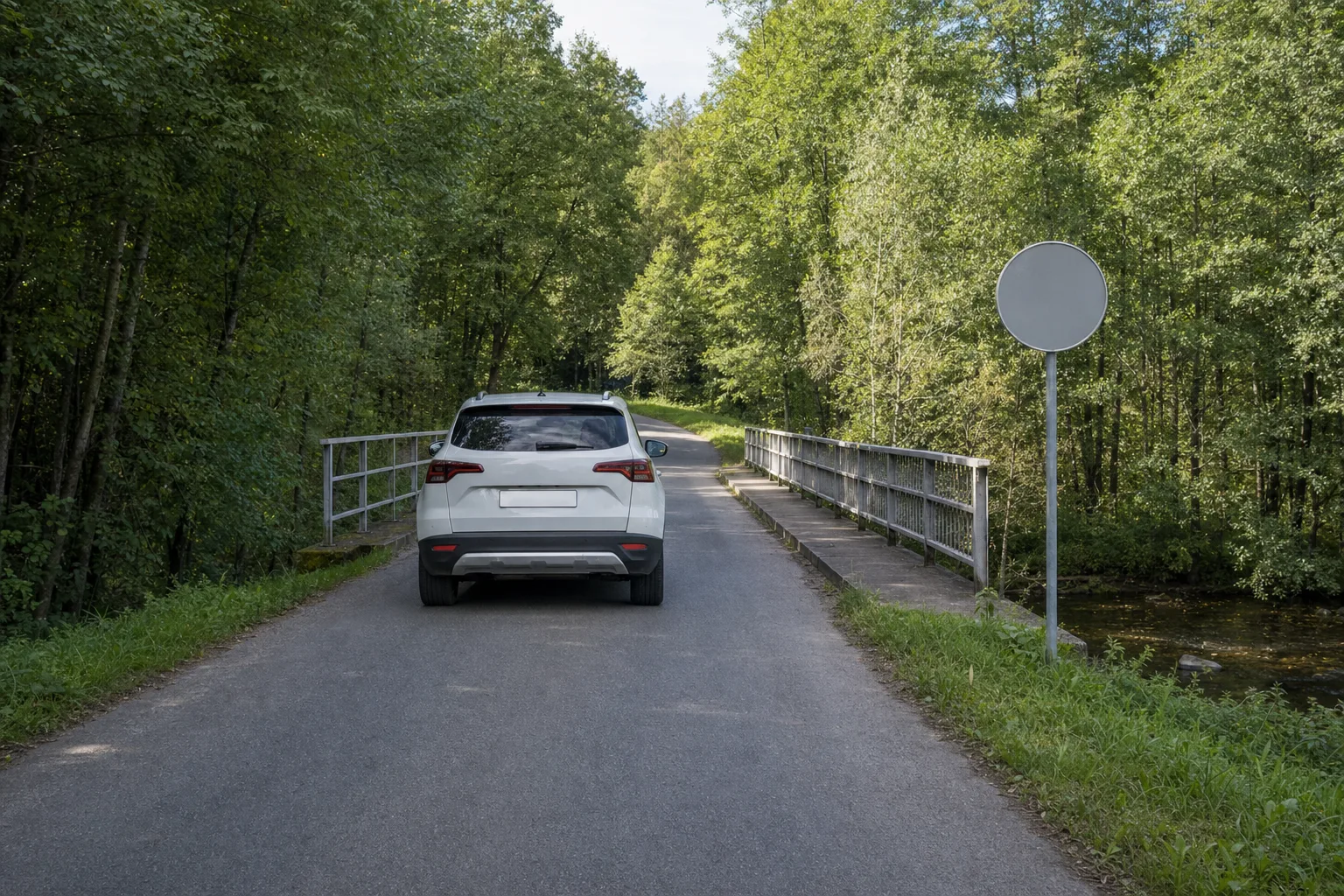

The laden mass of this car is 1450 kg. Its maximum authorised mass (MAM) is 1700 kg. May the driver cross this bridge?
🚦Practise Signs, road markings and traffic lights
Exam-style questions on this theme, with corrections and explanations — plus the full bank with access.
❓ Frequently asked questions
What shape is a danger sign in Belgium?
An equilateral triangle pointing upwards, with a white background, red border and black symbol.
How far before the danger is the sign placed?
Outside built-up areas, about 150 metres before. In built-up areas, closer. An additional panel may indicate the exact distance.
Does a danger sign oblige me to slow down to a specific speed?
No. It does not impose a numbered speed, but you must adapt your pace to the danger. A speed limit, on the other hand, is a different sign (a circle with a red border).
What does the triangle with an exclamation mark mean?
It is the "other danger" sign. An additional panel placed below it specifies the exact nature of the danger.