⏱️ 5 min read
When overtaking is prohibited
Overtaking is one of the riskiest manoeuvres: for a few seconds you occupy the lane reserved for oncoming traffic. For that reason, the Belgian highway code prohibits it in a series of specific situations. Knowing them by heart avoids both a head-on collision and an eliminatory fault at the theory exam.
📑 In this lesson (6)
Overtaking means risking the opposite lane
Overtaking a vehicle on the left means, on a two-way road, encroaching on the lane of oncoming road users. The basic rule is simple: you only overtake if you have sufficient visibility and space to complete the manoeuvre without obstructing or endangering anyone. As soon as that condition is no longer guaranteed, overtaking becomes prohibited.

Prohibitions linked to road markings
The centre marking of the carriageway largely determines the right to overtake. A solid white line must not be crossed or straddled: as long as it is on your left, you cannot move out to overtake. Where a solid line runs alongside a broken line, it is the line closest to you that counts.
- Solid white line on your left: overtaking prohibited (you cannot cross it).
- Broken line: crossing is allowed if the manoeuvre is safe.
- Solid + broken line side by side: only the line on your side counts.
Places where visibility is lacking
Even without markings, overtaking is prohibited wherever you cannot see far enough. Two situations are systematically covered by the Belgian highway code:
- At the brow of a hill and in a blind bend: the hidden stretch of road may conceal an oncoming vehicle.
- Unless the overtaking takes place on a carriageway with two or more lanes in your direction of travel, where no encroachment on the opposite lane is needed.
Near crossings and junctions
Several prohibitions protect the most exposed road users and conflict zones. You cannot overtake:
- On the approach to a pedestrian crossing: the manoeuvre would hide a pedestrian about to cross.
- On the approach to a junction where you do not have priority: you must first be able to give way.
- On and near a level crossing: the railway area must remain clear.
Sign C35  and difficult conditions
The prohibition can also be imposed by a sign. Sign C35 (round, red border, two cars with a red one on the left) prohibits overtaking any motor vehicle with more than two wheels. This prohibition applies until the end-of-prohibition sign C37  or until the next junction. Sign C39
  , for its part, specifically targets lorries.
Finally, in conditions of reduced visibility — fog, heavy rain, snowfall, smoke — where you cannot see clearly for about 200 m, overtaking a motor vehicle is prohibited. In those conditions, caution outweighs saving a few minutes.
| Situation | Overtaking |
|---|---|
| Solid white line on the left | Prohibited |
| Brow of a hill / blind bend | Prohibited (unless 2 lanes in your direction) |
| Approach to a pedestrian crossing | Prohibited |
| Vehicle stopped for pedestrians | Prohibited |
| Junction without priority / level crossing | Prohibited |
| Sign C35 present | Prohibited (motor vehicles > 2 wheels) |
| Reduced visibility (< ~200 m) | Prohibited |
Double overtaking and level crossings
Two complementary prohibitions deserve particular attention. The first concerns double overtaking: it is prohibited to overtake a vehicle that is itself in the process of overtaking another. Pulling out past two vehicles already side by side would force you to occupy the opposite lane for a long time, with no visibility and no room to move back in. The second concerns unguarded level crossings: near them, overtaking is prohibited, because no barrier and no light signals an approaching train.
- Double overtaking prohibited: never overtake a vehicle that is already engaged in overtaking another vehicle.
- Unguarded level crossing: overtaking is prohibited near it, except for a two-wheeled vehicle.
🧠 Check you've got it
Question 1 / 3
3 exam-style questions on this lesson — instant correction.
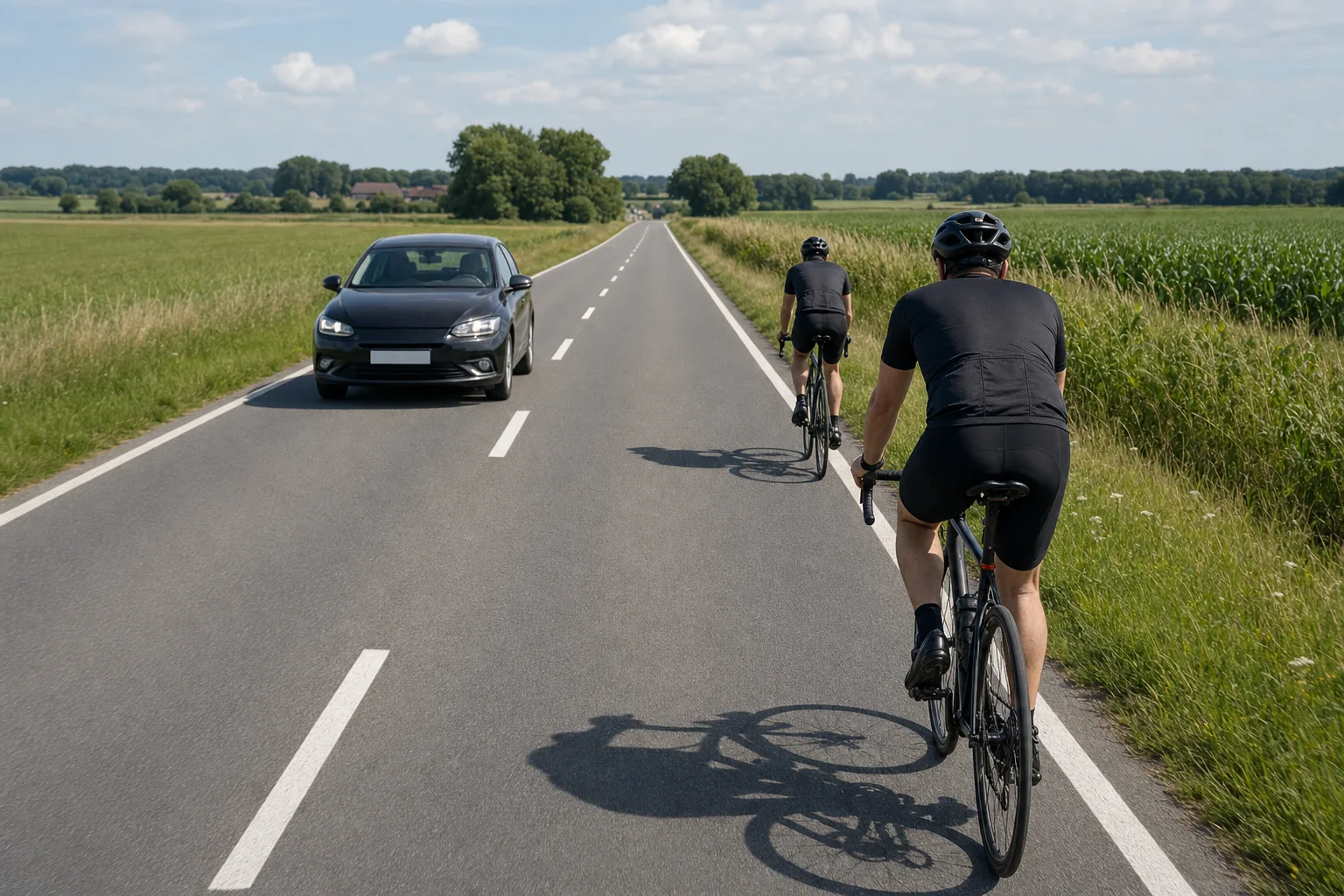
In which case must you keep a lateral distance of at least 1.5 metres when you overtake a cyclist?
🚙Practise Overtaking and passing
Exam-style questions on this theme, with corrections and explanations — plus the full bank with access.
❓ Frequently asked questions
Can I overtake a cyclist under sign C35 ?
Yes. Sign C35 only prohibits overtaking motor vehicles with more than two wheels. Overtaking a cyclist, a moped or a motorcycle remains allowed, provided you respect the lateral distance and safety.
Why is it prohibited to overtake a vehicle stopped at a pedestrian crossing?
Because that vehicle has often stopped to let someone cross whom you cannot see. By overtaking it, you risk knocking down the hidden pedestrian. It is one of the most dangerous situations in traffic.
Is overtaking prohibited at the brow of every hill?
It is prohibited at the brow of a hill whenever visibility there is insufficient, unless the carriageway has at least two lanes in your direction of travel. On a road with a single lane per direction, treat the brow of a hill as a no-overtaking zone.
Can I overtake in fog?
No. When visibility is reduced to the point that you can no longer see clearly for about 200 m (fog, heavy rain, snow, smoke), overtaking a motor vehicle is prohibited.