Eco-driving
Driving "clean" does not mean driving slowly: it means driving intelligently. Eco-driving reduces your fuel consumption, your CO2 emissions and the wear on your vehicle, while making driving safer and calmer. The Belgian theory exam expects a few simple reflexes from you: smooth driving, an engine that is not overworked and a well-maintained vehicle.
📑 In this lesson (6)
What is eco-driving?

Eco-driving is a way of driving that aims to use less fuel and to reduce pollution. It relies on anticipation and smoothness: you avoid jerky driving, read the traffic far ahead and let the vehicle coast on its momentum as often as possible. Good news: economical driving is almost always safer driving too, because it is calmer and more predictable.
Smooth, anticipatory driving
The biggest gain comes from your way of driving. Look far ahead to anticipate traffic lights, slowdowns and stops. By easing off the accelerator in time, you let the vehicle decelerate on its momentum rather than braking hard and then having to accelerate again. Every application of the brakes "wastes" the energy you have just used to accelerate.
- Accelerate progressively, without unnecessary bursts of throttle when pulling away.
- Avoid harsh braking: decelerate by releasing the accelerator as early as possible.
- Keep a steady speed and maintain a good safe following distance so you are not braking constantly.
- Drive at an appropriate speed: fuel consumption climbs sharply at high speeds.
Change up early, keep the engine speed low
An engine that revs too high uses far more fuel. The key reflex is therefore to change up to the higher gear quickly and to drive at a low engine speed. Conversely, staying in a low gear for a long time with the engine screaming wastes fuel for nothing.
- Change up to the higher gear as soon as possible, without straining the engine.
- Drive in the highest gear compatible with your speed and with safety.
- Downhill, engine braking (gear engaged, foot off the accelerator) slows you down without using fuel.
- Avoid letting the engine rev high before changing gear.
Switch off the engine during a prolonged stop
An engine idling while stationary uses fuel and pollutes without moving you forward. During a prolonged stop — a closed level crossing, standstill traffic, waiting at roadworks — switch off the engine. Many recent vehicles do this automatically thanks to the start-stop system.
A well-maintained vehicle uses less fuel
Eco-driving also depends on the condition of the vehicle. The most important everyday point is tyre pressure: under-inflated tyres increase rolling resistance, and therefore fuel consumption, wear and braking distance. Check the pressure regularly, when the tyres are cold, using the values specified by the manufacturer.
- Keep the tyre pressure correct: it is good for fuel consumption and for safety.
- Remove unnecessary loads: a needlessly weighed-down boot pushes up fuel consumption.
- Take off unused accessories: an empty roof rack, roof box or bicycle carrier greatly increases air resistance.
- Use the air conditioning in moderation: when worked hard, it increases fuel consumption.
Pollution, CO2 and low-emission zones (LEZ)
Burning fuel releases CO2 (a greenhouse gas) and pollutants harmful to health (fine particles, nitrogen oxides). To improve air quality, several Belgian cities have introduced low-emission zones (LEZ, Low Emission Zone), for example in Brussels, Antwerp and Ghent. The most polluting vehicles are restricted or banned there depending on their Euro standard and their fuel type.
- An LEZ is indicated by specific signs marking its entrance and exit.
- Access depends on the vehicle's Euro standard, which becomes stricter over the years.
- Driving in an LEZ with a non-authorised vehicle exposes you to a fine.
| Action | Effect |
|---|---|
| Anticipate, drive smoothly | Less braking and re-accelerating |
| Change up early | Low engine speed, less fuel |
| Switch off the engine during a prolonged stop | Zero unnecessary fuel use and zero unnecessary pollution |
| Properly inflated tyres | Less resistance, safer braking |
| Remove unnecessary loads and accessories | Less weight and less air resistance |
🧠 Check you've got it
Question 1 / 3
3 exam-style questions on this lesson — instant correction.
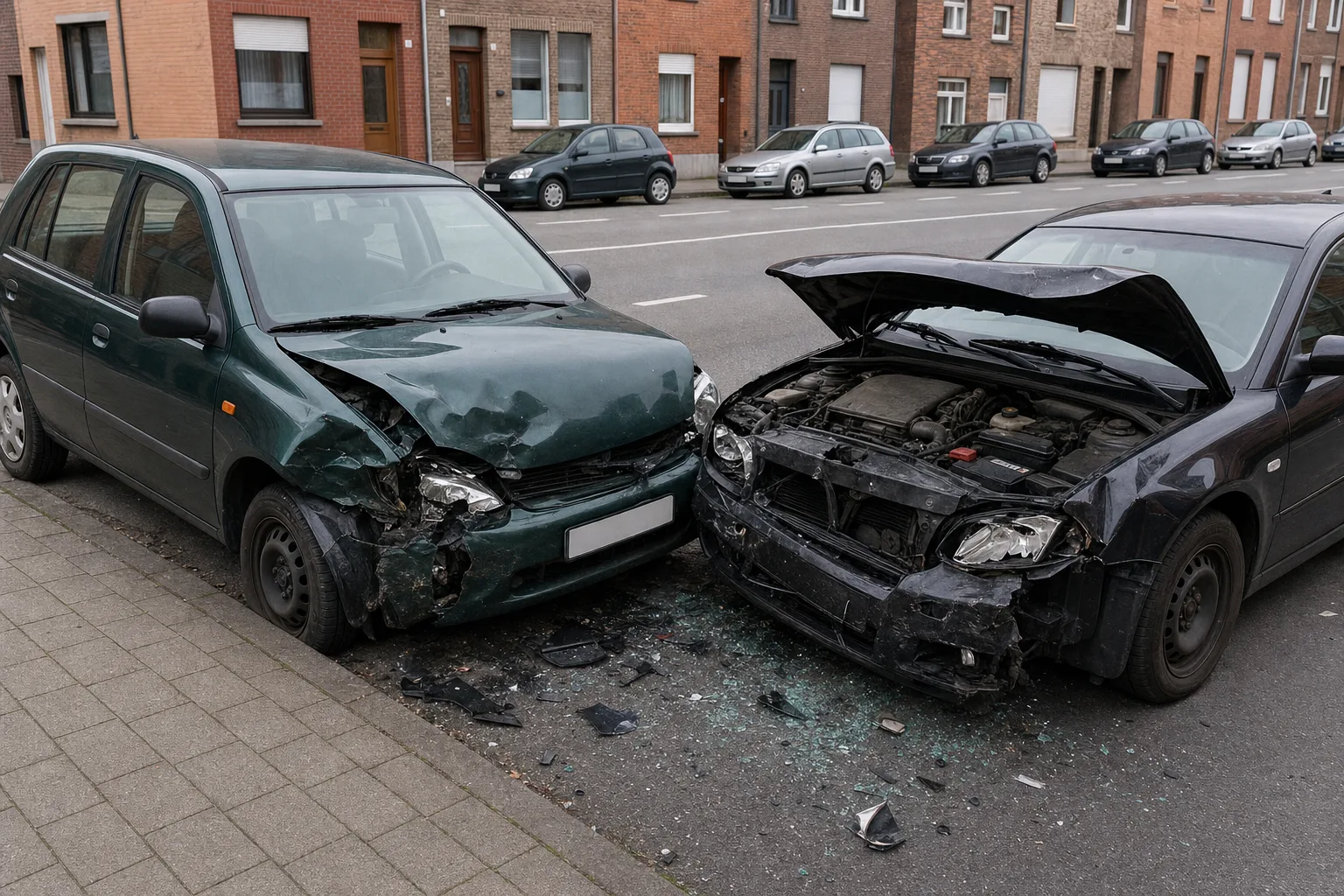
An accident with injuries has just occurred. What is your first action?
🛣️Practise Special situations (motorway, tunnels, difficult conditions, eco-driving)
Exam-style questions on this theme, with corrections and explanations — plus the full bank with access.
❓ Frequently asked questions
Is eco-driving just driving slowly?
No. It means driving smoothly and with anticipation: progressive acceleration, steady speed, early gear changes and an engine that is not overworked. You keep up with the flow of traffic, but without unnecessary jerky driving.
Do you really have to switch off the engine in traffic jams?
Yes, during a prolonged stop (a standstill queue, a closed level crossing). An engine idling while stationary uses fuel and pollutes needlessly. Many recent vehicles do it automatically with the start-stop system.
Do under-inflated tyres really affect fuel consumption?
Yes. Under-inflated tyres increase rolling resistance, and therefore fuel consumption and wear, and lengthen the braking distance. Check the pressure regularly, when the tyres are cold, using the manufacturer's values.
What is a low-emission zone (LEZ)?
It is an urban zone where the most polluting vehicles are restricted or banned depending on their Euro standard and their fuel type, in order to improve air quality. Several Belgian cities have one. Check that your vehicle is allowed in before entering.