⏱️ 5 min read
Road markings
Markings painted on the carriageway are signage in their own right, on the same footing as signs. They organise the lanes, determine who must give way and show where you may or may not drive and park. In Belgium, they are white, except for yellow, which is reserved for parking and temporary markings. Knowing how to read them saves you plenty of faults on the exam and on the road.
📑 In this lesson (7)
Signage in its own right
Road markings carry the same binding force as signs. They are normally white. Yellow is used for parking marks and for temporary roadworks markings, which then take precedence over the white marks. A line can separate lanes, mark the edge of the carriageway or organise a junction.
Longitudinal lines between lanes
Lines painted in the direction of traffic organise how the carriageway is shared. Three cases come up again and again in the exam:
- Continuous white line: you are forbidden to cross or straddle it. So you may neither overtake nor drift into the neighbouring lane for as long as it is painted.
- Broken white line (dashes): it may be crossed, for example to overtake or change lane, provided the manoeuvre is safe and otherwise permitted.
- Mixed line: a continuous line alongside a broken one. You follow the line closest to you: if the broken line is on your side, you may cross; if it is the continuous one, crossing is forbidden.

Markings that require you to give way
Two transverse marks, painted across the carriageway at a junction, show where and how you must give way:
- Stop line: a wide continuous white line painted across the lane. Combined with the STOP sign (B5)
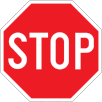 , it marks the spot where you must come to a complete stop before giving way.
 - Give-way line: a row of white triangles (often called "shark's teeth"), points facing you. Combined with sign B1
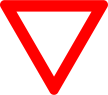 , it shows where to give way without being required to stop if the road is clear.
Pedestrian and cyclist crossings
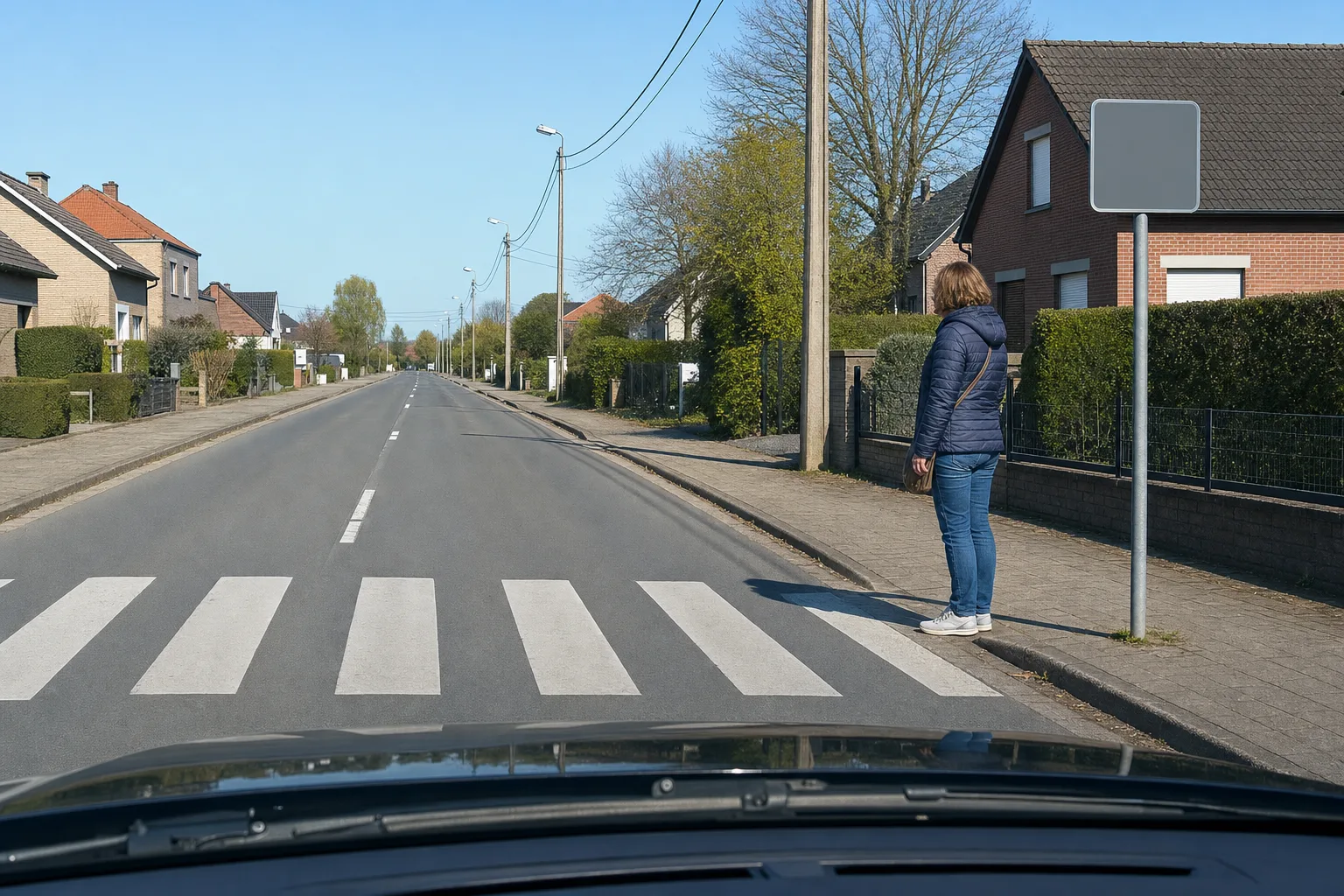
- Pedestrian crossing: wide white stripes parallel to the axis of the road. You must let pedestrians cross when they are on it or about to step onto it, and never stop or park on it.
- Cyclist crossing: two lines of white squares or diamonds (chequered pattern). Watch out for cyclists and moped riders crossing it.
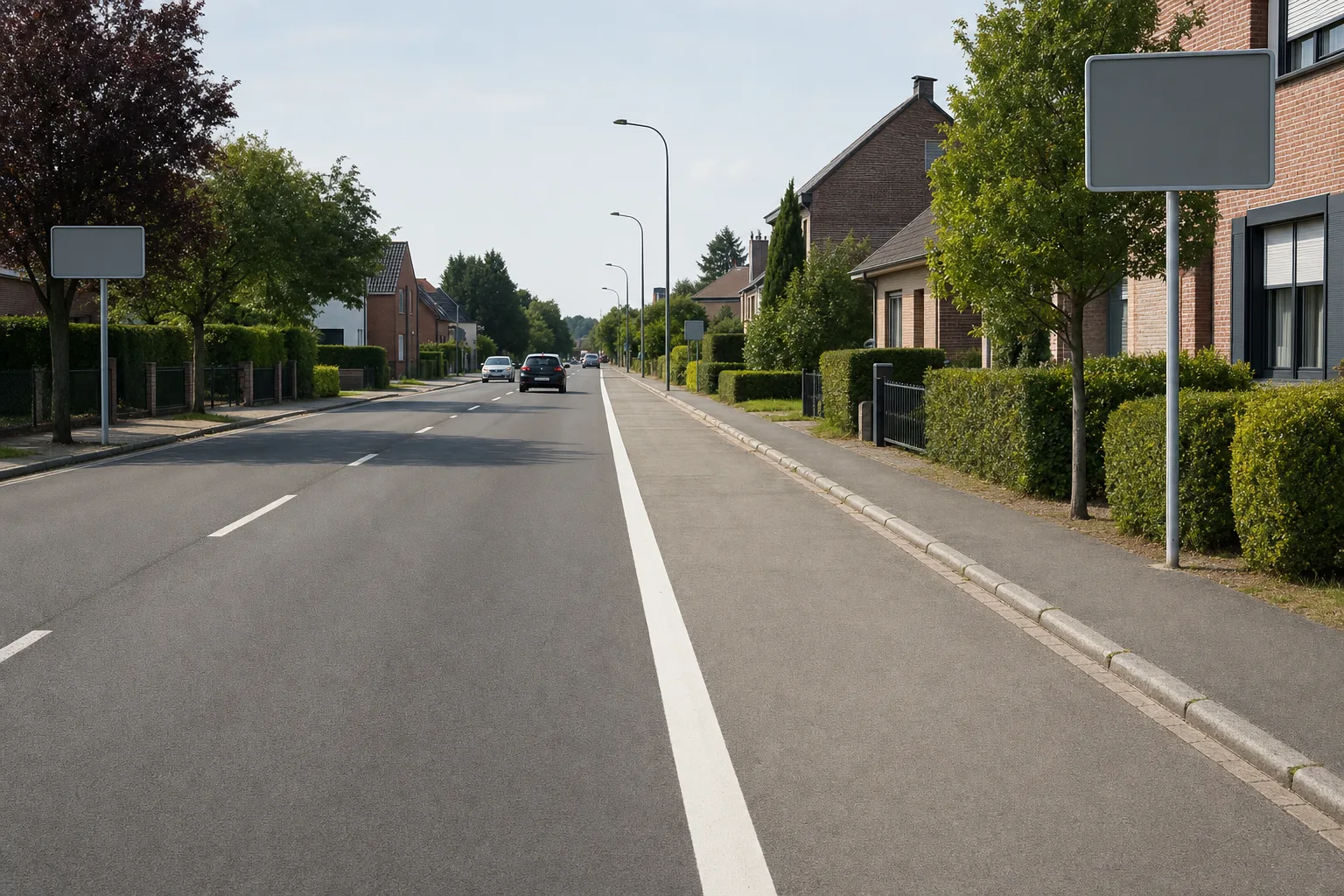
- Marked cycle path: bounded by two parallel broken white lines. It is reserved for cyclists and class A moped riders; as a rule, you may neither drive nor park on it.
Lane-selection arrows
On the approach to a junction, white arrows painted on the carriageway show the direction you must follow from each lane: straight ahead, left, right, or several directions combined. Once you have entered a pre-selection lane, you are required to follow the indicated direction. A merge arrow, drawn at an angle, tells you to move into the neighbouring lane in good time because yours is ending.
Parking markings
- Parking bays: white lines mark out the spaces where you may leave your vehicle. You must park inside the painted bays.
- Broken yellow line along the edge of the carriageway (on the kerb or on the ground): parking is forbidden along the entire length of the mark.
- Continuous yellow line at the edge of the carriageway: both stopping and parking are forbidden there.
Bus lanes and reserved lanes
A lane marked with the word "BUS" on the ground and bordered by continuous white lines is a bus lane reserved for public transport vehicles (and, depending on the signage, for taxis, priority vehicles or cyclists). As the driver of a car, you may neither drive nor park on it. The word written on the ground also tells you exactly what kind of reserved lane it is.
| Marking | Meaning |
|---|---|
| Continuous white line | Forbidden to cross or straddle |
| Broken white line | May be crossed if the manoeuvre is safe |
| Mixed line | Follow the line closest to you |
| Wide solid line across the lane (STOP) | Complete stop compulsory |
| Triangles (shark's teeth) | Give way |
| Broken yellow line | Parking forbidden |
| Continuous yellow line | Stopping and parking forbidden |
| "BUS" lane | Reserved: cars forbidden |
🧠 Check you've got it
Question 1 / 3
3 exam-style questions on this lesson — instant correction.

This sign (C1) is placed at the entrance of the street you wanted to take. What is the correct action?
🚦Practise Signs, road markings and traffic lights
Exam-style questions on this theme, with corrections and explanations — plus the full bank with access.
❓ Frequently asked questions
May I drive over a continuous white line to get around an obstacle?
In principle no: a continuous line may be neither crossed nor straddled. You may only cross it in very limited cases, for example to pass a fixed obstacle when there is not enough room and no vehicle is coming the other way, and always without danger.
What is the difference between a stop line and a give-way line?
The stop line is a wide solid strip across the lane: with a STOP sign, you must come to a complete stop. The give-way line is made of triangles (shark's teeth): you give way but you are not required to stop if the road is clear.
What does a yellow line along the kerb mean?
A broken yellow line forbids parking along its entire length. A continuous yellow line is stricter: it forbids both stopping and parking.
What should I do if yellow roadworks markings contradict the white lines?
Temporary yellow roadworks markings take precedence over the usual white marks. You must follow the yellow layout, even if it crosses or covers the white lines.