⏱️ 4 min read
Give way and stop
Two signs govern the loss of priority at a junction: the B1 "give way" 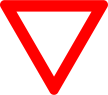 (inverted triangle) and the B5 "stop"
  (red octagon). They are similar in spirit but require different behaviour. Mixing the two up, or forgetting to come to a complete stop at a stop sign, is one of the most heavily penalised mistakes in the theory exam. Here is how to tell them apart once and for all.
📑 In this lesson (6)
Two signs, one shared goal: give way
The B1 and B5 signs both indicate that you do not have priority at the intersection: you must let drivers on the road you are joining pass first. Priority from the right no longer applies in your favour. The big difference lies in how you approach the junction: must you, or must you not, come to a complete stop?

The B1 sign: give way
The B1 is a downward-pointing triangle, white with a red border. It means: "give way". As you approach it, you must slow down and be ready to stop, but stopping is only compulsory if necessary. If the road you are crossing is completely clear, you may proceed without coming to a standstill, provided you do not impede any road user with priority.
The B5 sign: stop
The B5 is an octagon (eight sides) with a red background bearing the word "STOP" in white. Its unique shape makes it recognisable even from behind or in poor visibility. It imposes two cumulative obligations: come to a complete stop, then give way to drivers on the road you are joining. The complete stop is compulsory even if the road is entirely clear: your wheels must genuinely come to a standstill — merely slowing down is not enough.
Where to stop? The stop line
The stopping point is marked on the road surface. At a stop sign, it is a continuous white transverse line (the "stop line"): you bring the front of your vehicle to a halt just before it. At a give way sign, the road carries a transverse line made of white triangles ("shark's teeth") or a broken line, marking the point where you must give way.
If no line is marked, or if it has worn away, you stop at the point giving you the best view of the priority road, without pulling out onto it. If needed, after the first stop at the line, you may edge forward carefully to see better, then give way again.
| Criterion | B1 — Give way | B5 — Stop |
|---|---|---|
| Shape | Downward-pointing triangle | Red octagon marked "STOP" |
| Complete stop | Only if necessary | Always compulsory |
| Road clear | You may pass without stopping | You stop anyway, then move off |
| Road marking | White triangles (shark's teeth) | Continuous white stop line |
| Shared obligation | Give way | Give way |
The common traps in the exam
- Believing that at a stop sign you can "crawl through" without coming to a standstill: false. The stop must be complete, with the vehicle genuinely stationary.
- Thinking that giving way always means stopping: at a B1 , stopping is only required if a road user with priority is coming.
- Forgetting that "give way" applies to all road users with priority: cars, motorcycles, but also cyclists and pedestrians already crossing.
- Confusing the stop line (continuous, for the stop sign) with the shark's teeth (triangles, for the give way sign).
- Moving off too soon after the stop, without having properly checked that the road is clear in both directions.
And after giving way?
Once you have given priority and the road is genuinely clear, you pull out without delay so as not to block the junction. Giving way means not forcing drivers with priority to change their speed or course abruptly. If your presence forces them to brake or swerve, you have not given way properly: that too is a fault, in the exam and on the road.
🧠 Check you've got it
Question 1 / 3
3 exam-style questions on this lesson — instant correction.
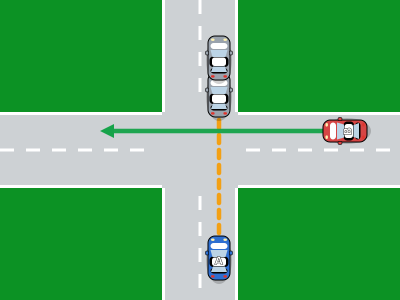
You want to cross straight over an unsignalized crossroads (blue car A), but just beyond it traffic is at a standstill (queue). A red car (B) is using the cross road. What do you do?
🔀Practise Right of way and intersections
Exam-style questions on this theme, with corrections and explanations — plus the full bank with access.
❓ Frequently asked questions
What is the difference between give way and stop?
Both require you to give way. But at a stop (B5) , a complete stop is compulsory, even if the road is clear. At a give way (B1) , you only have to slow down and stop if a road user with priority is approaching.
Do I have to stop at a stop sign if I can see no one is coming?
Yes, always. At a stop sign, a complete stop is compulsory in every case, even when the road is perfectly clear. Your wheels must genuinely come to a standstill before the stop line.
Where exactly do I have to stop at a stop sign?
Just before the continuous white stop line marked on the road. If it is missing or worn away, you stop at the point giving you the best view of the priority road, without pulling out onto it.
Is the road marking the same for both signs?
No. The stop sign goes with a continuous white transverse line. The give way sign goes with a line of white triangles, known as "shark's teeth". The shape of the marking lets you tell them apart.