⏱️ 6 min read
Information signs
A square or rectangular sign with a blue background: that's an information sign. Its primary mission is to inform you about the road you are travelling on or about a nearby service. But be careful: some of them, like the entrance to a 30 zone or a residential area, also impose rules that you must follow until the end of the zone. Knowing how to tell them apart is a classic theory exam question.

📑 In this lesson (8)
What are information signs for?
Information signs give you useful information: the type of road, the start or end of a zone, the presence of a car park, a dead end or a reserved lane. Most of them simply inform, without prohibiting or imposing anything. However, some of them announce the entrance to a zone subject to special rules: as long as you are driving in it, those rules apply.
How do you recognise them?
An information sign is most often square or rectangular and has a blue background with a white pictogram or text. This shape and colour immediately set it apart from the three other main families: the red triangle (danger), the circle with a red border (prohibition) and the blue circle (obligation).
Start and end of a built-up area
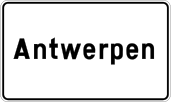
The F1 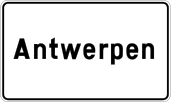 sign (name of the locality on a light background) marks the start of a built-up area. The F3
 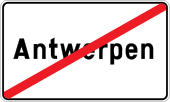 , on which the name is crossed out with a red line, marks its end. These signs are not just decorative: between the two, the speed limit is 50 km/h by default, and many rules specific to built-up areas apply (for example the obligation to let a bus leaving its stop merge back into traffic).
Zone signs
Some information signs open a zone where special rules remain in force until a corresponding end sign (the same symbol crossed out). The three zones you absolutely must know:
- 30 zone: the speed limit is 30 km/h throughout the zone, often around schools or in residential neighbourhoods.
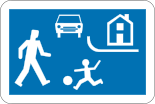
- Residential area (sign showing a house, pedestrians and a child playing): the speed limit is 20 km/h, pedestrians and games are allowed across the full width of the road and drivers must give way to them.
- Meeting zone: same principle as the residential area (priority for pedestrians, 20 km/h), but intended for areas with many shops and activities.
Type of road: motorway and road reserved for motor vehicles
Other information signs specify the type of road you are entering, which changes the rules that apply:
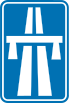
- Motorway (sign F5
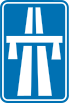 , symbol of a bridge on a blue background): from this sign onwards the motorway rules apply — minimum speed, ban on pedestrians, cyclists and slow vehicles, U-turns and reversing prohibited.
 - Road reserved for motor vehicles: reserved for motor vehicles, it also excludes pedestrians, cyclists and slow machines, but its rules differ slightly from the motorway.
- A corresponding end sign (crossed-out symbol) indicates that you are leaving the motorway or the road reserved for motor vehicles, and that the ordinary rules resume.
Parking, dead ends and reserved lanes
- Parking (E9)
 : the white letter P on a blue background indicates a place where parking is allowed. An additional panel may limit the duration or reserve the spaces for certain categories.
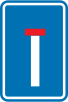
 - Dead end: this blue sign indicates a road with no through way. You enter it knowing you will have to turn back; it informs you, without prohibiting anything.
- Bus lane: a sign (often accompanied by the BUS marking on the road) indicates a lane where only buses — and sometimes taxis or bicycles depending on the wording — are allowed.
- Pedestrian crossing: a square blue information sign showing a pedestrian on a crossing marks the location of a crossing. Not to be confused with the danger triangle, which announces the approach of a crossing further on.
Informing or imposing: the distinction to remember
This is the whole point of this family: a blue sign informs by default, but when it opens a zone or defines a type of road, it triggers a set of rules. The table below sums up the difference.
| Sign | What it does |
|---|---|
| Start of built-up area (F1) | Imposes 50 km/h until the F3 |
| 30 zone | Imposes 30 km/h throughout the zone |
| Residential area / meeting zone | Imposes 20 km/h, priority for pedestrians |
| Motorway (F5) | Triggers the motorway rules |
| Parking (E9) | Informs: parking allowed |
| Dead end | Informs: no through road |
Pedestrian zone and cycle street
Two recent zone signs complete the family of information signs. Like 30 zones or residential areas, they are opened by an entrance sign and remain in force until the corresponding end sign (the same symbol crossed out).
- Pedestrian zone (signs F103 at the entrance and F105 at the exit): vehicle traffic is prohibited in principle. Only a few road users are admitted under strict conditions (deliveries at certain times, residents, cyclists when an additional panel allows it), and always at walking pace, giving priority to pedestrians.
- Cycle street (signs F111 at the entrance and F113 at the exit): cars are allowed, but the cyclist has priority and may occupy the full width of the lane (half of the carriageway on a two-way road). A motor vehicle may never overtake a cyclist there and the speed limit is 30 km/h.
🧠 Check you've got it
Question 1 / 3
3 exam-style questions on this lesson — instant correction.

This round blue sign with a white arrow. What does it require of you?
🚦Practise Signs, road markings and traffic lights
Exam-style questions on this theme, with corrections and explanations — plus the full bank with access.
❓ Frequently asked questions
What are the shape and colour of an information sign?
It is generally square or rectangular, with a blue background and a white pictogram or text. This shape distinguishes it from the triangle (danger) and the circles (prohibition and obligation).
Can an information sign impose a rule on me?
Yes. Most simply inform, but those that open a zone (30 zone, residential area) or define a type of road (motorway, built-up area) impose rules that remain in force until the corresponding end sign.
How far does the limit of a 30 zone remain in force?
Until the end-of-30-zone sign (the same symbol crossed out). A junction or intersection does not cancel the zone: as long as you have not seen the end sign, the 30 km/h limit applies.
What is the difference between the blue pedestrian crossing sign and the red triangle one?
The square blue sign is an information sign: it marks the exact location of the crossing. The triangle with a red border is a danger sign: it announces that a pedestrian crossing lies further ahead and that you must be extra vigilant.