⏱️ 5 min read
Priority signs
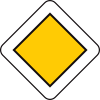
At a junction, who goes first? When a priority sign is present, it decides — no longer just priority from the right. Downward-pointing triangle, red octagon, yellow diamond: each shape has a precise meaning. Being able to read them at a glance avoids serious faults in the exam and collisions on the road.



📑 In this lesson (5)
What are priority signs for?
Priority signs set the order of passage where simple priority from the right is not enough or does not apply. Some require you to give way, or even to stop; others grant you priority along an entire road. As soon as one of these signs is present, it takes precedence over the general rule at the junction.
The signs that make you give way
B1 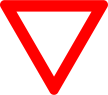 — Give way
The B1 is an equilateral triangle with a red border, white background, point facing down. Its inverted shape makes it unique: no other Belgian sign points downwards. It means you must give way to drivers travelling on the road you are joining. You are not required to come to a complete stop: if the way is clear, you may proceed without stopping.
B5  — Stop
The B5 is a red octagon (eight sides) bearing the word STOP in white. It imposes two cumulative obligations: come to a complete stop (wheels fully stationary) at the stop line or, failing that, at the point from which you can see the crossing road, then give way to all drivers on that road. Slowing down is not enough: the stop must be real, even if the way seems clear.
The signs that give you priority
B9 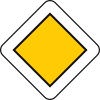 — Priority road
The B9 is a yellow diamond with a white border (a square standing on its point). It marks the start of a priority road: along its entire length, you keep priority at junctions, without having to apply priority from the right. The sign is generally repeated after each major junction to confirm that the road remains a priority road.
B11  — End of priority road
The B11 repeats the yellow diamond, but crossed by a black or grey diagonal band. It announces the end of the priority road. From that point on, you become an ordinary driver again: at the following junctions, priority from the right applies once more, unless other signs indicate otherwise.
B15  — Right of way
The B15 is a one-off sign, valid for a single junction. It tells you that you have priority over the crossing road at that specific junction. It often works together with the B17 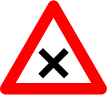 sign placed on the other road, which requires the other driver to give way.
B17 — Junction with priority from the right
The B17 is a danger sign (triangle with a red border) announcing a junction where priority from the right applies. Contrary to popular belief, it does not give you any priority: on the contrary, it reminds you that, absent any other indication, you must give way to the right. It is a warning, not an advantage.
Priority at a narrowing (B19  and B21
  )
)
On a narrowed carriageway where two vehicles cannot pass each other, two signs organise who goes first. They come as a pair, one for each direction of traffic:
- B19 — Priority to oncoming traffic : you do not have priority. You must stop to let vehicles coming from the opposite direction through before entering the narrowing. The sign shows a red arrow (your direction) giving way to a black arrow.
- B21 — Priority over oncoming traffic : you have priority. Vehicles coming from the opposite direction must let you through the narrow section first. The sign shows a black arrow (your direction) with priority over a red arrow.
When do you lose priority from the right?
Priority from the right is the default rule, but priority signs suspend it in several cases. You lose priority (and must give way) when:
- A B1 (give way) or a B5 (stop) applies to you.
- You join a priority road (B9) from an ordinary road: vehicles on the priority road go first.
- A B19 requires you to give way at the narrowing.
- You emerge from a place not open to public traffic (car park, garage, dirt track): you then give way to everyone, even to the left.
| Sign | Shape / colour | What you must do |
|---|---|---|
| B1 — Give way | Triangle pointing down | Give way (stopping not required) |
| B5 — Stop | Red octagon | Complete stop, then give way |
| B9 — Priority road | Yellow diamond on a white background | You keep priority at junctions |
| B11 — End of priority road | Yellow diamond with a diagonal bar | Back to priority from the right |
| B15 — Right of way | One-off sign | You have priority at that junction |
| B17 — Junction with priority from the right | Triangle with a red border | Give way to the right (warning) |
| B19 — Give way at the narrowing | Red arrow gives way to black arrow | Let oncoming vehicles through |
| B21 — Priority at the narrowing | Black arrow has priority over red | You go first |
🧠 Check you've got it
Question 1 / 3
3 exam-style questions on this lesson — instant correction.
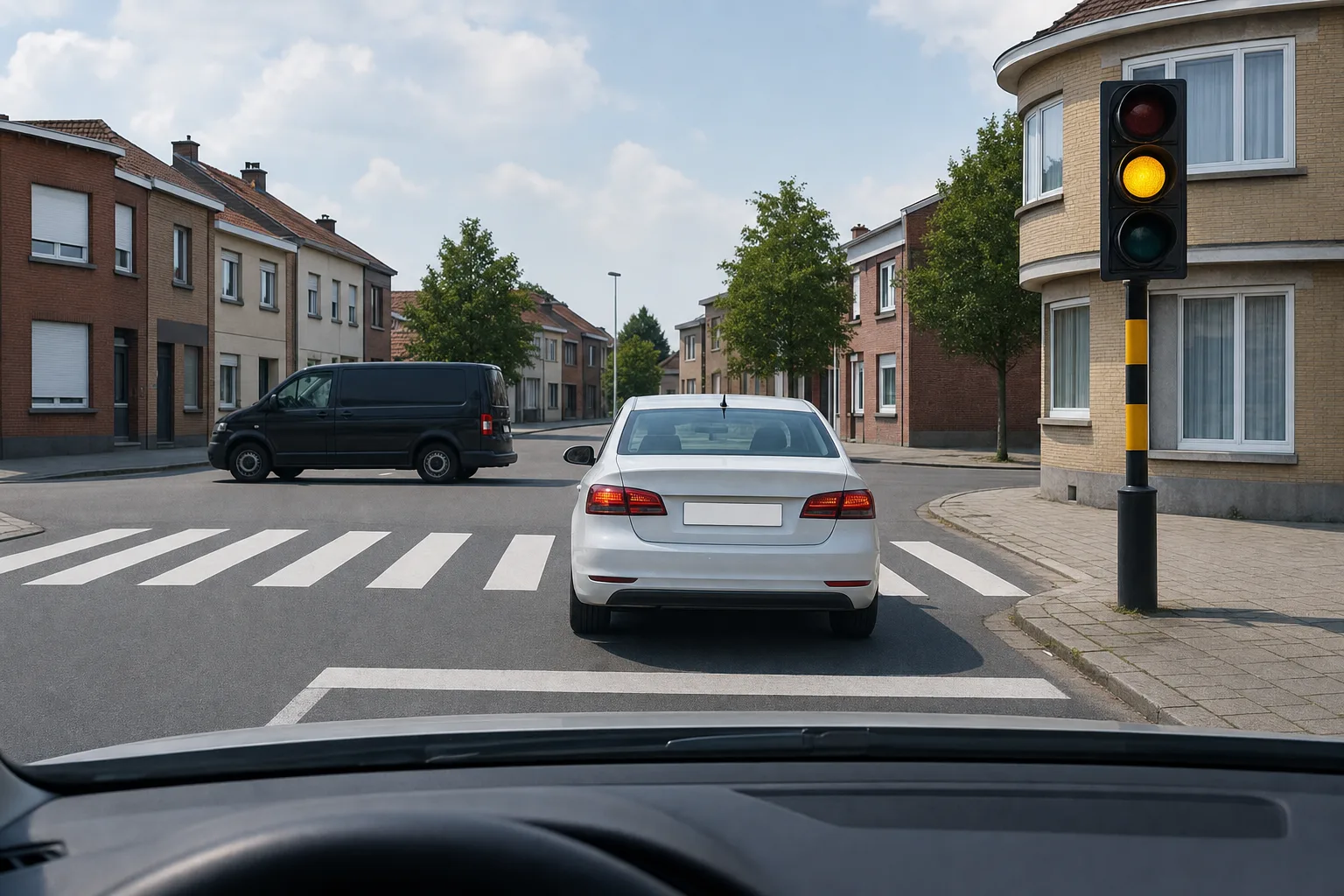
The photo is taken from the car you are driving. What is your reaction?
🚦Practise Signs, road markings and traffic lights
Exam-style questions on this theme, with corrections and explanations — plus the full bank with access.
❓ Frequently asked questions
What is the difference between sign B1 and sign B5 ?
Both require you to give way, but the B5 (stop) additionally requires a complete stop of the vehicle before giving way. At a B1 (give way) , you may continue without stopping if the way is clear.
Does the yellow diamond give me priority everywhere?
The B9 gives you priority at junctions as long as you stay on the priority road. That priority ends at the B11 sign (diamond with a bar): after that, priority from the right applies again.
Does sign B17 give me priority?
No, that is a classic trap. The B17 is a danger sign that announces a junction with priority from the right. It warns you that you will have to give way to the right; it grants you no advantage.
How do I know who goes first through a narrowing?
Look at the colour of the arrow for your direction. With the B19 , your arrow is red: you give way to oncoming vehicles. With the B21 , your arrow is black: you have priority and go first.