⏱️ 5 min read
Roundabouts
The roundabout has replaced thousands of junctions in Belgium because it keeps traffic flowing and reduces serious accidents. But it reverses one reflex: here, the classic priority from the right does not apply. Many candidates get this wrong. Here is how to approach it, drive around it and exit it correctly.
📑 In this lesson (6)
What is a roundabout?
A roundabout is a junction built around a central island, where traffic flows in one direction only (in Belgium, to the left, i.e. anticlockwise). Officially, it is only a roundabout when it is announced by the D5  sign, the round blue sign showing three curved arrows.

The D5 is almost always accompanied, at each entry, by the B1 "give way"  sign (and sometimes the corresponding road markings). It is this combination that sets the roundabout's priority rule.
Who has priority?
When approaching a roundabout marked with the D5 , you must give way to vehicles already on the ring. You slow down, and if necessary stop, before entering. Once inside the ring, you have priority over those still waiting to enter.
The essential point to understand: priority from the right does not apply inside the roundabout. Once on the ring, you therefore do not have to give way to vehicles arriving on your right to enter. It is the opposite of a classic junction.
The indicator: the golden rule
The Belgian highway code lays down a simple, compulsory rule: to leave the roundabout, you must switch on your right indicator, early enough to warn other road users that you are going to take the next exit.
- When entering: no indicator is required by the code, since you are following the ring. (For the first exit, some instructors advise indicating right, but it is not a legal obligation.)
- While driving round the ring past your exit: no right indicator as long as you are continuing.
- Just before exiting: right indicator, as soon as you have passed the exit before yours.
Which lane should you choose?
On a roundabout with several lanes, your choice of lane depends on the exit you are aiming for. The principle: you stay in the right-hand lane if you are exiting early, and you may use the left-hand (inner) lane if you have to travel a large part of the ring.
- Exit to the right (1st exit): enter and stay in the right-hand lane.
- Straight ahead: generally the right-hand lane, unless markings or arrows on the road indicate otherwise.
- Distant exit or U-turn: use the left-hand lane, then move back gradually to the right to exit.
Do not cut across anyone's path
Changing lanes on a roundabout is still a lateral movement: you must give way to the road user already in the lane you are joining. When you leave the left-hand lane to exit, you may not cut across the path of a vehicle travelling on your right on the ring.
In practice: if you are in the inner lane and miss the chance to move over safely, do an extra lap rather than forcing your way through by cutting off another vehicle.
Cyclists and vulnerable road users
Roundabouts are danger points for cyclists. Depending on the layout, the cycle path may be marked on the ring or run alongside it separately. Watch out for cyclists at all times, especially when exiting: a cyclist continuing round the ring may be in your right-hand blind spot.
When the cycle path is marked on the ring itself, a cyclist riding on it enjoys the same priority as the other road users already on the ring. Also think of the pedestrians crossing the entry and exit arms, often at a pedestrian crossing.
| Step | What you do |
|---|---|
| On approach (D5 + B1 signs) | Slow down and give way to the ring |
| On the ring | You have priority; no priority from the right |
| Lane choice | Right to exit early, left to go further round |
| Before exiting | Right indicator + blind-spot check |
| Cyclist on the ring | Give way to them, do not cut across their path |
🧠 Check you've got it
Question 1 / 3
3 exam-style questions on this lesson — instant correction.
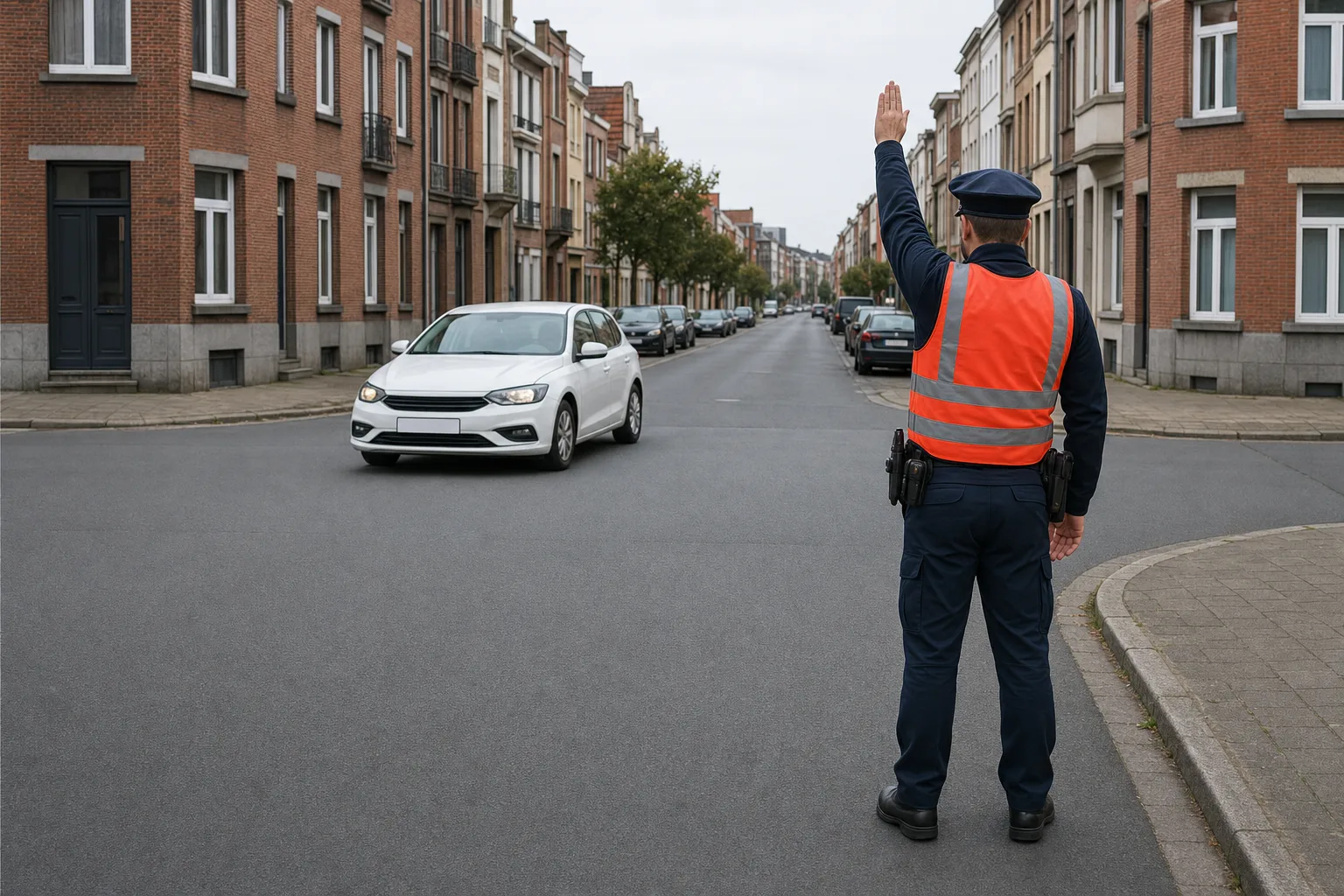
The white car is already in the middle of the junction when the officer raises an arm. What is the correct attitude for the driver?
🔀Practise Right of way and intersections
Exam-style questions on this theme, with corrections and explanations — plus the full bank with access.
❓ Frequently asked questions
Do you have to give way when entering a roundabout?
Yes. At the entry to a roundabout marked with the D5 , you give way to vehicles already on the ring. A B1 "give way" sign is almost always present at each entry.
Does priority from the right apply on a roundabout?
No, not inside the ring. Once you are on the roundabout, you have priority and you do not have to let in vehicles arriving on your right. Careful: without a D5 sign, it is not a true roundabout and priority from the right becomes the rule again.
When should I use my indicator on a roundabout?
To exit: right indicator, as soon as you have passed the exit before yours. On entry, the code does not require an indicator since you are following the ring.
How do you overtake a cyclist on a roundabout?
On the ring, it is best to stay behind the cyclist rather than squeeze past. Above all, check your right-hand blind spot before exiting: a cyclist continuing round the ring has priority and must not have their path cut off.