⏱️ 5 min read
Approaching a junction
The junction is where most traffic conflicts occur. Arriving there without a method means risking a collision or an eliminatory fault. Approaching a junction correctly means first reading the situation, then applying the right priority rule and only entering when you are sure you can cross and leave it without obstructing anyone.
📑 In this lesson (6)
What is a junction?
A junction is the place where two or more public roads cross, join or separate. At this point, paths meet: a clear order of passage is therefore needed. That order depends entirely on what organises the junction: a sign, a road marking, traffic lights, an authorised official… or nothing at all.

The types of junctions
Before deciding who goes first, identify what type of junction you are dealing with. This is the reflex to acquire: you don't guess the priority, you read it.
- Unsigned junction: no sign, no road marking, no lights, no official. Priority from the right applies.
- Junction with vertical signage: a B1 (give way)
 , B5 (stop)
  , B15 (priority road)
  or B17
  sign sets the order of passage.
 - Junction with traffic lights: the traffic lights regulate the passage and take precedence over priority signs.
- Junction controlled by an authorised official: their instructions take precedence over everything else, including lights and signs.
- Roundabout: a particular junction where you give way to vehicles already on the circulatory carriageway.
Applying the right priority rule
Once the type of junction is identified, the rule follows naturally. In the absence of any other signal, priority from the right prevails (see the dedicated lesson). But a sign or a road marking may require you to give way, or even to stop completely.
- Give way (B1) : slow down, observe, and let road users on the road you are approaching pass. You only have to stop if it is necessary in order to give way.
- Stop (B5) : you must come to a complete stop at the marked line (or, failing that, at the entrance to the junction), then give way. Stopping is compulsory, even if the road is clear.
- Priority road (B15) : you keep priority, but stay careful; another road user may make a mistake.
- Exit from a place not open to traffic (car park, garage, dirt track): you give way to all road users, from the left as well as the right.
Clearing the junction: never get stuck
Having priority or a green light is not enough to enter. The rule is clear: you may only enter a junction if traffic conditions are such that you will most likely not be brought to a standstill in the junction. If the queue ahead of you is stopped and you risk being stuck in the middle of the crossing, you must wait before the line, even on green.
Turning at a junction
Changing direction is prepared well before the junction. Announce your intention with your indicator, position yourself correctly on the carriageway and adjust your speed. The direction you take then changes which road users you must give way to.
- Turning right: move over to the right in advance, check your blind spot and give way to pedestrians crossing the road you are entering, as well as to cyclists riding along the carriageway.
- Turning left: position yourself near the centre line of the carriageway, let oncoming road users going straight ahead or turning right pass first, then the pedestrians.
- Going straight ahead: stay in your lane, watch both sides and apply the junction's priority rule.
Caution and observation: the method
- Slow down on approach and look for the signage: sign, road marking, lights, official.
- Work out which rule applies and therefore who you must give way to.
- Look left, right and left again before entering.
- Check that you will be able to clear the junction without getting stuck.
- Enter decisively, without unnecessary hesitation, as soon as the road is clear.
| Type of junction | What determines the order of passage |
|---|---|
| No signage at all | Priority from the right |
| B1 or B5 sign facing you | Give way (B5: complete stop) |
| Priority road (B15) | You keep priority |
| Traffic lights | The lights, which take precedence over signs |
| Authorised official present | Their instructions, which take precedence over everything |
🧠 Check you've got it
Question 1 / 3
3 exam-style questions on this lesson — instant correction.
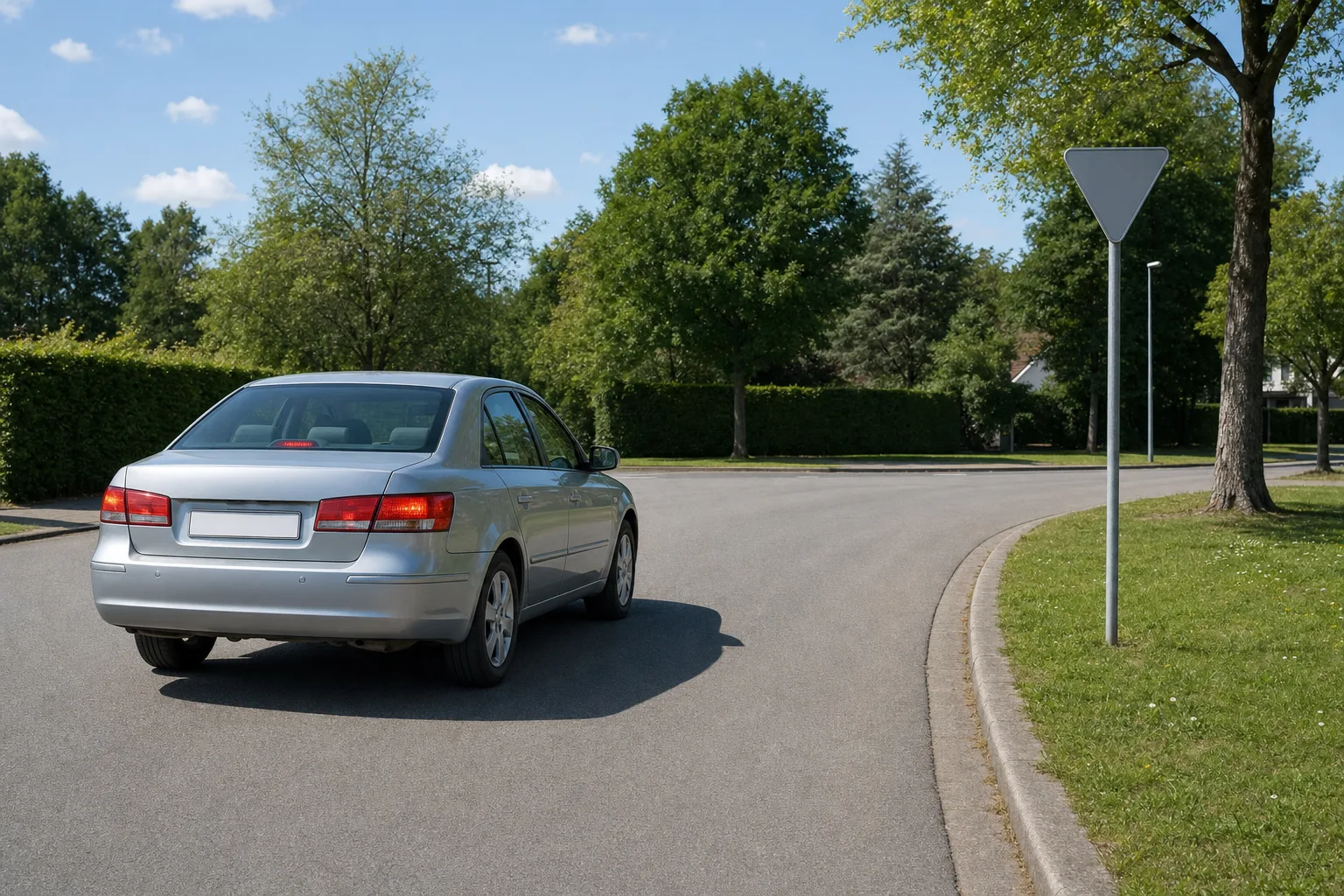

The driver of this car wants to turn right at this junction. Are they correctly positioned on the carriageway?
🔀Practise Right of way and intersections
Exam-style questions on this theme, with corrections and explanations — plus the full bank with access.
❓ Frequently asked questions
How do I know which priority rule applies at a junction?
Proceed in order: an authorised official takes precedence over everything, then the traffic lights, then the priority signs and markings. If none of these are present, priority from the right applies.
The light is green but the junction is congested. May I move forward?
No. You may only enter if you are sure you can clear the junction. If you risk being brought to a standstill in it, you must wait behind the line, even on green.
At a stop sign, do I really have to stop if the road is clear?
Yes. The B5 sign requires a complete stop at the line, no matter what. Failing to bring the vehicle to a complete standstill is a fault, even with no other road user in sight.
When turning left, who must I give way to?
To oncoming road users going straight ahead or turning right, then to pedestrians crossing the road you are entering. Having priority at the junction never exempts you from this rule.