⏱️ 7 min read
MAM and loading
Loading your car or towing a trailer isn't just about "fitting in as much as possible". The Belgian highway code sets mass limits that must never be exceeded and requires the load to be properly distributed and firmly secured. Handled badly, a load lengthens your braking distance, unbalances the vehicle and can fall onto the road. Here are the rules you need to master for the exam and to drive safely.
📑 In this lesson (6)
MAM and laden mass: two concepts not to confuse
The MAM (maximum authorised mass) is the mass that the vehicle, when loaded, may never exceed. It is a fixed value, determined by the manufacturer and shown on the registration certificate and the certificate of conformity. The laden mass (or actual mass) is the vehicle's effective mass at a given moment: the vehicle's unladen weight + driver + passengers + luggage + fuel. As long as the laden mass remains less than or equal to the MAM, you are within the rules.
For a car + trailer combination, we also speak of the MAM of the combination: the total mass of the towing vehicle and the trailer, loaded, may not exceed the authorised value. Overloading is an offence, but above all it is dangerous: strained brakes, overheating tyres, degraded road holding.
A well-distributed load
How you distribute the load matters as much as its weight. A badly placed load unbalances the vehicle and makes it unpredictable:
- Place heavy objects low down and in the centre, as close as possible to the axle, to lower the centre of gravity.
- Distribute the load evenly between left and right, and between front and rear.
- Avoid stacking too high: a load perched up high increases the risk of tipping over, especially in bends.
- For a trailer, make sure the load on the towing drawbar is correct: neither too much nor too little, otherwise the trailer swings or "snakes".
The load must be firmly secured
The code requires the load to be positioned and, where necessary, secured so that it does not drag, fall off, shift dangerously or compromise the stability of the vehicle. Use straps, nets or suitable devices. Emergency braking or a tight bend can shift an unsecured load with surprising force.
The load may never obscure the elements that ensure your visibility and that of others:
- neither the number plate;
- nor the lights and reflectors (position lights, brake lights, indicators);
- nor the mirrors or the driver's field of vision;
- the load must also not impair the manoeuvrability of the vehicle or produce noise, dust or any other avoidable nuisance.
When the load overhangs the vehicle
A load that overhangs at the rear (for example planks or a ladder) must be marked so it remains visible to other road users. The principle: a load overhanging by more than one metre at the rear must carry a marker. Depending on the conditions:
- In daylight, when visibility is good: a red panel or flag (or a retro-reflective device) at the end of the load.
- At night or in poor visibility: a red light at the rear and a reflective device, so that the end of the load is clearly visible.
- In width, the load may in principle not extend beyond the vehicle's limits in a dangerous way; any significant sideways overhang must stay within the legal limits and, where applicable, be marked.
Towing a trailer with a category B licence
The category B licence allows you to drive a car and tow a trailer, but within certain mass limits. Beyond them, additional training or another licence becomes necessary:
- Trailer up to 750 kg MAM: allowed with a standard category B licence, whatever the mass of the car (within the MAM of the combination permitted by the manufacturer).
- Trailer over 750 kg: the category B licence is still sufficient as long as the MAM of the combination (car + trailer) does not exceed 3 500 kg.
- Code 96: when the MAM of the combination is between 3 500 and 4 250 kg, additional training lets you obtain code 96 (an endorsement added to the category B licence).
- Category BE licence: required beyond that, for heavier combinations (up to 7 000 kg combination MAM under the rules in force).
| Situation | Licence required |
|---|---|
| Trailer ≤ 750 kg MAM | Category B licence |
| Trailer > 750 kg, combination ≤ 3 500 kg | Category B licence |
| Combination between 3 500 and 4 250 kg | Category B licence + code 96 |
| Heavier combination | Category BE licence |
What the category B licence lets you drive
The category B licence is not limited to the family car. It covers a whole family of vehicles, provided two cumulative limits are respected: the MAM may not exceed 3 500 kg and the vehicle may not carry more than 8 passengers in addition to the driver (known as 8 + 1, i.e. 9 seats in total). As soon as either of these two thresholds is crossed, the category B licence is no longer enough.
- A car (a motor car intended for carrying people): the classic saloon, estate or SUV.
- A dual-purpose car (carrying people and goods), such as a converted estate or a light commercial vehicle with a bench seat.
- A minibus or a van, as long as the MAM does not exceed 3 500 kg and the number of seats stays within the 8 + 1 limit.
MAM and laden mass: the limit and the reality
Alongside the MAM (the limit never to be exceeded), we also speak of the laden mass: this is the vehicle's actual mass at a specific moment, load and occupants included. It is the same pair of concepts seen above: the MAM is the ceiling set by the manufacturer, the laden mass is what the vehicle actually weighs. The laden mass must always remain less than or equal to the MAM. Measured at a weighbridge, the laden mass lets you check in practice that you are not overloaded.
Recap of the loading rules
- Rear overhang: the load may extend beyond the rear, but within reasonable limits; it must remain stable and firmly secured.
- Maximum width: 2.55 m load included (car + load). Beyond that, the vehicle becomes oversized.
- Nothing may extend beyond the front of the vehicle: the load never overhangs at the front.
- A load that overhangs by more than 1 m at the rear must be marked: a panel (or flag) by day and a reflector / red light at night or in poor visibility.
🧠 Check you've got it
Question 1 / 3
3 exam-style questions on this lesson — instant correction.
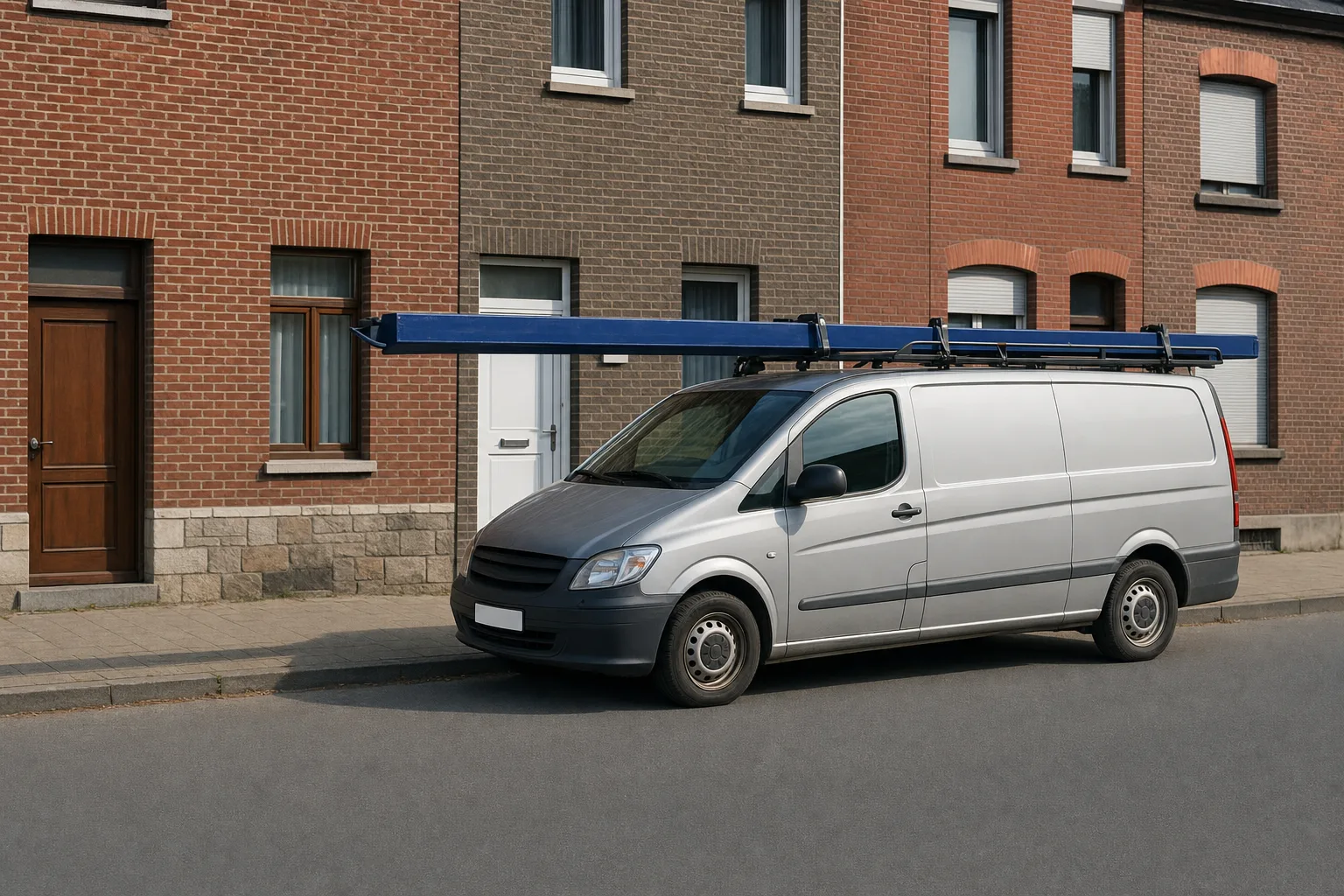
By how much may the load extend beyond the front of your car?
🔧Practise Vehicle, documents and equipment
Exam-style questions on this theme, with corrections and explanations — plus the full bank with access.
❓ Frequently asked questions
Where do I find my vehicle's MAM?
On the registration certificate and the certificate of conformity. The manufacturer's plate, on the bodywork, also shows the vehicle's MAM and, where applicable, the authorised MAM of the combination.
Can I tow a caravan with my category B licence?
Yes, as long as the MAM of the combination (car + caravan, loaded) does not exceed 3 500 kg. Between 3 500 and 4 250 kg, you need code 96; beyond that, the category BE licence.
What are the risks of overloading?
Overloading is an offence and can lead to a fine as well as the vehicle being immobilised until it complies. Above all, it lengthens the braking distance, prematurely wears out brakes and tyres and degrades road holding.
How do I mark a load that overhangs at the rear?
By day, with a red panel or flag fixed to the end; at night or in poor visibility, with a red light together with a reflective device, so that other road users can clearly see the end of the load.