⏱️ 5 min read
Lighting and lights
Seeing and being seen: all of your car's lighting serves these two purposes. But you still need to switch on the right lights at the right time. Confusing dipped headlights with main beam, forgetting the rear fog light or overusing the hazard lights are classic mistakes, on the road as well as in the exam. Here is what each light is for and when to use it.
📑 In this lesson (6)
The lights that make you visible

Some lights do not really illuminate the road: they signal your presence to other road users. They are not very powerful but are essential as soon as the light fades.
- Position lights (formerly called "sidelights"): small white lights at the front and red lights at the rear. They make your vehicle visible but do not light up the carriageway. On their own, they are never sufficient for driving at night.
- Number-plate lights: they illuminate the rear number plate and come on at the same time as the position lights.
The lights that illuminate the road
Dipped headlights ("dipped beam")
Dipped headlights, often called dipped beam, are your basic lights for driving at night or in poor visibility. Their beam is angled downwards to light the road ahead of you without dazzling other drivers. This is the lighting you use most often.
Main-beam headlights ("full beam")
Main-beam headlights, or full beam, project a long, powerful beam. They light up the road far ahead of you but dazzle anyone facing them. You only use them on an unlit road, when no other road users would be bothered by their light.
Fog lights
Fog lights are reserved for conditions of severely reduced visibility. Their use is strictly regulated, because used incorrectly they hinder other drivers.
- Front fog lights: permitted in fog, snowfall or heavy rain. They may replace or supplement the dipped headlights when visibility is poor.
- Rear fog light: very powerful and bright red, it is only permitted in fog or snowfall reducing visibility to less than 100 m, or in heavy rain.
The lights that signal manoeuvres
- Indicators (direction indicators): they announce in advance any change of direction or lane, as well as moving off from the side of the road. Use them in good time, then switch them off once the manoeuvre is complete.
- Hazard lights (hazard warning lights): all four indicators together. They signal a stationary vehicle that constitutes a hazard, a sudden slowdown on a motorway, or a vehicle being towed.
- Brake lights: red, they come on automatically when you brake to warn the road user behind you.
When must you switch on your lights?
You must use dipped headlights (or, depending on the conditions, fog lights):
- At night, that is, between nightfall and daybreak.
- During the day, as soon as visibility is insufficient: fog, heavy rain, snowfall, a very dark sky.
- In a tunnel, even in broad daylight and even if it is lit.
| Situation | Lights to use |
|---|---|
| Night, unlit road, no one in sight | Main-beam headlights |
| Night, you pass or follow another road user | Dipped headlights (dipped beam) |
| Tunnel, even in daylight | Dipped headlights |
| Fog/snow < 100 m, or heavy rain | Dipped beam + front and rear fog lights |
| Change of direction or lane | Indicator in good time |
| Stationary vehicle constituting a hazard | Hazard lights |
The horn and headlight flashes
The horn is not a tool for venting your frustration: it is a danger warning device. Its use is strictly limited, and it varies depending on whether you are inside or outside a built-up area.
- In a built-up area: the horn is permitted only to avoid an accident. Outside that case, sounding your horn is prohibited.
- Outside built-up areas: the horn may also be used to announce overtaking to the road user you are about to overtake, in addition to its role as a danger warning.
- At night, replace the horn with brief headlight flashes (momentary switches to main beam) to signal your presence or announce overtaking without waking the neighbourhood.
🧠 Check you've got it
Question 1 / 3
3 exam-style questions on this lesson — instant correction.
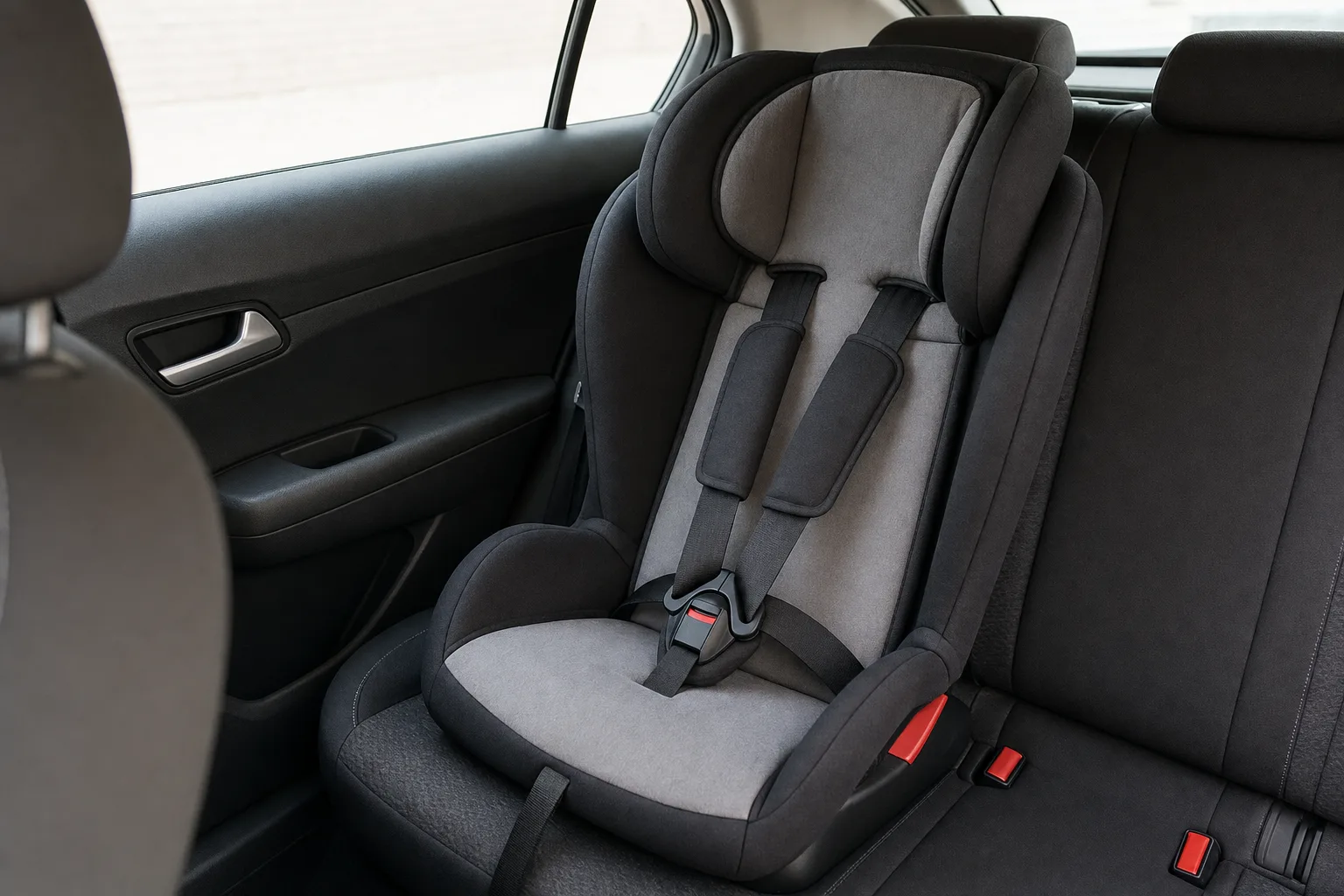
A child over 10 years old who is 1.45 m tall.
🔧Practise Vehicle, documents and equipment
Exam-style questions on this theme, with corrections and explanations — plus the full bank with access.
❓ Frequently asked questions
What is the difference between dipped headlights and main-beam headlights?
Dipped headlights (dipped beam) light the road downwards without dazzling: they are the basic lighting at night. Main-beam headlights (full beam) light far and bright, but dazzle other road users; you only use them on a deserted, unlit road.
When may I switch on the rear fog light?
In fog or snowfall reducing visibility to less than 100 m, or in heavy rain. As soon as visibility improves, you must switch it off so as not to dazzle the driver behind you.
Must I switch on my lights in a tunnel in broad daylight?
Yes. In a tunnel, you must use at least the dipped headlights, even in broad daylight and even if the tunnel is lit.
May I drive at night with only the position lights on?
No. Position lights only make your vehicle visible, they do not light the road. To drive at night, you must use dipped headlights (or main beam when conditions allow).