⏱️ 4 min read
The mandatory documents
An official signals you to stop: can you present all the required documents? Driving in Belgium means carrying, on you or on board the vehicle, a precise set of papers. Forgetting one of them can cost you a fine, or even the immobilisation of the vehicle. Here is the complete list and what the theory exam expects of you.
📑 In this lesson (7)
Why these documents are mandatory

Each document proves a specific point: that you are allowed to drive, that the vehicle is known to the authorities, that it is insured and that it is fit to be on the road. During a check, an authorised official may require you to present them on the spot. Some must be on board the vehicle, others on the driver.
A valid driving licence
You must hold a valid driving licence for the vehicle's category (category B for an ordinary car) and have it on you while driving. The licence must be in force: an expired, suspended or withdrawn licence does not entitle you to get behind the wheel. A learner driver, on the other hand, drives with a provisional driving licence and must comply with the conditions attached to it.
The registration certificate
The registration certificate (the "carte grise") proves that the vehicle is registered in Belgium. It must be kept on board the vehicle. It includes, among other things, the number plate, the registration holder and the vehicle's main characteristics. The corresponding number plate must be fitted at the front and rear, clean, legible and compliant with the official model.
The certificate of conformity
The certificate of conformity attests that the vehicle meets the technical standards in force (safety, emissions, dimensions). It is issued by the manufacturer when the vehicle is placed on the market. You must be able to present the original or an accepted proof during a check. It is this document that originally allows the vehicle to be registered.
Proof of insurance
Every motor vehicle on the public highway must be covered by third-party liability insurance, which compensates damage caused to third parties. The proof of insurance (green card or its equivalent) must be kept on board. Driving without valid insurance is a serious offence: it can lead to heavy penalties and, in the event of an accident, considerable financial consequences.
The roadworthiness test certificate
When the vehicle is subject to it, it must have passed the roadworthiness test and have a valid roadworthiness test certificate on board. The test checks the vehicle's general condition: brakes, tyres, lights, steering, emissions, etc. An expired certificate or a vehicle with unrepaired defects can lead to a ban on driving until the situation is put right.
What to present during a check
During a roadside check, the authorised official may ask for all these documents. Stay calm, stop in a safe place, switch off the engine and present the requested papers without rushing. If a document is not on board at the time of the check, you may sometimes be given a deadline to produce it at a police station, but this is at the official's discretion and does not always avoid a penalty. The simplest approach is to keep everything stored in the same place and to check before every important journey that nothing is missing.
| Document | What it proves | Where |
|---|---|---|
| Valid driving licence | You are allowed to drive | On the driver |
| Registration certificate | The vehicle is registered | On board |
| Certificate of conformity (or proof) | The vehicle meets the standards | To be presented |
| Proof of third-party liability insurance | Third parties are covered | On board |
| Valid roadworthiness test certificate | The vehicle is fit to be on the road | On board (if required) |
🧠 Check you've got it
Question 1 / 3
3 exam-style questions on this lesson — instant correction.
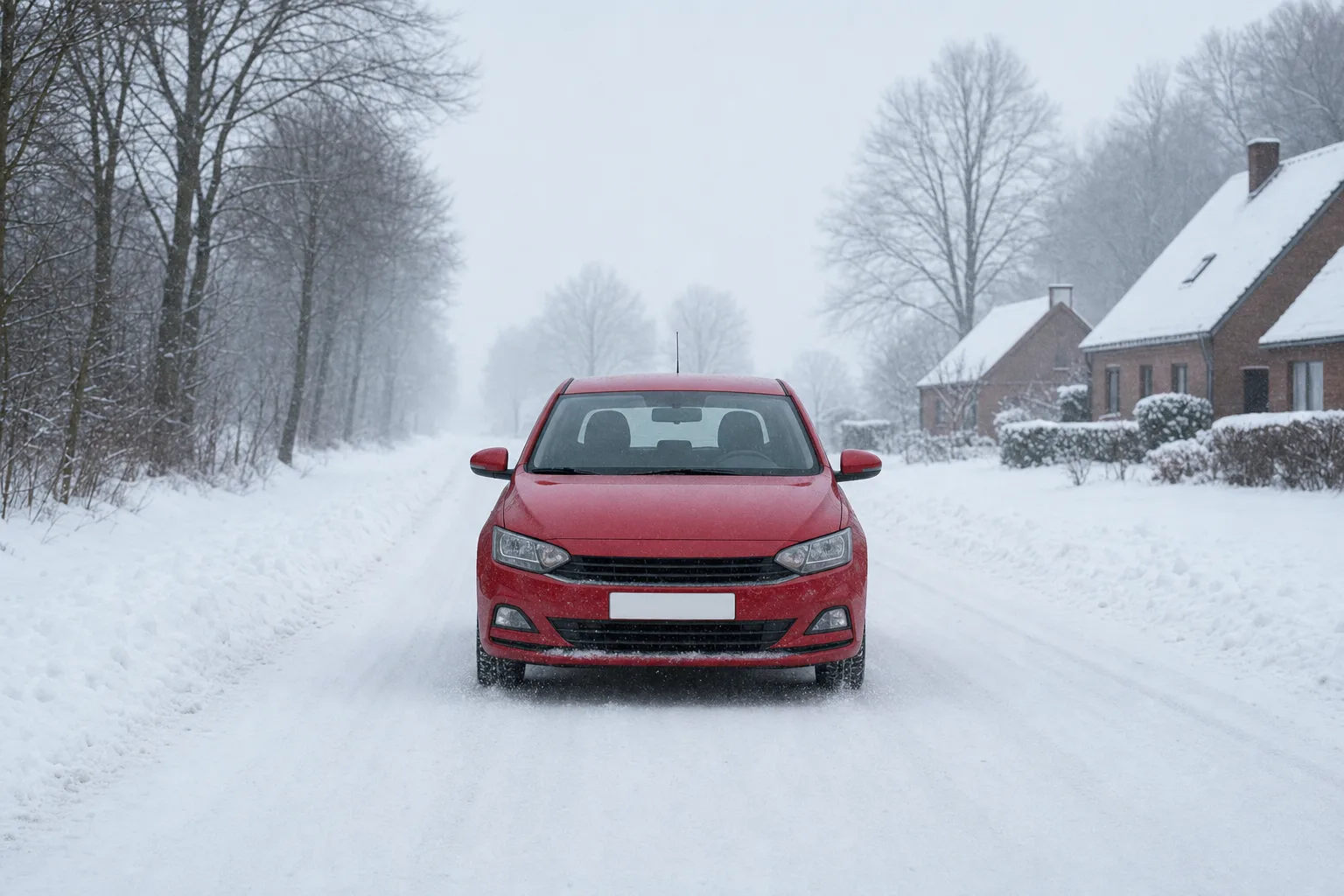
25 September. Flanders is covered with a layer of snow. May this driver drive with studded tyres?
🔧Practise Vehicle, documents and equipment
Exam-style questions on this theme, with corrections and explanations — plus the full bank with access.
❓ Frequently asked questions
Must I always have my driving licence on me when driving?
Yes. The valid licence must be on the driver while driving and presented at the request of an authorised official. A photocopy is not enough.
What happens if I drive without insurance?
It is a serious offence. Besides heavy penalties, you will have to bear yourself the damage caused to third parties in the event of an accident. Never drive without valid third-party liability insurance.
Must the registration certificate stay in the car?
Yes. The registration certificate must be kept on board the vehicle so it can be presented during a check.
Must my vehicle always pass the roadworthiness test?
When the vehicle is subject to it, it must have a valid roadworthiness test certificate on board. The test checks the vehicle's general condition (brakes, tyres, lights, etc.).