⏱️ 4 min read
Priority vehicles
A blue light flashing in the distance, a siren approaching behind you: these are the signs of a priority vehicle on a call-out. Ambulance, fire brigade, police — every second counts for them. Knowing how to react quickly and without panicking saves them time that can save a life. Here is exactly what to do, and what you must never do.
📑 In this lesson (5)
What is a priority vehicle?
A priority vehicle is a vehicle assigned to an urgent mission: emergency services, firefighting, police interventions, urgent transport of injured people or organs, etc. To be recognised as a priority vehicle on the road, it must use its special signals: the flashing blue light and a special audible warning device (the two-tone siren). It is only the combination of these signals that gives it priority-vehicle status under the Belgian highway code.
Blue light alone, or blue light with siren?
This is an essential distinction and a great exam classic. The flashing blue light alone, without the audible warning device, simply signals the vehicle's presence: it may be driving slowly, parked at an incident scene or moving without absolute urgency. In that case, you are not obliged to give way to it — you simply remain watchful and careful as it approaches.
On the other hand, as soon as the blue light is accompanied by the special audible warning device, the vehicle is on an urgent call-out: you must clear the way and give way to it without fail. The presence of both signals together is the condition that triggers your obligation.
How to give way correctly
First locate the vehicle: is it coming from behind, from ahead, from a side street? The two-tone siren can make the direction hard to judge; turn down the radio and keep your eyes open. Then clear the way calmly and predictably:
- Pull over to the right and slow down to clear the way.
- If necessary, stop completely, without braking sharply and without obstructing other road users.
- Avoid coming to a standstill in the middle of a junction or on a pedestrian crossing: move forward or back slightly to clear the intersection.
- Stay alert: a second priority vehicle sometimes follows the first.
And at a red light?
If you are stopped at a red light and a priority vehicle on a call-out needs to get through, you may cross the stop line or move forward carefully to clear the way for it, provided it can be done without danger to other road users (pedestrians, cyclists, cross traffic). You are not committing an offence in that case: the obligation to give way to the priority vehicle takes precedence, but safety remains absolute. If moving forward creates the slightest risk, stay where you are.
What you must never do
- Never follow a priority vehicle to take advantage of the gap it opens: it is prohibited and extremely dangerous.
- Do not brake sharply or swerve unpredictably in a way that would surprise other drivers.
- Do not stop right in the middle of a junction, where you would block the very passage that needs clearing.
- Do not panic: an abrupt manoeuvre causes more accidents than the siren itself.
Priority vehicle stopped or attending an incident
An emergency vehicle may also be stopped at the scene of an accident or a fire, blue light on. Approach it with the utmost care: slow down considerably, be ready to stop and to let personnel, injured people and other responders pass. Follow the instructions of the officials and keep clear of fire hoses laid out on the carriageway.
| Vehicle's signals | Your obligation |
|---|---|
| Flashing blue light + special siren | Give way immediately, clear the way, stop if necessary |
| Flashing blue light alone (no sound) | No obligation to give way; remain careful and watchful |
| Priority vehicle stopped at an incident | Slow down considerably, pass around it with care |
| You are at a red light, siren behind you | Clear the way even beyond the line, but only if it is safe |
🧠 Check you've got it
Question 1 / 3
3 exam-style questions on this lesson — instant correction.
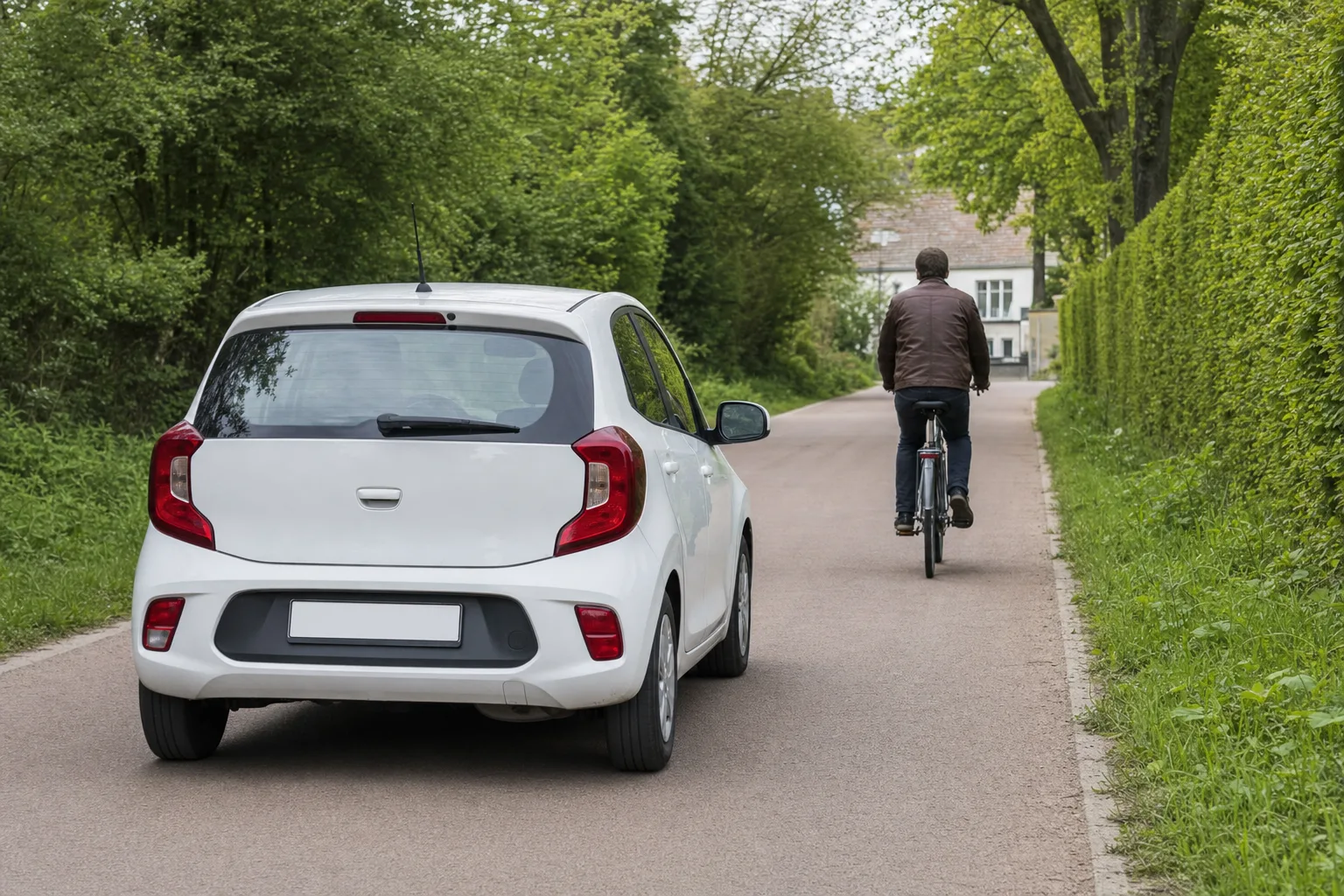
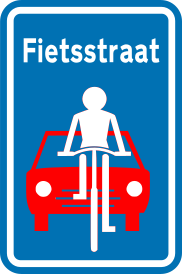
In this cycle zone, is the car allowed to overtake a cyclist?
🚸Practise Vulnerable road users and priority vehicles
Exam-style questions on this theme, with corrections and explanations — plus the full bank with access.
❓ Frequently asked questions
Must I give way to a vehicle with a blue light but no siren?
No. Without the special audible warning device, the vehicle does not have the status of a priority vehicle on a call-out. You simply remain careful and watchful, with no obligation to give way to it.
May I cross a red light to let an ambulance through?
Yes, you may move forward or cross the stop line to clear the way, but only if it can be done without any danger to pedestrians and other road users. If there is the slightest risk, stay stopped.
Am I allowed to follow a priority vehicle to get there faster?
No, it is strictly prohibited and very dangerous. The other road users moved aside for the emergency vehicle, not for you: weaving through in its wake causes accidents.
What should I do if I cannot tell where the siren is coming from?
Slow down, turn down the radio and watch your mirrors and the side streets carefully. As long as you have not located the vehicle, do not make any abrupt manoeuvre: drive gently until you can spot it and clear the way in the right direction.