⏱️ 4 min read
Buses, trams and public transport
A bus pulling away, a tram appearing on its rails, a school bus at a standstill: public transport vehicles come with rules that many candidates forget. Poorly known, they cost points in the exam and cause collisions in town. Here is how to share the road with them without hesitating.
📑 In this lesson (6)
The bus leaving its stop
In a built-up area, when a bus clearly signals its intention to leave a stop using its indicators, drivers travelling in the same lane must slow down and, if necessary, stop to let it merge back into traffic. This is known as the bus's pulling-out priority.
This obligation only applies if the bus has switched on its indicators, and only in built-up areas. Outside built-up areas, the bus does not have this pulling-out priority and must give way like any vehicle joining the traffic.
Careful: this priority is never absolute. The bus driver cannot force their way through and must still avoid endangering others. On your side, you are not required to brake sharply at the risk of causing a rear-end collision: you let the bus go if the manoeuvre can be done safely.
The tram almost always has priority
The tram (rail vehicle) enjoys a special priority: unless indicated otherwise, you must give way to it, whether it comes from your right or your left. The classic priority from the right therefore does not apply to a tram. The reason is simple: a tram can neither swerve from its path nor stop as quickly as a car.
How do you overtake a tram?
Since the tram usually runs in the middle of the carriageway, overtaking follows its own rule. As a rule, a moving tram is overtaken on the right, the side where there is no oncoming traffic to pass on the tracks.
Overtaking on the left is only allowed in certain cases: when there is not enough room on the right, when you are driving on a one-way carriageway, or when the rails run right along the right-hand edge of the carriageway. In every case, never overtake a tram without sufficient visibility and space.
| Situation | Overtaking side |
|---|---|
| Tram in the middle of the carriageway (general case) | On the right |
| Not enough room on the right | On the left |
| One-way carriageway | On the left (allowed) |
| Rails along the right-hand edge | On the left |
The stopped tram and its passengers
When a tram stops to let passengers on or off, they often cross the carriageway to reach the pavement. Where there is no refuge or island protecting the passengers, you must stop to allow them to board, alight and leave the carriageway safely. You only move off again once the way is clear.
School buses and child transport
A school bus deserves maximum vigilance: children get on, get off and may dart out in front of or behind the vehicle without looking. A vehicle carrying children is marked with a special disc (yellow-orange background depicting children) when it is stopped to let pupils on or off.
- Approach a stopped school bus at a very reduced speed, ready to brake.
- Watch the front and the rear of the bus: a child may cross without being visible.
- Keep a sufficient lateral distance when passing or overtaking the vehicle.
- Never overtake a stopped children's bus without perfect visibility.
Sharing the road with buses and trams
Public transport vehicles are long, heavy and have large blind spots. Never position yourself right beside their wheels or immediately behind them at a stop. Also respect dedicated lanes: lanes reserved for buses and trams are, unless signs indicate otherwise, off-limits to cars.
🧠 Check you've got it
Question 1 / 3
3 exam-style questions on this lesson — instant correction.
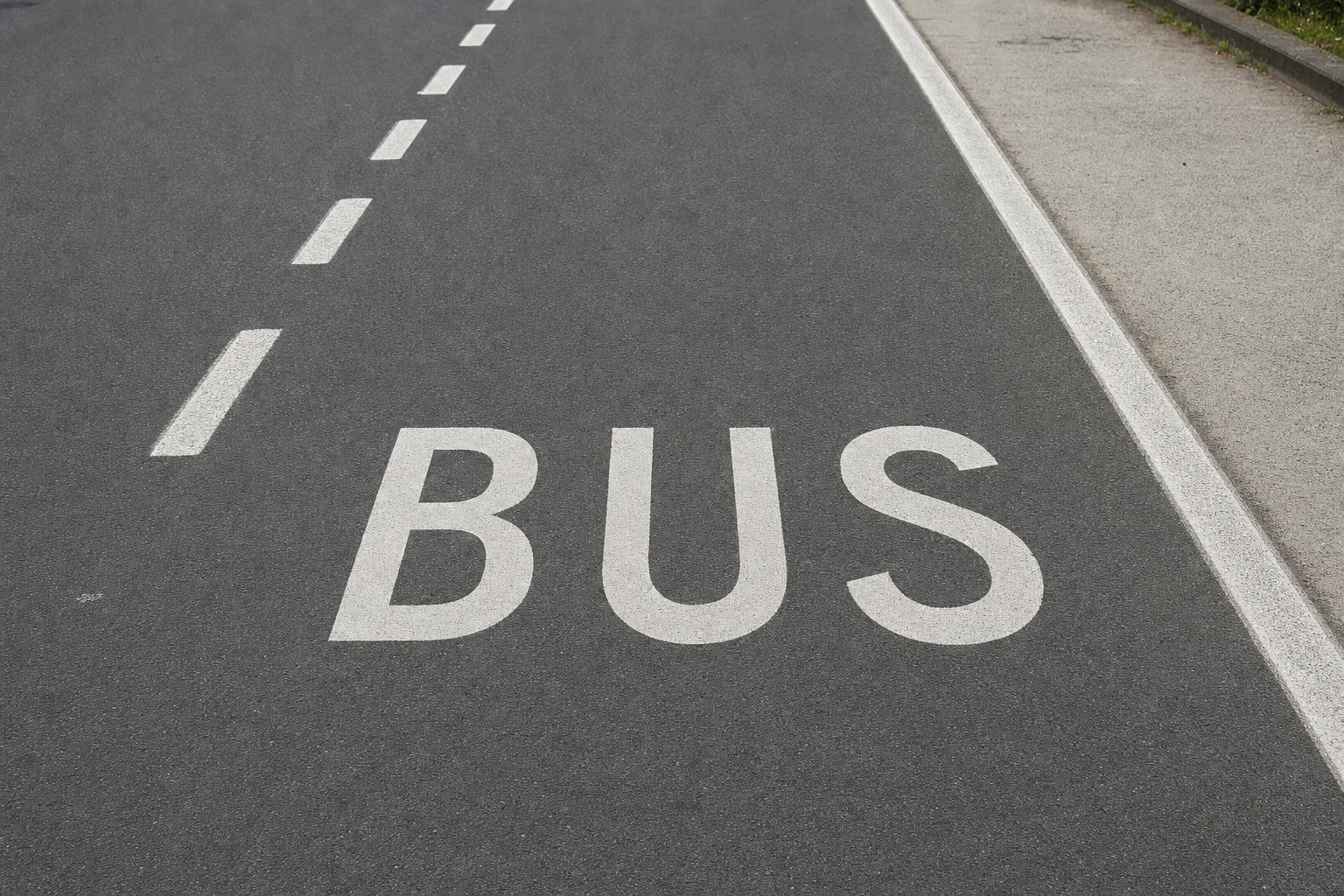
Parking is prohibited on a traffic lane reserved for buses. However, you are allowed to drive on it in order to pass oncoming traffic or overtake safely.
🚸Practise Vulnerable road users and priority vehicles
Exam-style questions on this theme, with corrections and explanations — plus the full bank with access.
❓ Frequently asked questions
Does the bus always have priority when it leaves its stop?
No. This pulling-out priority only applies in built-up areas and only if the bus has switched on its indicators. You let it go if the manoeuvre can be done without danger; outside built-up areas, the bus does not benefit from this priority.
On which side should I overtake a tram?
As a general rule, on the right. Overtaking on the left is only permitted if there is not enough room on the right, on a one-way carriageway, or if the rails run along the right-hand edge of the carriageway.
Do I have to stop for tram passengers?
Yes, when the tram is stopped and there is no refuge protecting the passengers. You must stop to allow them to board, alight and cross the carriageway safely.
Does a tram coming from the left really have priority?
Yes. The tram's priority works both ways: whether it arrives from your right or your left, you give way to it, unless signs indicate otherwise. The usual priority from the right does not apply to a tram.