⏱️ 5 min read
Pedestrians
The pedestrian is the most vulnerable road user: no bodywork, no seatbelt, no airbag. The driver, meanwhile, is in control of several hundred kilos. This difference creates a heightened duty of care. Knowing when to give way, where pedestrians walk and how to react near children or elderly people is part of the basics of the theory exam.
📑 In this lesson (7)
A general duty of care
The Belgian highway code requires every driver to be especially careful in the presence of pedestrians. You must adapt your speed, remain in control of your vehicle and be ready to stop at any moment. This obligation applies everywhere, but it is even stronger where pedestrians may appear suddenly: near schools, bus stops, shopping areas or pedestrian crossings.

The pedestrian crossing
A pedestrian crossing is marked on the road by wide white stripes parallel to the axis of the road (the "zebra" markings). You must give way to pedestrians who are already crossing or who are about to step onto the crossing. In practice, when approaching a crossing, you slow down and, if necessary, stop to let people cross.
Careful: the pedestrian crossing gives the pedestrian priority, but it does not exempt them from being careful. A pedestrian may not step onto it unpredictably just in front of a vehicle that is too close. As a driver, however, you remain in the best position to avoid an accident: the responsibility to anticipate rests on you.
Turning and meeting pedestrians
When you turn at a junction to enter another road, you must give way to pedestrians who are crossing or about to cross the carriageway you are entering. This is a point that is often forgotten: the pedestrian crossing the street you are turning into has priority over you.
Extra vigilance: children, elderly people, people with reduced mobility
Some pedestrians are more unpredictable or slower. The driver must take this into account and adapt their behaviour well before reaching them:
- Children: they cross without looking, run after a ball, step out from between two cars. Near schools and playgrounds, ease off the accelerator and be ready to brake.
- Elderly people: they walk and react more slowly, and misjudge distances. Give them time to cross completely.
- People with reduced mobility: people in wheelchairs, blind or visually impaired people (often recognisable by a white cane), people using a walking frame. Particular vigilance and patience are required.
Where do pedestrians walk?
Knowing where pedestrians belong helps you anticipate where they may come from. The Belgian rules are as follows:
- Pedestrians normally walk on the pavement or, failing that, on the verge (the usable strip alongside the carriageway).
- If there is neither a pavement nor a usable verge, pedestrians may use the carriageway, but must keep as close as possible to the edge.
- Outside built-up areas, on the carriageway, they walk in principle on the left, facing oncoming traffic, so they can see it better.
- To cross, they must use the pedestrian crossing if there is one within roughly 30 metres; otherwise, they cross perpendicularly and with caution.
Summary: who has priority?
| Situation | You must… |
|---|---|
| Pedestrian already on a crossing | Give way, stop if necessary |
| Vehicle stopped in front of a crossing | Do not overtake it |
| You are turning at a junction | Give way to pedestrians crossing your road |
| Pedestrian with a white cane wanting to cross | Stop to let them pass |
| Near a school, area with children | Slow down considerably, be ready to brake |
Road user: pedestrian or driver?
Under the Belgian highway code, a road user is any person using the public highway (art. 2). But careful: not all road users are pedestrians! The distinction is crucial, because the pedestrian and the driver do not follow the same rules or occupy the same place on the road. A few cases come up often in the exam and trip candidates up.
- A rider on horseback is a driver, not a pedestrian.
- A person leading or driving an animal (for example a herd or a draught animal) is also a driver.
- A person pushing a bicycle or a moped by hand is, however, considered a pedestrian: engine off, on foot beside their machine, they follow the rules for pedestrians.
🧠 Check you've got it
Question 1 / 3
3 exam-style questions on this lesson — instant correction.
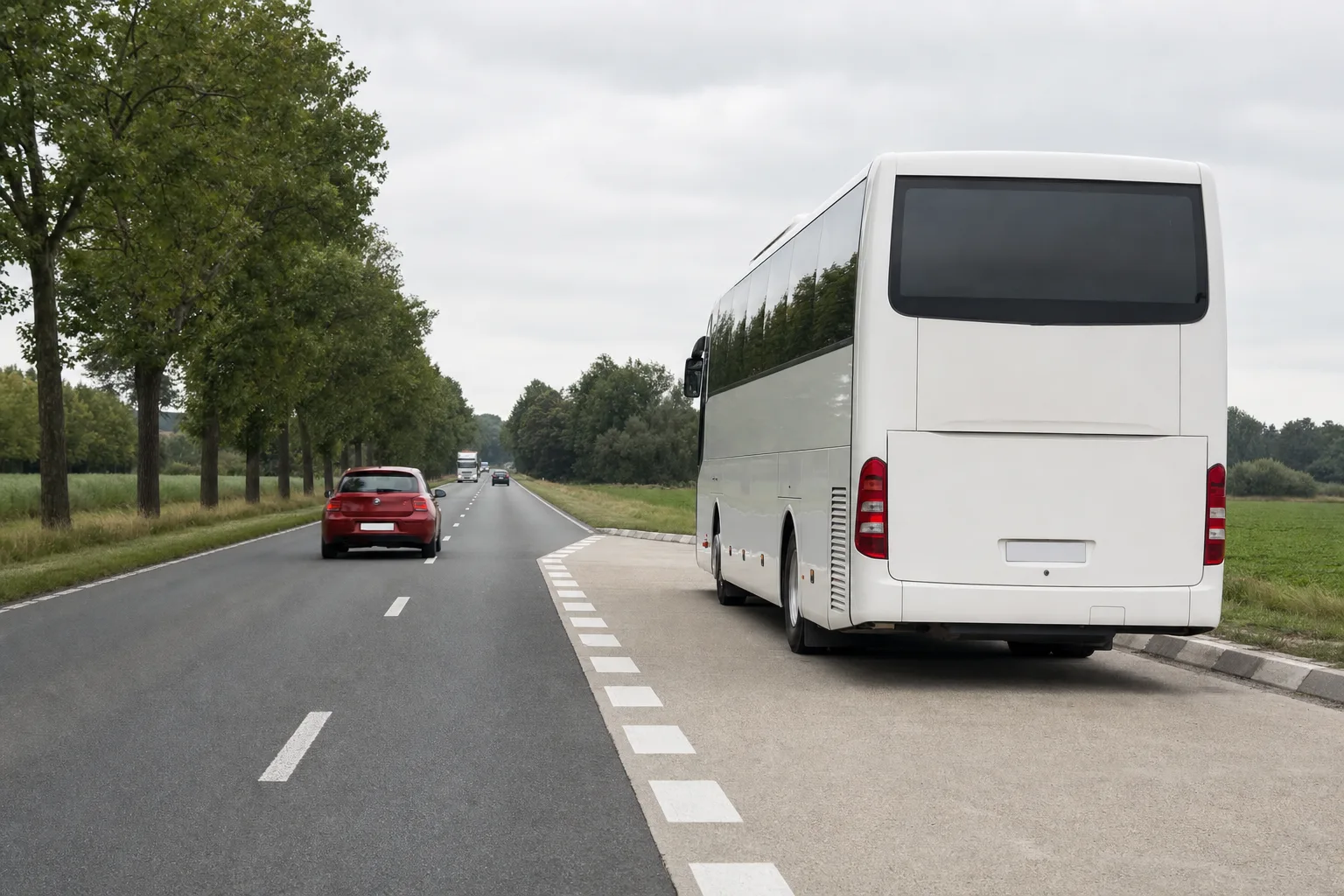
Outside a built-up area, are you required to let a bus that is about to pull away from its stop go first?
🚸Practise Vulnerable road users and priority vehicles
Exam-style questions on this theme, with corrections and explanations — plus the full bank with access.
❓ Frequently asked questions
Must I stop as soon as a pedestrian is waiting at the edge of a crossing?
You must give way to a pedestrian who is crossing or clearly about to step onto the crossing. In practice, as soon as a pedestrian arrives at the crossing intending to cross, slow down and stop to let them pass.
May I overtake a car that is slowing down before a pedestrian crossing?
No. Overtaking is forbidden on the approach to a pedestrian crossing when a vehicle stops or slows down there. That vehicle may be hiding a pedestrian who is crossing.
Is the pedestrian always in the right on the road?
No, pedestrians also have obligations (crossing at a nearby crossing, not darting out without looking). But as vulnerable road users, they are particularly protected: even when a pedestrian acts carelessly, the driver must do everything possible to avoid an accident.
What does it mean when a pedestrian is holding a white cane?
The white cane (sometimes yellow) indicates a blind or visually impaired person. They enjoy heightened protection: when they want to cross, you must stop and give them time to do so safely.