⏱️ 4 min read
Stopping or parking?
Bringing your car to a standstill for a few seconds to drop off a passenger, or leaving it for an hour outside a shop: in the eyes of the Belgian highway code, these are not the same situations. The distinction between stopping and parking governs almost every rule in this topic. Master it and you avoid a good share of the traps in the theory exam.
📑 In this lesson (4)
Two concepts not to be confused
The Belgian highway code draws a very precise distinction between stopping and parking. The difference does not come down to a set number of minutes, but to what you are doing while at a standstill and your presence near the vehicle.

Stopping
A vehicle is stopped when it is at a standstill for the time needed for people to get in or out or for goods to be loaded or unloaded. The driver stays close by, ready to move the vehicle. As long as that operation continues, you are stopping, even if it takes several minutes.
Parking
A vehicle is parked as soon as it is at a standstill beyond the time needed for people to get in or out or for goods to be (un)loaded. In practice, as soon as you leave your vehicle to do something else — go into a shop, visit someone, go to work — you are parking. The decisive criterion is therefore not a clock, but the activity linked to the standstill.
Why does the distinction matter so much?
Because the prohibitions are not the same. In many places, parking is prohibited while stopping remains allowed. A spot can therefore be perfectly legal for dropping someone off, but prohibited for leaving your car. In the exam as on the road, always ask yourself first: am I stopping or parking?
Where to stop and park correctly?
The positioning rules apply to stopping and parking alike. The general idea: pull over without obstructing traffic and in a way that is predictable for other road users.
- On the right relative to your direction of travel. On a one-way road, however, stopping and parking are allowed on both sides.
- Off the carriageway whenever possible: on a usable level verge or, failing that, as close as possible to the edge of the carriageway.
- Parallel to the edge of the carriageway, unless the layout of the site (for example road markings) requires a different arrangement.
- In the direction of traffic: you may not pull over facing against the flow of traffic on your side.
A few common-sense rules to follow
- Your vehicle must never obstruct or endanger other road users, including pedestrians and cyclists.
- Leave enough room for traffic to pass: on a narrow road, stopping or parking can become impossible for lack of space for others.
- Pull over as far to the right as possible and keep reasonably close to the edge, without encroaching needlessly on the carriageway.
- Before opening a door, make sure you take no one by surprise, especially a cyclist riding along your vehicle.
| Situation | Category |
|---|---|
| Dropping off a passenger and driving away immediately | Stopping |
| Unloading shopping while you stay near the vehicle | Stopping |
| Leaving the car to go into a shop | Parking |
| Leaving the car outside your home for the night | Parking |
| Waiting with the engine running, the driver away from the vehicle | Parking |
Once the category is identified, you can apply the rules specific to each: see Where parking is prohibited and Regulated parking.
🧠 Check you've got it
Question 1 / 3
3 exam-style questions on this lesson — instant correction.
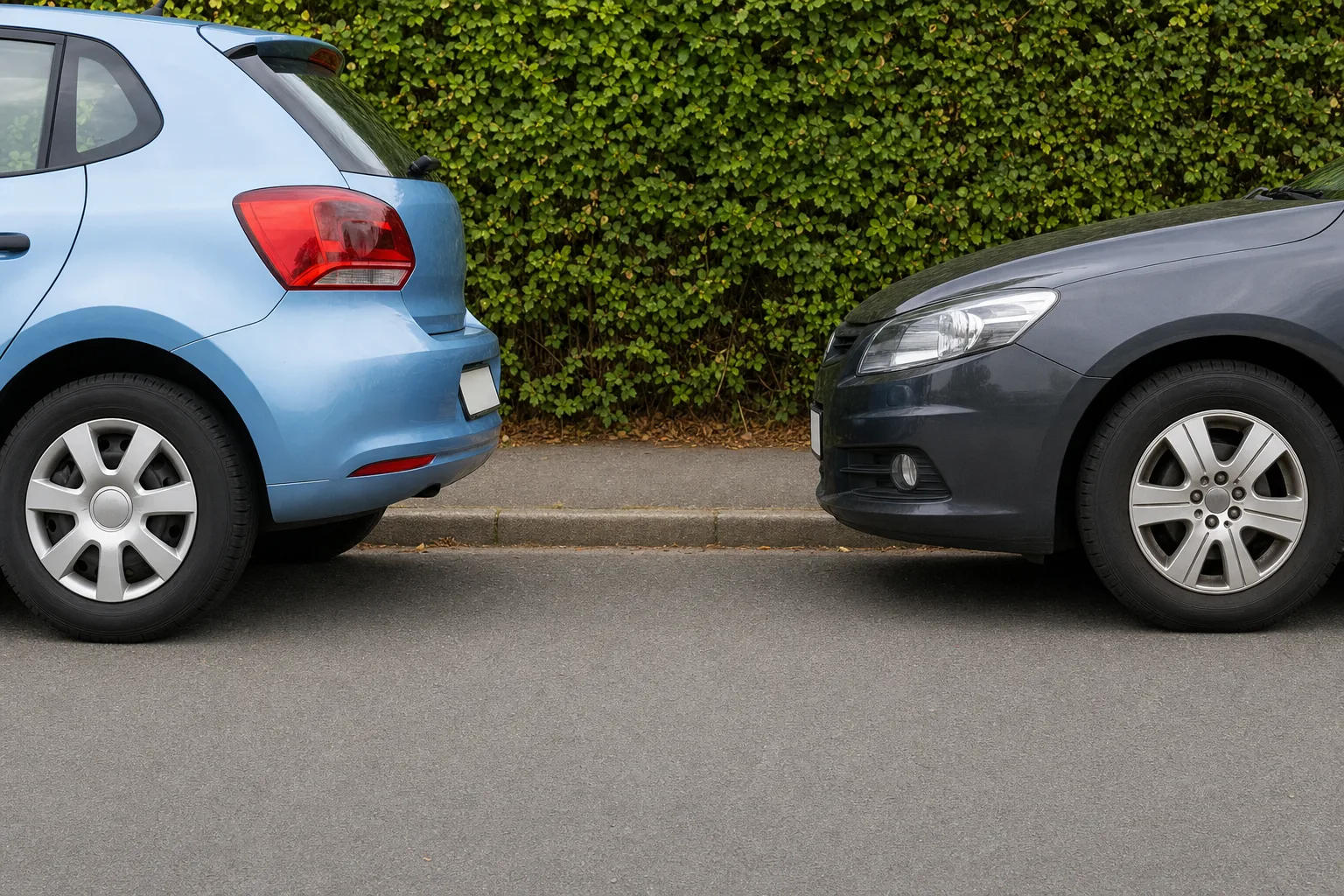
Outside a built-up area, in Wallonia. What gap must be left between two parked cars?
🅿️Practise Stopping and parking
Exam-style questions on this theme, with corrections and explanations — plus the full bank with access.
❓ Frequently asked questions
What is the maximum duration of a stop?
There is no set number of minutes. As long as you are picking up or dropping off people, or loading or unloading goods, while staying close by, you are stopping, even if it takes several minutes. As soon as you leave the vehicle for something else, you are parking.
On which side of the road should I stop or park?
On the right, in your direction of travel, parallel to the edge and off the carriageway if possible. On a one-way street, you may pull over on both sides.
Is leaving the engine running with no one at the wheel a stop?
No. If the driver walks away from the vehicle, it is no longer stopping but parking, whether the engine is running or not. Stopping assumes you stay close by, ready to drive off straight away.
May I stop where parking is prohibited?
Often yes: many places prohibit parking while still allowing stopping. But some places prohibit stopping too. Always check the signs and refer to the lesson on prohibited places.