⏱️ 4 min read
Prohibition signs
A white disc circled in red with a black drawing: that is a prohibition sign. Unlike the danger sign, which merely warns, this one prohibits something, and failing to comply is an offence. Knowing how to read them and their exact scope is one of the keys to the theory exam.


📑 In this lesson (5)
What are prohibition signs for?
Prohibition signs forbid you a specific behaviour: driving through, turning, overtaking, parking, or exceeding a certain speed. They apply to you as soon as you pass them, and failing to comply is an offence. That is the big difference from the danger sign, which only warns.
How do you recognise them?
A prohibition sign is recognised by its shape: a disc (circle) with a white background, bordered in red, with a black symbol in the centre. Some feature a diagonal red bar striking through the symbol. A few prohibition signs are exceptions to this standard image, such as no entry (C1)  , which is an entirely red disc crossed by a wide horizontal white band.
The main prohibition signs
- No entry (C1) : red disc with a horizontal white band. It is prohibited to drive your vehicle into this road.
- Access prohibited (C3)
 : white disc with a red border, no symbol. Access prohibited in both directions to all drivers.
 - Access prohibited to certain categories: lorries, motorcycles, mopeds, cyclists, pedestrians, horse-drawn vehicles… depending on the pictogram shown.
- No turning left or right: black arrow struck through with a red line.
- No U-turns: U-shaped arrow struck through.
- No overtaking (C35)
 : two cars side by side, the left one in red. For lorries, it is sign C39
  .
. - Maximum speed (C43)
 : a black number (e.g. 50, 70, 90) inside the disc. It sets the speed you must not exceed.
 - No parking (E1)
 : blue disc circled in red with a diagonal red bar.
 - No stopping and no parking (E3)
 : blue disc circled in red with a red cross. Stricter: you may neither stop nor park.
 - Size or mass prohibitions: maximum height, maximum width, maximum length or maximum authorised mass (in metres or tonnes).
How far does a prohibition apply?
As a general rule, a prohibition applies from the sign until the next junction, unless indicated otherwise. Beyond the junction, the prohibition no longer applies, unless a new sign repeats it.
- An end-of-prohibition sign (white disc struck through with a diagonal grey or black band) explicitly ends the prohibition before the junction.
- A supplementary panel (below the main sign) can extend, shorten or specify the scope: distance, vehicle category, days and hours.
- Some prohibitions apply to an entire zone (e.g. a paid-parking zone): they apply until the end-of-zone sign.
Don't mix up the sign families
In the exam, the shape and colour are often enough to classify a sign before you even read its symbol. Keep this cue in mind:
| Shape and colour | Family | Role |
|---|---|---|
| White disc, red border | Prohibition | Prohibit a behaviour |
| Disc with a blue background | Obligation | Impose a behaviour |
| Triangle, red border | Danger | Warn |
| Blue square or rectangle | Information | Inform |
🧠 Check you've got it
Question 1 / 3
3 exam-style questions on this lesson — instant correction.
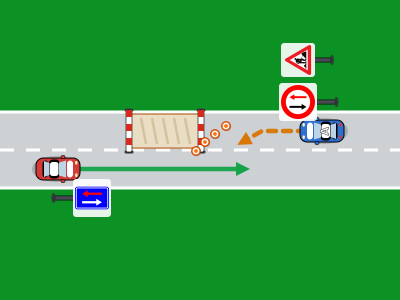
Car A approaches road works and faces this B19 sign. What does it mean for car A?
🚦Practise Signs, road markings and traffic lights
Exam-style questions on this theme, with corrections and explanations — plus the full bank with access.
❓ Frequently asked questions
What is the shape of a prohibition sign in Belgium?
A disc (circle) with a white background, a red border and a black symbol. No entry (C1 ) is the exception: it is an entirely red disc with a horizontal white band.
What is the difference between E1 and E3 ?
E1 (diagonal bar) prohibits parking: a brief stop is still possible. E3 (cross) prohibits both stopping and parking: you may not even come to a brief standstill.
How far does a prohibition remain valid?
In principle until the next junction, unless an end-of-prohibition sign, a supplementary panel or an end-of-zone sign decides otherwise.
How do you tell a prohibition from an obligation?
By the colour: a circle with a red border on a white background prohibits, a circle with a blue background imposes. The same symbol, for example an arrow, therefore changes meaning depending on the sign's colour.