⏱️ 4 min read
Where parking is prohibited
Parking seems simple, but the Belgian highway code prohibits stopping or parking in many specific places. The golden rule: never obstruct other road users or block visibility. Distinguishing no stopping (the strictest) from no parking (sometimes more flexible) is one of the most tested points on the theory exam.
📑 In this lesson (4)
Stopping or parking: they are not the same thing
Stopping means immobilising the vehicle for the time needed to let people get in or out, or to load or unload goods. Parking is a longer immobilisation, for other reasons. The distinction is crucial: wherever stopping is prohibited, parking is necessarily prohibited too. But the reverse is not true: in some places, parking is prohibited while a brief stop remains tolerated.

Where BOTH stopping and parking are prohibited
In the following places, you may not even come to a brief standstill. Stopping there is an offence, because it directly endangers or blocks other road users:
- On pedestrian crossings and cycle crossings, as well as less than 5 metres before these crossings (on the side you approach from), so as not to hide pedestrians stepping out.
- On pavements and, in built-up areas, on raised verges; on cycle paths and less than 1 m on either side of a cycle path.
- On the carriageway, on railway tracks and on level crossings.
- On and under bridges, in tunnels and, as a rule, at junctions (unless indicated otherwise).
- In front of a vehicle entrance (garage door, resident access), except in front of your own and with your own vehicle, or if the number plate is displayed there.
- Double parked, that is, alongside another vehicle already stopped or parked along the carriageway (with the exception of two-wheelers).
- Anywhere the vehicle hides road signs or signals (signs or traffic lights) from the view of other road users.
Where only parking is prohibited
In these places, you may not leave the vehicle parked, but stopping (long enough to let someone in or out, for example) remains possible if it causes no obstruction:
- Along a broken yellow line painted on the kerb or at the edge of the carriageway: it means precisely "no parking, stopping allowed".
- Less than 1 metre in front of or behind another vehicle already parked, and more generally anywhere your vehicle would prevent another from getting out.
- Less than 15 metres on either side of a bus, trolleybus or tram stop sign.
- In reserved spaces (disabled persons without the special card, electric charging vehicles, taxis, etc.) and wherever an E1
 sign prohibits parking.
 - Wherever road markings (crossed-out bay, hatched area) or a sign forbid it.
Obstructive and dangerous parking
Beyond the specific places, the highway code prohibits any obstructive or dangerous parking. Even where no sign or marking prohibits it, you are still at fault if your vehicle reduces visibility, narrows the usable passage or forces others into risky manoeuvres. Parking is notably dangerous near the brow of a hill and on blind bends.
| Place | Stopping | Parking |
|---|---|---|
| Pedestrian crossing (and 5 m before) | Prohibited | Prohibited |
| Pavement, cycle path | Prohibited | Prohibited |
| In front of a vehicle entrance | Prohibited | Prohibited |
| Double parked | Prohibited | Prohibited |
| Broken yellow line | Allowed | Prohibited |
| Less than 1 m from a parked vehicle | Allowed | Prohibited |
🧠 Check you've got it
Question 1 / 3
3 exam-style questions on this lesson — instant correction.
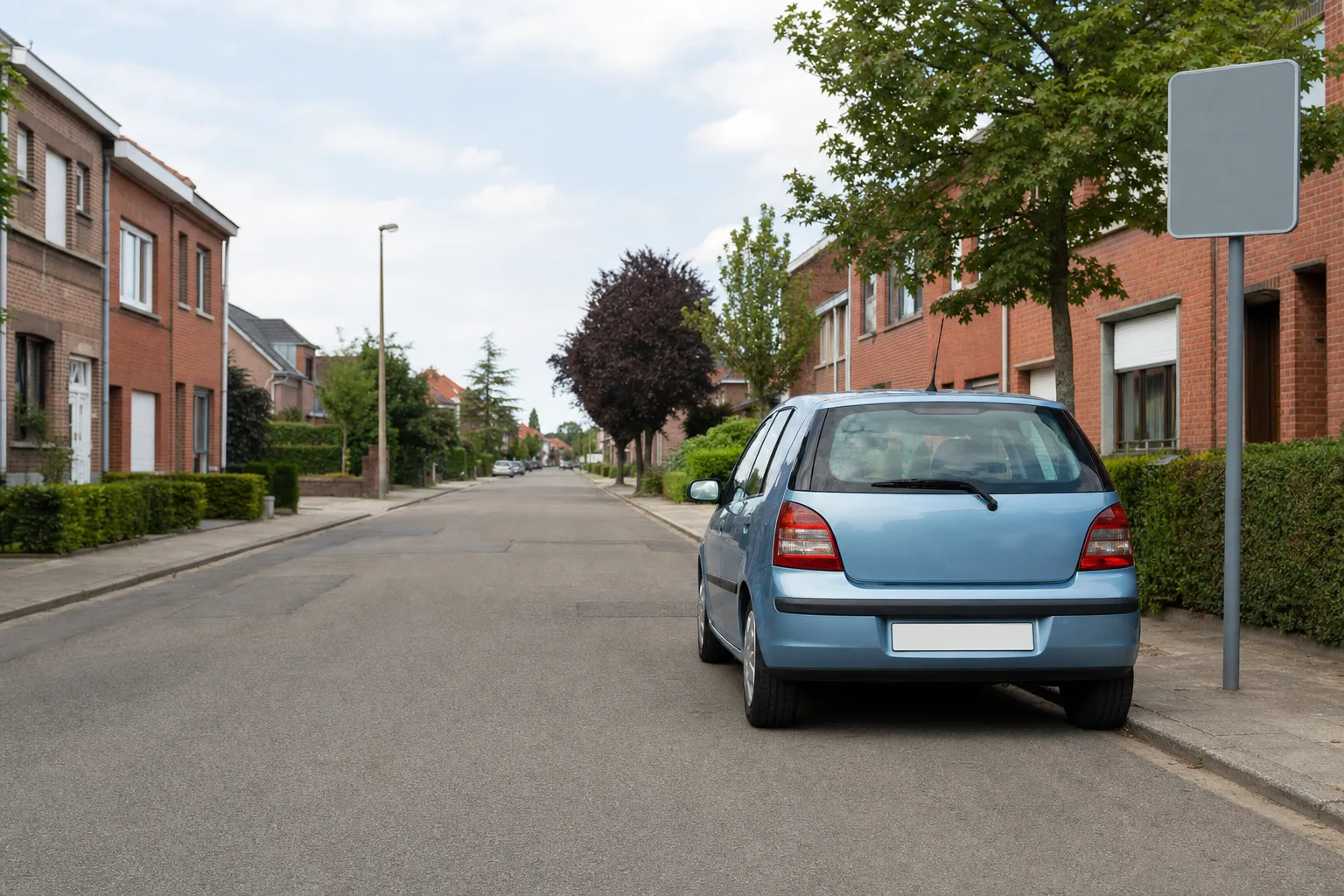

In a built-up area. What is the car allowed to do at this spot?
🅿️Practise Stopping and parking
Exam-style questions on this theme, with corrections and explanations — plus the full bank with access.
❓ Frequently asked questions
Can I stop for a minute on a pedestrian crossing?
No. Both stopping and parking are prohibited on a pedestrian crossing and less than 5 metres before it. Even for a brief moment, you hide pedestrians stepping out.
What is the difference between a solid and a broken yellow line?
The broken yellow line at the edge of the carriageway prohibits parking, but stopping remains allowed. The solid yellow line prohibits both stopping and parking.
Can I park in front of a neighbour's garage entrance for a short moment?
No. Both parking and stopping are prohibited in front of any vehicle entrance. Only the owner may stop in front of their own, with their own vehicle.
Is double parking really prohibited even briefly?
Yes. Alongside a vehicle already stopped or parked, both stopping and parking are prohibited (except for two-wheelers). It is one of the most common faults in town.